
Adopt a site-specific Vegetation Management Plan (VMP) that treats years 1–3 as an intensive establishment phase, then shift to integrated vegetation maintenance (IVM) and robotic operations to protect yield, reduce long-term costs, and satisfy Australian regulatory requirements. That single decision, made early, is the difference between a site that runs itself and one that generates constant reactive spend.
Industry guidance from NREL confirms that native vegetation establishment typically requires 3–5 years of active management before mowing frequency can taper. During the initial years, plan for multiple inspections and maintenance visits each growing season. After stabilisation, a small number of integrated vegetation maintenance visits per year is the standard target. Brightview Solar & Groundskeeping deploys autonomous mowing and spraying to handle the difficult-access zones that drive most of the labour cost and safety risk in that schedule.
Do these four things this week:
- Walk the site and photograph vegetation against every inverter pad, transformer bay, and BESS enclosure.
- Map high-risk electrical assets and flag any vegetation already exceeding 30 cm clearance.
- Confirm in writing who owns VMP responsibilities: the asset owner, O&M contractor, or a specialist provider like Brightview Solar & Groundskeeping.
- Pull your current state environmental and biosecurity obligations and check whether a clearing permit or pesticide licence is already required.
Table of Contents
- What must a vegetation management plan contain for Australian solar sites?
- How often should you inspect and maintain vegetation on a solar farm?
- Which vegetation control methods work best for each zone?
- How do you stop invasive weeds from taking over a solar site?
- How does vegetation create fire risk around electrical infrastructure?
- How does vegetation height affect solar panel output?
- How do you design ground cover that supports biodiversity without increasing O&M costs?
- What compliance and reporting obligations apply to Australian solar farms?
- What does robotic vegetation management actually deliver on a solar site?
- How to implement a VMP on your site: step by step
- Key takeaways
- Why early planning is the only vegetation strategy that actually works
- Brightview Solar & Groundskeeping: robotic maintenance for solar sites
- Useful sources
- FAQ
What must a vegetation management plan contain for Australian solar sites?
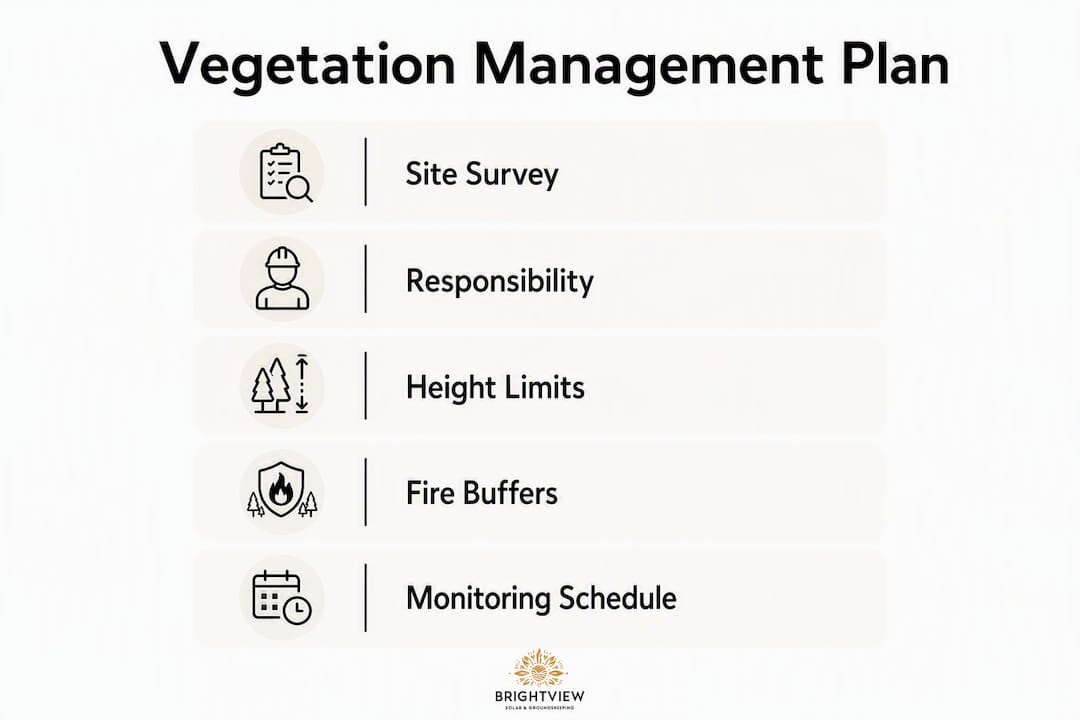
A VMP is not a mowing schedule stapled to a site map. It is a living document that defines goals, assigns responsibilities, and creates an audit trail that satisfies insurers, state environmental agencies, and grid operators. Planning VMPs into development and permitting avoids the post-contract uncertainty that leads to costly change orders during EPC handover.
Core components every Australian VMP must include:
- Site survey and baseline map: GPS-referenced map showing inverter and transformer zones, BESS pads, access roads, drainage lines, ponds or wetlands, native vegetation patches, culturally sensitive areas, and erosion-prone slopes. This is the foundation everything else references.
- Responsibilities and contacts: Named individuals or contractors responsible for each maintenance activity, with escalation contacts for biosecurity finds, fire risk, and electrical hazards.
- Vegetation goals and thresholds: Target ground cover type, maximum permitted vegetation height (commonly low vegetation height thresholds under arrays, confirmed with your O&M engineer), and shading setbacks from panel edges.
- Fire buffers: Defined cleared or managed zones around inverters, transformers, and BESS, with dimensions confirmed against local fire authority guidance.
- Invasive species controls: A list of declared weeds relevant to your state, treatment priorities, and the hygiene protocols contractors must follow on arrival and departure.
- Permitted methods: Which herbicides are approved under your state pesticide regulations, grazing arrangements if applicable, and mechanical methods permitted in each zone.
- Monitoring schedule and adaptive triggers: Inspection frequency, what to record (photos, GPS tracks, treatment logs), and the conditions that trigger an unscheduled visit or a change in method.
- Compliance and permit register: Clearing permits, pesticide licences, environmental offset conditions, and any indigenous heritage consultation requirements relevant to the site.
For monitoring records, the standard that satisfies most Australian insurers and state regulators is: dated inspection log, geo-tagged photographs, GPS track of works completed, and contractor credentials on file. Brightview Solar & Groundskeeping’s robotic operations generate GPS logs automatically, which slot directly into this documentation requirement without additional manual recording.
The Woodside Solar Facility Weed Management Plan, assessed by the Western Australian EPA, is a useful reference for how a state-level weed management document is structured for a utility-scale site in Australia.
How often should you inspect and maintain vegetation on a solar farm?
Three maintenance visits per growing season during years 1–3 is the standard establishment-phase cadence. Skip that intensity and you trade a short-term saving for a persistent weed problem that can take decades to correct.
A practical seasonal timeline for Australian sites:
- Pre-construction (6–12 months before energisation): Apply short-residual herbicides to suppress existing weed seed bank. Allow the minimum waiting period before soil disturbance or seeding — typically 14–30 days depending on product, per label requirements. Finalise seed mix selection for your climate zone.
- Year 1, establishment season (spring/summer): Three inspection and maintenance visits. Focus on weed suppression, erosion control on disturbed slopes, and confirming germination of target species. Record baseline photos at fixed reference points.
- Year 2, second growing season: Three visits again. IVM is typically introduced towards the end of the second full growing season, combining targeted mowing with selective herbicide for persistent invasives.
- Year 3, late establishment: Two to three visits. Spot-spray problem areas, assess whether reseeding is needed in thin patches, and begin reducing visit frequency where native cover is establishing well.
- Years 4–5, transition to steady state: 1–2 IVM visits per year. Dormant-season mowing in late autumn/early winter, one peak-season inspection in spring. IVM visit frequency reduces further after year 5 when vegetation is stable.
- Ongoing: Annual inspection of high-risk zones (inverter pads, BESS, right-of-way corridors) regardless of overall visit frequency. These zones never drop off the schedule.
For high-risk electrical zones, monthly visual checks during fire season are prudent even in a mature site. Record findings in the same log format used during establishment so the audit trail is continuous.
Pro Tip: Schedule robotic mowing operations during early morning or late afternoon when generation output is lowest. This minimises any access disruption and aligns with ecological windows that protect pollinators active at peak solar hours.
Which vegetation control methods work best for each zone?
Mowing consumes most onsite time and is the backbone of most solar O&M programmes, but low array heights and uneven terrain make standard ride-on mowers a poor fit for many Australian utility-scale sites. The right method depends on the zone, the species present, and the access constraints.
| Method | Best suited for | Key advantage | Main limitation |
|---|---|---|---|
| Rotary/ride-on mowing | Wide inter-row areas with flat terrain | Fast, low cost per hectare | Cannot access tight rows; risk near electrical assets |
| Robotic mowing | Tight inter-row access, repeatable schedules, high-risk zones | Safe, consistent, GPS-logged; operates without staff near live infrastructure | Requires site prep and geofencing setup |
| Selective herbicide spraying | Woody invasives, broadleaf weeds, spot treatment | Targets problem species without disturbing native cover | Requires licensed applicator; withholding periods apply |
| Autonomous spraying | Large-area weed control, precise spot application | Reduces chemical use and human exposure; GPS-mapped treatment records | Setup and calibration needed; product registration must be confirmed |
| Grazing (sheep) | Wide-area low-growth maintenance on suitable sites | Low-impact, low fuel-load, biodiversity-neutral | Requires fencing, water, animal welfare management; not suited to all sites |
| Mechanical removal | Woody saplings, isolated invasive plants | Removes root system; no chemical residue | Labour-intensive; not scalable for large infestations |
The most effective programmes combine methods by zone rather than applying one approach site-wide. A practical integration strategy: early-season selective spraying to knock back winter annuals, mid-season robotic mowing to maintain height thresholds under arrays, and late-season dormant mowing to reduce fuel loads before fire season. Grazing works well on the outer buffer zones of larger sites where fencing is already in place, but it is rarely sufficient as a sole method during the establishment phase.
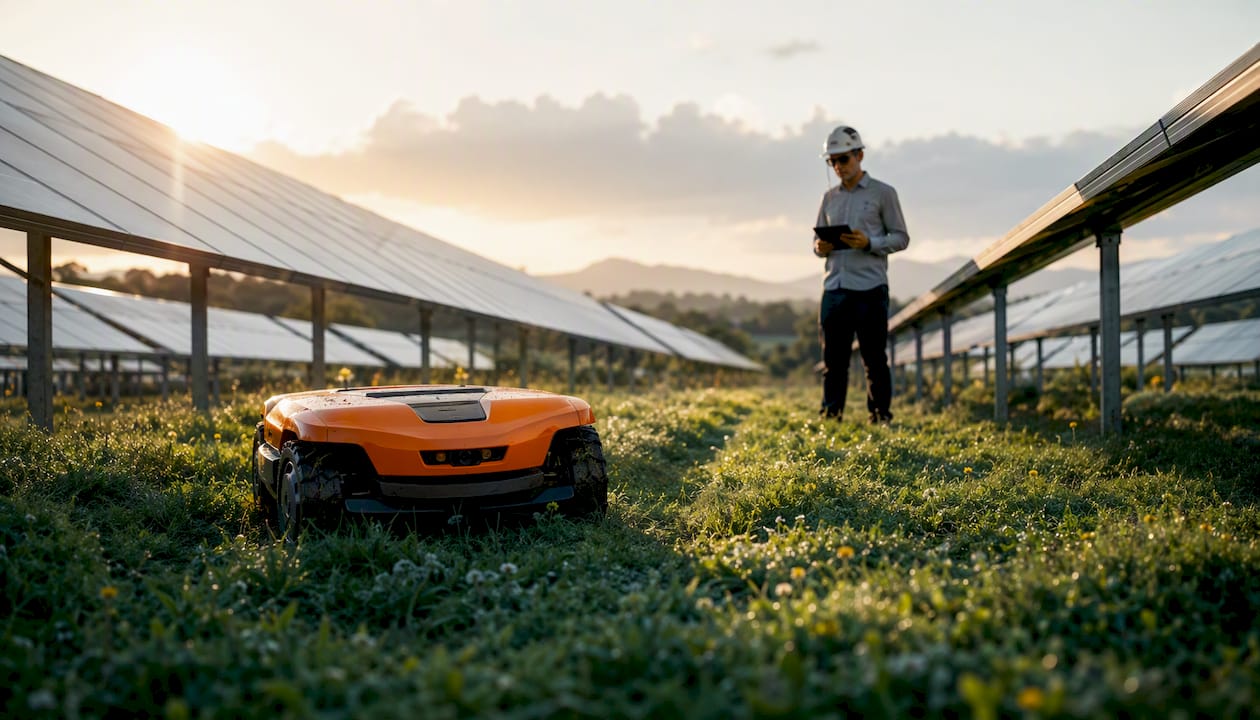
Autonomous spraying solutions are particularly well suited to the spot-treatment work that makes up a large share of IVM visits, because they can map treatment locations precisely and generate the application records that pesticide regulations require.
How do you stop invasive weeds from taking over a solar site?
Biosecurity on a solar farm is an active programme, not a one-off inspection. Every contractor vehicle and every piece of machinery that enters the site is a potential vector for weed seed. The sites that manage this well treat it as a procurement requirement, not an afterthought.
Biosecurity protocol for contractors and visitors:
- Pre-arrival: All machinery must be cleaned and inspected before entering the site. Require photographic evidence of washdown for mowers, spray units, and earthmoving equipment arriving from other agricultural or solar sites.
- Site entry: Designated washdown area at the site entrance. Contractor signs a biosecurity declaration confirming equipment is free of soil, plant material, and seed.
- During works: Any plant identified as a declared weed under state legislation must be reported immediately to the site manager. Do not mow or disturb the area until the species is confirmed and a treatment plan is in place.
- Departure: Remove all plant material from the site in sealed bags. No green waste left on-site unless it is from approved species and will be mulched in a designated area.
- Record keeping: Log every contractor visit, the machinery used, and the washdown status. This record is part of your VMP audit trail.
For Australian sites, the invasive species of greatest concern typically fall into three categories: perennial pasture grasses that outcompete native groundcovers (e.g. kikuyu, buffel grass in warmer regions), woody saplings from invasive shrub species (e.g. lantana, African boxthorn), and broadleaf invaders that establish quickly in disturbed soils post-construction. State biosecurity authorities publish declared weed lists by region; confirm which species are notifiable in your jurisdiction before finalising the VMP.
Pro Tip: During site establishment, targeted seedbed management, including shallow cultivation to trigger weed germination followed by spot-spraying before seeding your target mix, can dramatically reduce the long-term weed seed bank. The upfront effort pays back across the entire asset life.
How does vegetation create fire risk around electrical infrastructure?
Dry vegetation under and around solar arrays is fuel. That is the starting point for every fire-risk assessment on an Australian solar site, and it is the framing that insurers and industry guidance use when they evaluate whether a site’s vegetation management is adequate.
Defensible space around critical electrical infrastructure should be confirmed with your local fire authority, since requirements vary between states and between rural and peri-urban sites. The 30–50-metre guidance is a common industry reference point, but some state fire authorities specify different distances or fuel-load limits.
Safety inspection priorities for electrical zones:
- Inverter pads: clear all vegetation to bare ground or gravel within the defined buffer; inspect monthly during fire season.
- Transformer bays: remove dead litter and dry grass accumulation after every mowing event; check cable entry points for rodent activity.
- BESS enclosures: maintain the widest defensible space on site; these assets carry the highest consequence if a fire reaches them.
- Access roads: keep road verges mowed to maintain emergency vehicle access and reduce the fuel corridor that connects the perimeter to the array interior.
- Under-array zones: dormant-season mulching or removal of accumulated dead material is more effective than mowing alone for reducing fuel load.
Tie every inspection to a dated record in your VMP log. When an insurer reviews your coverage after an incident, the inspection log is the primary evidence that the site was managed to a defensible standard.
How does vegetation height affect solar panel output?
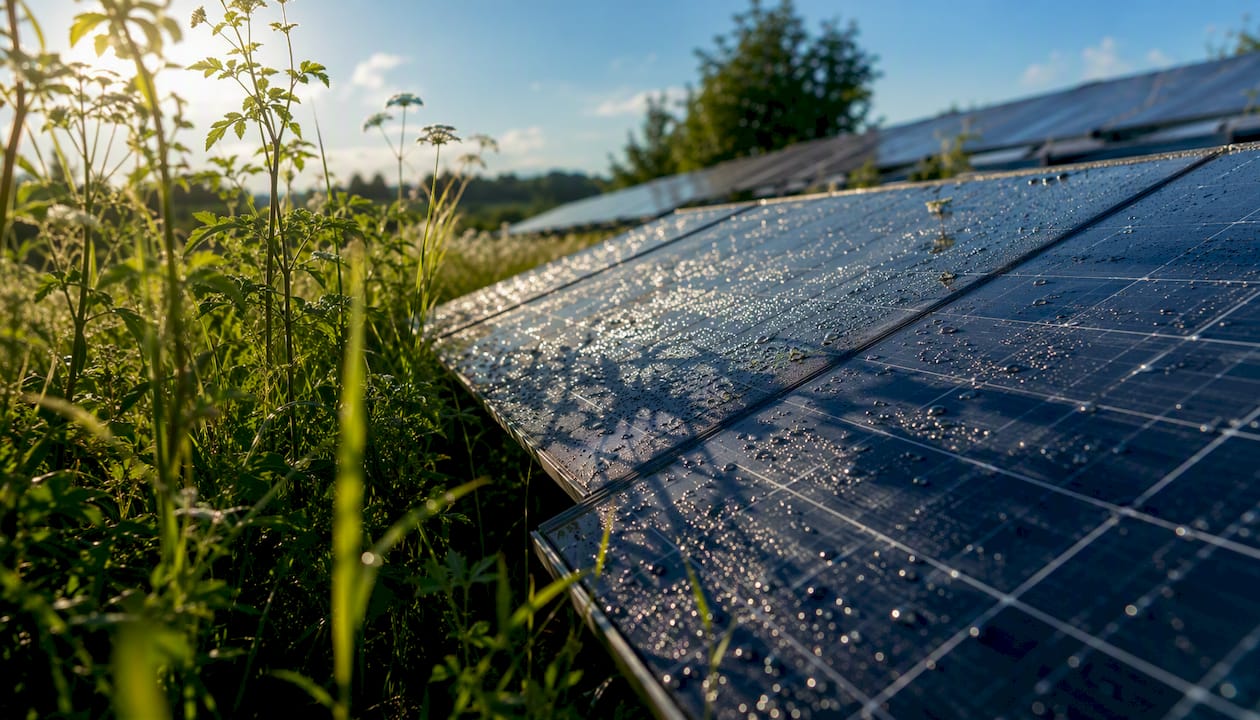
Direct shading is the most immediate yield impact, but it is not the only one. Windborne debris from tall or seeding vegetation deposits on panel surfaces and creates uneven soiling patterns that standard cleaning schedules may miss. Rodent habitat in dense groundcover leads to cable gnawing and electrical faults that can take arrays offline for days.
| Vegetation condition | Typical performance impact | Monitoring method |
|---|---|---|
| Vegetation at or below 30 cm under arrays | Minimal shading; low soiling risk | Monthly visual inspection |
| Vegetation 30 cm, approaching panel edge | Partial shading on lower cell rows; soiling risk increases | Fortnightly inspection; yield check by string |
| Vegetation exceeding panel height or seeding | Significant shading; high soiling and debris load | Immediate intervention; string-level performance data |
| Dense groundcover harbouring rodents | Cable damage risk; potential electrical fault | Quarterly rodent inspection; thermal imaging of cable runs |
A 10 MW facility can lose over $93,000 per year due to shading and soiling from unmanaged vegetation, based on estimates that vegetation overgrowth can reduce energy output by 7–30% annually. The lower end of that range is the realistic target for a site with a functioning VMP; the upper end is what happens when vegetation management is reactive rather than planned.
Monitoring does not require expensive remote sensing to be effective. String-level performance data from your inverter monitoring system, compared against a clean-site baseline, will flag shading events before they show up in monthly generation reports. Pair that with solar panel maintenance checks that include a vegetation height assessment at each visit.
Pro Tip: When a string underperforms against its neighbours on a clear day, check the vegetation at that row before assuming a panel or inverter fault. Shading from a single overgrown row is one of the most common causes of string-level underperformance, and it costs nothing to fix if caught early.
How do you design ground cover that supports biodiversity without increasing O&M costs?
The short answer: native and pollinator-friendly seed mixes reduce long-term mowing frequency, but they cost more to establish and require active management for 3–5 years before the benefit materialises. That trade-off is worth making on most Australian sites, but only if the budget and the VMP reflect the establishment reality.
NREL research across 54 sites found that native vegetation had higher establishment costs and activity than turfgrass in the early years, but the potential to reduce mowing events over time. The establishment range is commonly 3–10 years depending on climate, seed mix, and weed pressure.
Design strategies that balance biodiversity and operational access:
- Strip mowing: Mow alternate inter-row strips on a rotating schedule rather than the whole site at once. This maintains access and height control while preserving habitat in unmowed strips.
- Low-growth under-panel mixes: Select species with a mature height below 30 cm for the zones directly under arrays. This reduces the frequency of under-panel mowing without sacrificing ground cover.
- Pollinator corridors: Designate buffer strips along the site perimeter or between array blocks for taller, flowering native species. Keep these away from electrical assets and access roads.
- Reseeding protocol: Plan for spot reseeding in years 2–3 where germination is patchy. Native mixes rarely establish uniformly in the first season, and thin patches are where weeds re-establish fastest.
Eco-friendly landscaping services that understand native seed mixes and establishment timelines are worth engaging during the VMP design phase, not just for ongoing maintenance. Getting the species selection right for your soil type and rainfall zone avoids costly reseeding later.
Budget for higher activity in years 1–3. Native cover establishment is not a set-and-forget exercise. Owners who treat the first season as the only intensive year consistently end up with weed-dominated sites by year three.
What compliance and reporting obligations apply to Australian solar farms?
The regulatory framework for vegetation management on Australian solar sites spans multiple agencies and varies by state. There is no single national standard, which means your VMP needs to reference the specific instruments that apply to your site.
Common permit and approval categories:
- Vegetation clearing permits: Required in most states when removing native vegetation above defined thresholds. In Queensland, the Vegetation Management Act 1999 governs clearing; in Western Australia, the Environmental Protection Act 1986 and associated regulations apply. Check with your state’s environmental protection authority before any clearing works.
- Pesticide and herbicide licences: Commercial pesticide application requires a licence in every Australian state. Contractors must hold the appropriate category licence, and application records must be kept for the period specified by state law (commonly 2–5 years).
- Local council approvals: Some councils require development approval conditions to be met for ongoing vegetation management, particularly where environmental offset conditions were attached to the original planning approval.
- Environmental offset obligations: Where clearing was approved subject to offsets, the VMP must document how offset conditions are being met and provide evidence to the relevant authority on the schedule specified in the approval.
Stakeholder engagement is a compliance requirement on many Australian sites, not just good practice. Where indigenous heritage values are present, consultation with the relevant custodians should be documented in the VMP and updated whenever works are planned in sensitive areas. Neighbouring landholders should be notified of herbicide applications near property boundaries, and local councils may require periodic reporting against planning approval conditions.
State-specific rules change. Record the legal basis for every vegetation works decision in the VMP so that if the regulatory framework shifts, you can demonstrate that works were lawful at the time they were carried out.
What does robotic vegetation management actually deliver on a solar site?
Autonomous robotic mowers and sprayers are engineered to operate safely in tight rows, reduce blind spots around live electrical infrastructure, and generate GPS-logged records of every operation. For solar farms, that combination addresses three problems that traditional maintenance cannot solve as reliably: safe access in confined spaces, consistent height control between visits, and automatic documentation for compliance.
A Brightview Solar & Groundskeeping deployment follows a structured sequence. The site is assessed for terrain, array configuration, and access constraints. Geofencing boundaries are set to keep machines clear of electrical assets, water bodies, and sensitive vegetation patches. Safety checks are completed before each operational run. Every mowing or spraying pass is GPS-logged, and those logs are available for inclusion in the VMP audit trail.
In the first 12 months of a robotic deployment, the measurable outcomes to track are: vegetation height compliance against the VMP threshold at each inspection, number of unscheduled interventions required (a proxy for how well the robotic schedule is maintaining control), and the reduction in staff hours required in high-risk zones near electrical infrastructure. Robotic operations also enable 24/7 low-impact maintenance windows, which means work can be scheduled outside peak generation hours without the cost penalty of overtime labour.
The safety case for robotics is particularly strong on Australian sites where fire risk is high. Keeping staff out of dense vegetation near live infrastructure during fire season is not just an efficiency argument; it is a duty-of-care obligation that autonomous equipment directly addresses.
How to implement a VMP on your site: step by step
- Commission a site assessment. Engage a qualified contractor or Brightview Solar & Groundskeeping to walk the site, map vegetation zones, identify high-risk electrical assets, and document existing weed pressure. This assessment is the foundation of the VMP.
- Draft the VMP. Use the assessment data to define vegetation goals, assign responsibilities, select methods for each zone, and set the monitoring schedule. Integrating the VMP into development and permitting from the outset avoids costly change orders later.
- Select and qualify contractors. Require public liability insurance (minimum limits specified in your site risk assessment), current pesticide licences, evidence of washdown procedures, and GPS tracking capability for all works. Do not accept verbal assurances on any of these.
- Define KPIs in the contract. Sample KPIs: visit frequency compliance (number of scheduled visits completed on time), maximum permitted vegetation height at inspection (e.g. 30 cm under arrays), zero shading events from vegetation exceeding panel height, response time for high-risk findings (e.g. within 48 hours of identification), and inspection records submitted within 5 business days of each visit.
- Run a trial on the hardest-to-access area. For robotic deployment, start with the zone that presents the greatest access challenge for conventional equipment. Define acceptance criteria before the trial: height compliance at the end of the trial period, number of safety incidents, and GPS log completeness. Review against criteria before scaling.
- Scale to site-wide operations. Once the trial zone meets acceptance criteria, extend the programme zone by zone. Update the VMP to reflect the operational configuration and confirm that insurance and permit documentation covers the full site.
- Review and adapt annually. Consistent project monitoring drives decisions on reseeding, spot spraying, or modifying mowing frequency. Schedule a formal VMP review at the end of each growing season and update the plan based on what the monitoring data shows.
For procurement, the robotic lawn mower farm guide covers deployment considerations and pilot programme structures in detail.
Key takeaways
Effective solar farm vegetation management requires a site-specific VMP, an intensive establishment phase in years 1–3, and a shift to IVM and robotic maintenance once vegetation stabilises, to protect yield, reduce long-term costs, and meet Australian compliance obligations.
| Point | Details |
|---|---|
| Establishment phase intensity | Plan three maintenance visits per growing season in years 1–3; tapering too early creates persistent weed problems. |
| Steady-state schedule | After stabilisation, 1–2 IVM visits per year is the standard target, with annual high-risk zone inspections maintained regardless. |
| Fire and compliance records | Maintain cleared buffers around inverters and BESS (commonly 30–50 m) and keep dated inspection logs to satisfy insurers and state regulators. |
| Biodiversity trade-off | Native seed mixes reduce long-term mowing frequency but require 3–5 years of active establishment management and higher early O&M activity. |
| Brightview Solar & Groundskeeping | Provides robotic mowing, autonomous spraying, and panel cleaning with GPS-logged records that integrate directly into VMP audit trails. |
Why early planning is the only vegetation strategy that actually works
The most common mistake on Australian solar sites is treating vegetation management as an O&M problem rather than a development decision. By the time a site is energised and the first weed flush appears, the window for low-cost intervention has already closed. The seed bank is established, the access constraints are fixed, and the contractor is working from a reactive brief rather than a plan.
What the evidence consistently shows is that the sites with the lowest long-term O&M costs are the ones where the VMP was written before the EPC contract was signed, the seed mix was selected for the local climate and soil type, and the establishment-phase budget was treated as a capital cost rather than an afterthought. That is not a complicated insight, but it is one that a surprising number of operators discover too late.
The other underestimated factor is monitoring. A VMP without a monitoring cadence is a document, not a management system. The adaptive management loop, inspect, record, adjust, is what converts a plan into actual vegetation control. Robotic operations strengthen that loop because they generate records automatically and maintain consistent height control between visits, which means the monitoring data reflects real site conditions rather than the state of the site on the day a contractor happened to visit.
Adopt the plan early, treat the establishment phase seriously, and use robotics where access and safety make human operations difficult. That combination is what separates sites that manage vegetation from sites that are managed by it.
Brightview Solar & Groundskeeping: robotic maintenance for solar sites
Solar farm operators who have worked through the VMP process know the hardest part is not writing the plan. It is finding a contractor who can execute it consistently, document it properly, and access the zones that conventional equipment cannot reach safely.
Brightview Solar & Groundskeeping delivers robotic mowing, autonomous spraying, and robotic solar panel cleaning for commercial and utility-scale solar sites across Australia. Every operation is GPS-logged, geofenced to keep machines clear of electrical assets, and documented in a format that slots directly into your VMP audit trail. For sites in the establishment phase, the autonomous spraying capability handles targeted weed control with the precision and record-keeping that pesticide regulations require. For mature sites, the robotic mowing schedule maintains height compliance between IVM visits without putting staff near live infrastructure.
The practical next step is a site assessment. Brightview Solar & Groundskeeping will map your access constraints, identify the zones where robotic deployment delivers the greatest safety and compliance benefit, and provide a deployment plan that integrates with your existing VMP. Explore the solar energy robotics approach or review solar panel maintenance best practices to see how vegetation management and panel performance connect in practice. Contact Brightview Solar & Groundskeeping at brightviewpty.au to request your site assessment.
Useful sources
- Vegetation Management Plan, USS Rhea Solar LLC (Kane County)%20-%20USS%20Rhea%20Solar%20LLC.pdf) — detailed VMP template covering establishment schedules, IVM introduction, and monitoring requirements.
- Vegetation Management Cost and Maintenance Implications at Utility-Scale Solar Sites (NREL) — research across 54 sites on cost profiles, native vegetation establishment timelines, and mowing frequency data.
- Vegetation Management for Renewable Energy (Travelers Insurance) — insurance industry guidance on defensible space, fire risk, and inspection record requirements.
- Project Planning and Implementation of Vegetation Management Practices (BWSR) — guidance on integrating VMPs into development and permitting to reduce cost uncertainty.
- Woodside Solar Facility Weed Management Plan (WA EPA) — Australian example of a state-assessed weed management plan for a utility-scale solar facility.
- Solar Energy Robotics: How Automation Is Reshaping Solar Farms (Brightview Solar & Groundskeeping) — Brightview’s approach to autonomous mowing, spraying, and panel cleaning, including geofencing and GPS logging.
- Automated Grounds Maintenance in Australia: 2026 Guide (Brightview Solar & Groundskeeping) — scheduling, robotic mowing benefits, and maintenance cadence for Australian commercial sites.
This article provides general information about vegetation management practices and Australian regulatory frameworks. It is not legal, environmental, or professional advice. Confirm current permit requirements, pesticide regulations, and state-specific obligations with the relevant authority or a qualified professional before commencing works.
FAQ
What should a solar farm VMP include in Australia?
A VMP must include a site survey and baseline map, named responsibilities, vegetation height thresholds, fire buffers around electrical assets, invasive species controls, permitted methods, a monitoring schedule, and a compliance register covering state clearing permits and pesticide licences.
How often should vegetation be managed during the establishment phase?
Three inspections and maintenance visits per growing season during years 1–3 is the standard guidance, tapering to 1–2 IVM visits per year once vegetation stabilises, with high-risk electrical zones inspected annually at minimum regardless of overall site maturity.
How much can unmanaged vegetation reduce solar panel output?
Vegetation overgrowth can reduce energy output by 7–30% annually through shading and soiling; a 10 MW facility can lose over $93,000 per year when vegetation management is reactive rather than planned.
What defensible space is required around inverters and transformers?
Industry guidance commonly references 30–50 metres of cleared or managed defensible space around inverters, transformers, and BESS enclosures, though the exact requirement should be confirmed with your local fire authority, as state rules vary.
How does Brightview Solar & Groundskeeping support solar farm vegetation management?
Brightview Solar & Groundskeeping provides robotic mowing, autonomous spraying, and solar panel cleaning with GPS-logged records that integrate directly into VMP audit trails, covering difficult-access zones safely without placing staff near live electrical infrastructure.

