
For commercial and industrial sites, the safest approach to steep slope mowing is robotic or remote-operated equipment rated for the specific grade. If your slope exceeds the recommended limits for ride-on mowers or most robotic units, standard equipment is outside its safe operating range. The immediate action: measure the slope precisely using rise-over-run, then commission a site survey if the grade approaches or exceeds those thresholds.
Key facts to anchor your procurement decisions:
- Safe Work Australia guidance requires documented risk assessments before any hazardous groundskeeping work, including slope mowing
- Specialist remote-operated commercial mowers are rated up to 50–60 degrees on some units, far beyond what any ride-on or walk-behind can safely manage
- Brightview Solar & Groundskeeping conducts measured site surveys and staged pilots before any deployment on difficult terrain
Table of Contents
- When does steep slope mowing require robotic equipment?
- How do you measure a slope accurately before specifying equipment?
- What are the safe slope limits for different types of mowing equipment?
- Which weather and ground conditions make slope mowing unsafe?
- What site survey and deployment steps should property managers require?
- How does Brightview Solar & Groundskeeping handle steep slope mowing?
- Key takeaways
- Why robotic slope mowing is the only sensible call for commercial sites
- Brightview Solar & Groundskeeping: safe slope mowing for commercial sites
- Useful sources
- FAQ
When does steep slope mowing require robotic equipment?
The decision is primarily about safety and liability, not convenience. Removing the operator from the slope is the single most effective way to reduce rollover and slip exposure, and it directly supports insurer and WHS expectations under Safe Work Australia’s framework.
Specify robotic or remote-operated mowing when any of the following apply:
- Measured grade exceeds 15 degrees for ride-on equipment, or 20–25 degrees for walk-behind mowers
- Inaccessible or high-risk zones: drainage channels, embankments adjacent to roads or water, or areas with unstable soil
- High mowing frequency: repeated manual exposure compounds risk; robotic deployment removes that accumulation
- Labour or permit constraints: contractor availability, WHS permit-to-work requirements, or insurer conditions that restrict manual slope work
- Erosion-prone turf: heavy machinery on steep banks accelerates soil loss; tracked robotic systems apply lower ground pressure and reduce disturbance
Traditional equipment still fits on gentle gradients (under 10 degrees), short-term jobs, or where budget constraints make robotic deployment impractical. The non-negotiable caveat: never mow any slope, gentle or steep, when grass is wet or damp.
Pro Tip: Require any contractor to provide written insurer confirmation and a documented site-survey report before work begins on any slope. This makes liability transfer explicit and protects you if an incident occurs.
Liability reduction is the primary commercial driver for robotic adoption, not just terrain access. Shifting the operator off the slope is what insurers and WHS auditors look for first.
How do you measure a slope accurately before specifying equipment?
Visual estimates consistently understate slope severity, according to STIHL AU guidance. A slope that looks like 10 degrees often measures closer to 20. Use a measured figure in every tender document and insurer conversation.
Step-by-step rise-over-run method:
- Set a horizontal run of 3 metres along the slope base (use a tape measure and spirit level to confirm it is truly horizontal)
- Measure the vertical rise at the far end of that 3-metre run
- Divide rise by run, then multiply by 100 to get percent grade (e.g. 0.6 m rise ÷ 3 m run × 100 = 20%)
- Convert percent to degrees using: degrees = arctan(percent ÷ 100) — or use the table below
Tools to use: a digital inclinometer app (most smartphones have one), a digital level, or a laser level for longer banks. For complex or multi-face embankments, commission a licensed surveyor.
| Percent grade | Approximate degrees | Practical meaning |
|---|---|---|
| 15% | — | Gentle — most ride-ons acceptable |
| — | ~15° | Upper limit for most ride-on mowers |
| — | — | Walk-behind territory; ride-ons not recommended |
| — | — | Upper limit for many robotic mowers |
| — | — | Specialist remote-operated equipment required |
| — | — | Commercial tracked slope mowers only |
Tenders that specify measured percent and degree thresholds, and that request equipment slope-capability data sheets from contractors, reduce ambiguity and supplier risk materially.
What are the safe slope limits for different types of mowing equipment?
| Equipment type | Typical safe slope limit | Operational notes |
|---|---|---|
| Ride-on / zero-turn mower | Up to ~15° | Mow up and down only — never across; remove catcher to avoid weight imbalance |
| Walk-behind (self-propelled) | 20–25 degrees | Mow side-to-side across the slope; wear boots with deep lugs |
| Push mower | — | Side-to-side only; lighter and more manoeuvrable than ride-ons |
| Standard robotic mower | Up to 24° (45%) per STIHL AU depending on model | Requires perimeter wire or geofence; check model spec sheet |
| Commercial remote-operated mower | Up to 50–60° depending on model | Operator works from safe distance; tracked systems preferred |
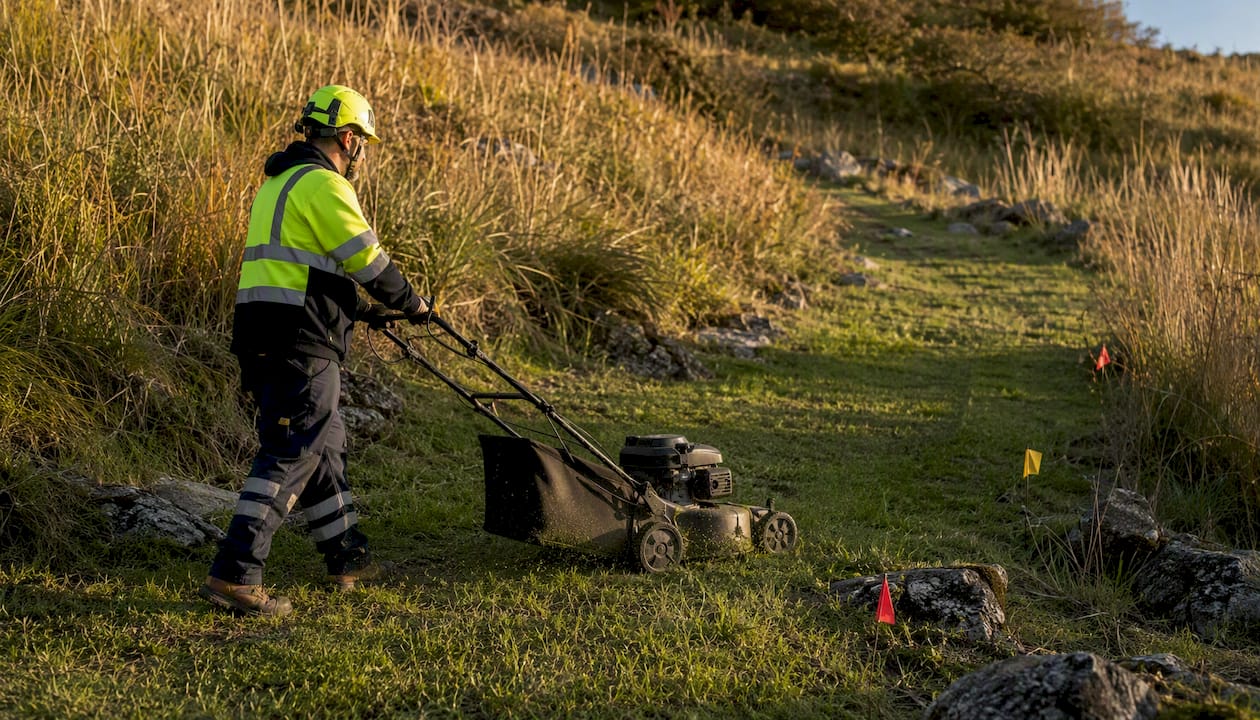
The direction rule is one of the most commonly violated safety basics. Push mowers go across the slope; ride-on mowers go up and down. Reversing this is a leading cause of lateral rollovers on riding equipment.
Pro Tip: When specifying contractor equipment, require the manufacturer’s slope-capability sheet (in degrees) as a contract deliverable. A verbal claim of “suitable for slopes” is not sufficient for WHS documentation or insurer review.
For slopes beyond standard mower limits, brushcutters, string trimmers, or specialist remote-operated machines are the appropriate alternatives. Safety features to require on any robotic or remote-operated unit: low centre of gravity, tracked traction system, automatic tilt/shutdown sensors, and documented slope-capability specifications.
Which weather and ground conditions make slope mowing unsafe?
Wet grass acts as a lubricant between tyres and turf, and mowing on damp slopes is a leading cause of traction loss and rollovers. Schedule slope mowing only when conditions are confirmed dry.
Conditions to avoid:
- Wet or damp grass, including morning dew — wait for afternoon sun to dry the blades fully
- Soft or waterlogged soil after recent heavy rain — stay off the slope for at least a day or two until it firms up
- Frost or icing on any surface
- Loose debris (leaf litter, bark, gravel) that reduces traction
- Eroded or rutted ground that creates unpredictable footing for equipment
A strict wet-condition clause in your scope of works is as important as equipment selection. Build it into contractor SOWs as a non-negotiable scheduling rule.
Turf management also matters. Keeping grass slightly longer on slopes (around 75–100 mm) shades the soil, deepens root systems, and reduces erosion between mowing cycles. Many robotic systems offer mulching that improves turf density and soil health over time, reducing long-term erosion risk compared with heavy mechanical scalping.
What site survey and deployment steps should property managers require?
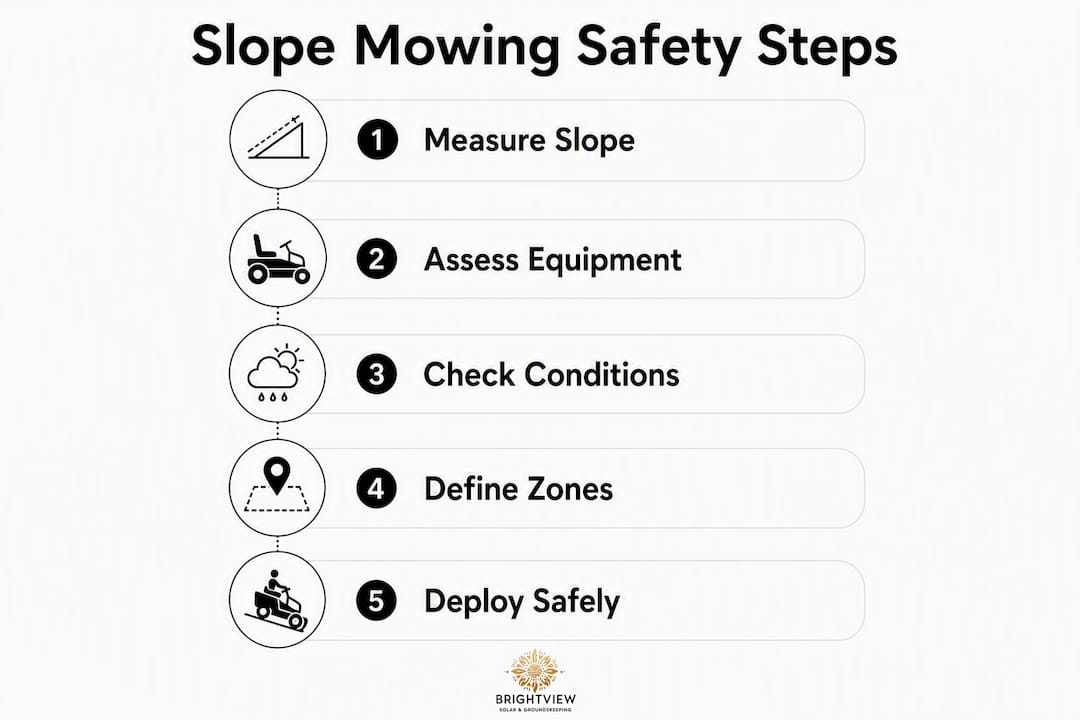
A staged deployment protects you legally and operationally. Here is the sequence to mandate:
- Commission a measured site survey — slope maps in percent and degrees, obstacle identification, soil and turf condition notes, and a draft risk register
- Contractor pilot in a contained area — typically one bank or zone, with the machine operating under supervision
- Review pilot report and risk register — cut quality, area coverage, uptime, and confirmed zero safety incidents before proceeding
- Full deployment — perimeter wire, geofence, or boundary markers established; exclusion zones and signage in place
- Routine maintenance schedule — blade checks, battery or fuel cycles, tilt-sensor calibration, and scheduled reporting to property manager
A site survey is not a formality. It is the document that determines whether your contractor’s equipment is legally appropriate for your site, and it is the first thing an insurer will ask for if an incident occurs. Require it in writing before any machine touches the slope.
The table below maps responsibilities and expected deliverables:
| Responsibility | Party | Deliverable | Acceptance criteria |
|---|---|---|---|
| Measured slope survey | Contractor | Slope map (% and degrees), risk register | All slopes mapped; grades confirmed against equipment spec |
| Equipment compliance | Contractor | Manufacturer slope-capability sheet | Rated grade exceeds site maximum |
| Insurance confirmation | Contractor | Certificate of currency | Public liability confirmed for slope work |
| Pilot performance review | Both parties | Pilot report: cut quality, uptime, incidents | Zero safety incidents; cut quality meets spec |
| Emergency procedures | Contractor | On-site emergency stop protocol, escalation contacts | Documented and briefed to site staff |
Also require: exclusion zone markers, public signage during operations, PPE confirmation, and on-site remote operator training records. For broader worksite safety practices, contractor safe-work procedures from adjacent disciplines offer useful cross-reference for risk registers.
How does Brightview Solar & Groundskeeping handle steep slope mowing?
Brightview Solar & Groundskeeping’s approach follows the staged sequence above as standard practice, not an optional add-on.
Service deliverables include:
- Measured site survey with slope maps in percent and degrees, obstacle identification, and a written risk assessment
- Pilot trial in a contained zone, with performance metrics captured (cut quality, uptime, safety incidents)
- Slope-rated equipment selection matched to the measured grade, including tracked systems for extreme inclines
- Perimeter and geofence setup with exclusion zones and on-site signage
- Scheduled maintenance and reporting covering blade condition, sensor calibration, and periodic performance summaries
Brightview Solar & Groundskeeping’s operations align with Safe Work Australia expectations: documented risk assessments, insurer confirmation, and equipment rated to the measured site grade. Robotic systems used by Brightview Solar & Groundskeeping operate with low centre of gravity and tracked traction, reducing soil disturbance and erosion compared with conventional wheeled machines.
When evaluating any provider for slope mowing, ask for the pilot performance report before committing to full rollout. The metrics that matter: cut quality rating, area coverage per hour, battery or fuel cycle uptime, and confirmed zero safety incidents. Brightview Solar & Groundskeeping provides these as standard pilot deliverables.
Robotic systems also deliver a turf-health benefit that manual mowing cannot match consistently. Mulching capability improves turf density and soil structure over successive cycles, which matters on erosion-prone banks. For a full overview of Brightview Solar & Groundskeeping’s robotic mowing service, including site-survey processes and maintenance contracts, the service guide covers the detail.
Key takeaways
Robotic or remote-operated mowing is the safest and most compliant choice for commercial slopes exceeding 15 degrees, and a measured site survey is the non-negotiable first step before any equipment is deployed.
| Point | Details |
|---|---|
| Measure before you mow | Use rise-over-run to get percent grade and degrees; never rely on visual estimates. |
| Know your equipment limits | Ride-ons are limited to ~15°; most robotic mowers to 24° (45%); commercial remote-operated units to 50–60°. |
| Never mow wet slopes | Damp grass reduces traction sharply and is a leading cause of slope-related incidents. |
| Require site survey and insurer confirmation | Demand written slope maps, equipment capability sheets, and certificate of currency before work begins. |
| Stage a pilot before full rollout | Capture cut quality, uptime, and safety incidents from a contained trial zone before committing to full deployment. |
| Brightview Solar & Groundskeeping | Delivers measured site surveys, slope-rated equipment, pilot metrics, and ongoing maintenance contracts for difficult terrain. |
Why robotic slope mowing is the only sensible call for commercial sites
The conventional wisdom in grounds maintenance is that robotic mowing is a premium option you consider when budget allows. That framing gets it backwards. On any slope above 15 degrees, manual mowing is not the baseline option with robotics as the upgrade. Manual mowing is the high-risk option with robotics as the standard.
The liability exposure from a single rollover incident, including WHS investigation, insurer claims, and reputational damage, far exceeds the cost of a properly scoped robotic deployment. Property managers who have been through that process once rarely go back to specifying ride-ons for steep banks.
What tends to get underestimated is the turf outcome. Robotic systems running consistent, frequent cycles at appropriate height produce denser, healthier turf on slopes than infrequent heavy cuts with conventional equipment. The erosion reduction is a genuine operational benefit, not a marketing claim.
The site survey is where most procurement processes still fall short. Managers accept a contractor’s verbal assurance that equipment is “suitable for slopes” without requesting the manufacturer’s slope-capability sheet or a measured site map. That gap is where incidents happen and where insurer disputes begin. Require the documentation. It takes one email to ask for it and it changes the risk profile of the entire engagement.
Brightview Solar & Groundskeeping: safe slope mowing for commercial sites
Steep terrain does not have to mean deferred maintenance or contractor risk. Brightview Solar & Groundskeeping deploys slope-rated robotic equipment backed by documented site surveys, measured risk assessments, and insurer-aligned safety protocols — so your grounds stay maintained and your liability stays managed.

The process starts with a measured site survey: Brightview Solar & Groundskeeping maps your slope grades in percent and degrees, identifies equipment requirements, and delivers a written risk assessment before any machine operates on site. A staged pilot follows, with performance metrics provided as standard. From there, ongoing maintenance contracts keep the site in consistent condition without repeated manual exposure.
To request a site survey and pilot, visit the Brightview Solar & Groundskeeping service page or review the robotic mower safety guide for the compliance documentation your procurement team will need.
Useful sources
- Safe Work Australia — risk assessment requirements for hazardous groundskeeping work
- STIHL AU: Mowing slopes safely and effectively — Australian-relevant equipment limits and measurement guidance
- UGA Extension: Lawn mower safety on slopes and hills — rise-over-run measurement method and percent grade formula
- RCMowersUSA: Slope mowing — commercial remote-operated mower slope capability (up to 50–60°) and tracked system design
- Sunseeker Tech: How to mow a steep hill — wet-condition hazards and scheduling guidance
- Lawn Love: How to mow on a slope or incline — direction rules and brushcutter alternatives for extreme slopes
- Brightview Solar & Groundskeeping: Robotic mowing service guide — site-survey process, pilot programme and maintenance contracts
- Brightview Solar & Groundskeeping: Robotic mower safety guide — compliance documentation for procurement and insurer conversations
FAQ
What slope is too steep for a ride-on mower?
Most ride-on and zero-turn mowers have a maximum recommended slope rating, and operating a ride-on across the slope rather than up and down on any incline significantly increases lateral rollover risk.
How do you measure a slope for mowing purposes?
Measure the vertical rise over a set horizontal run (e.g. 3 metres), divide rise by run, and multiply by 100 to get percent grade. Convert to degrees using arctan(percent ÷ 100), or use a digital inclinometer app on site.
Why are robotic mowers safer on steep slopes?
Robotic and remote-operated mowers remove the operator from the slope entirely, eliminating rollover and slip exposure. Commercial units use tracked systems and low centres of gravity, and are rated for much steeper grades on specialist models.
Can you mow a steep slope when the grass is wet?
No. Wet or damp grass sharply reduces traction for both equipment and operators, and is a leading cause of slope-related incidents. Always wait until the grass is fully dry before mowing any incline.
What should I require from a contractor before slope mowing begins?
Require a measured site-survey report with slope maps in percent and degrees, the manufacturer’s equipment slope-capability sheet, a written risk assessment, and a certificate of currency confirming public liability insurance for slope work.

