
Solar panel maintenance best practices are defined as the scheduled combination of monitoring, cleaning, inspection, and electrical testing that keeps a photovoltaic system producing at its rated capacity. Australian homeowners and property managers who follow a structured solar panel maintenance procedure can protect their investment, satisfy warranty requirements, and avoid the silent output losses that accumulate when panels are neglected. Brightview Solar & Groundskeeping works with residential and commercial clients across Australia to deliver exactly this kind of structured care, combining robotic cleaning technology with certified inspection services.
What are the essential solar panel maintenance best practices?
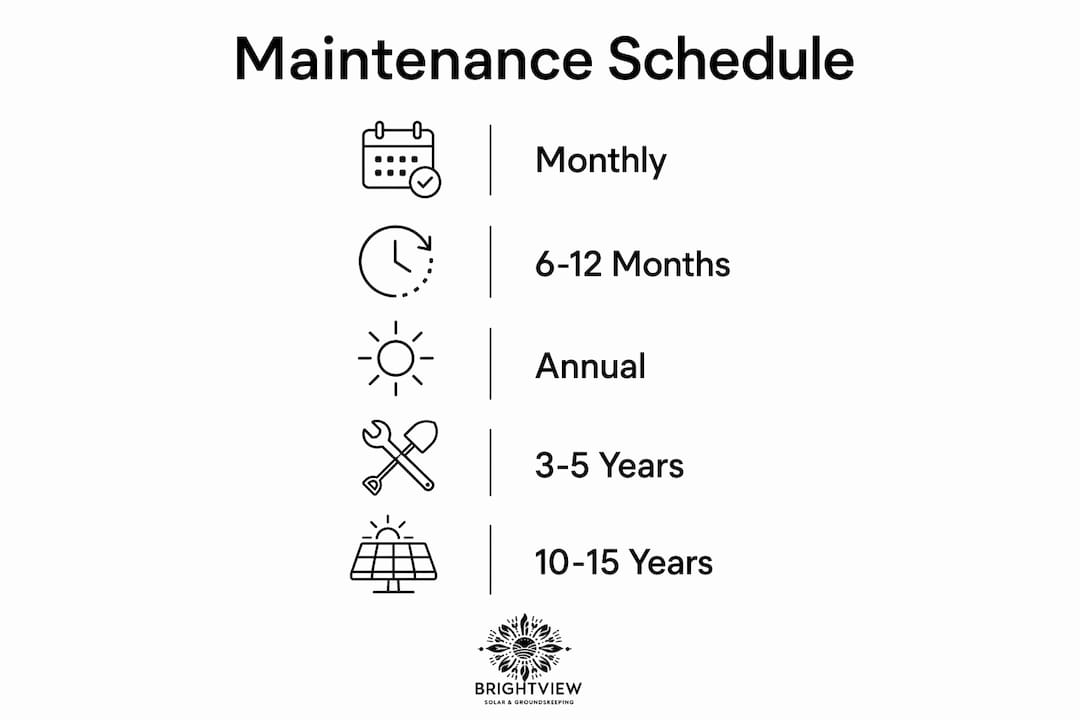
Effective solar panel upkeep covers five core tasks, each with a recommended frequency suited to Australian conditions.
Monthly: output monitoring. Check your inverter display or monitoring app every month to confirm the system is generating close to its expected output. Neglected systems can lose up to 25% of their output over time. That is a significant reduction in the energy savings you bought the system to achieve.
Every 6–12 months: professional cleaning. How often you clean depends on your local environment. Coastal properties collect salt residue. Inland areas near farmland accumulate dust and pollen. Urban rooftops gather traffic grime. Professional cleaning 1–2 times per year is the standard recommendation, with adjustments for local conditions.
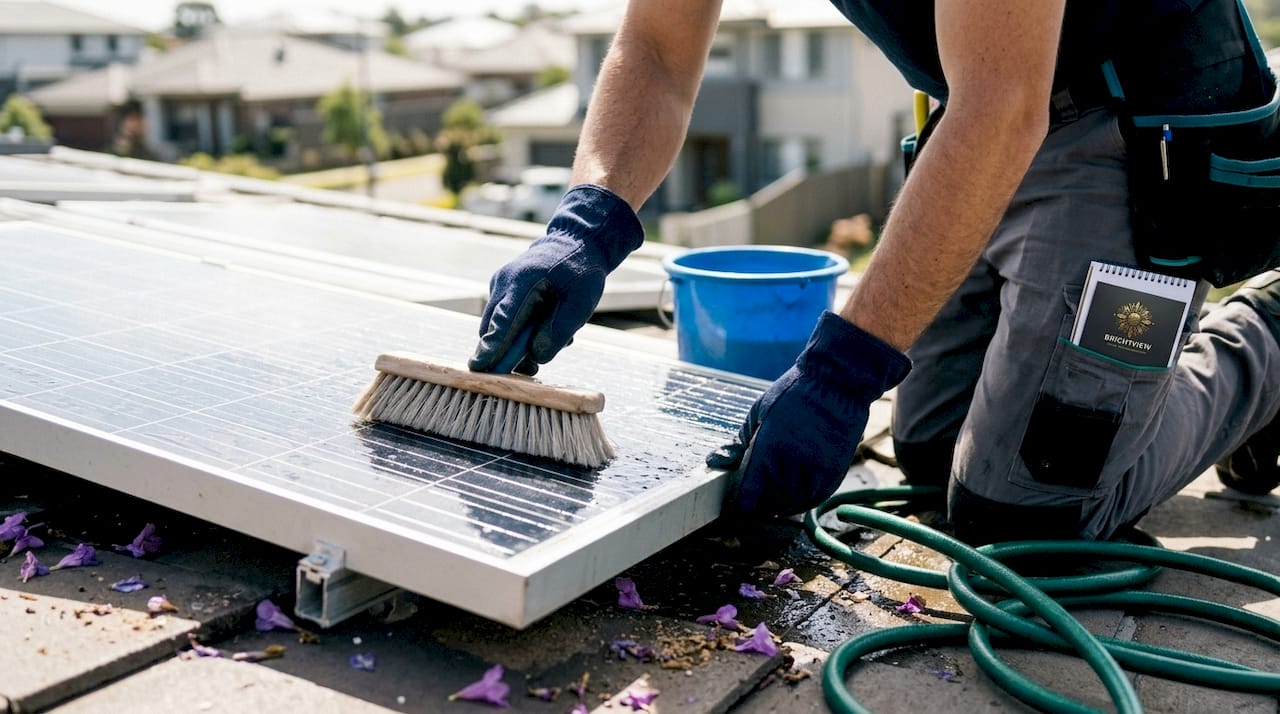
Annually: visual inspection and written report. A qualified technician should walk the roof, check for cracked cells, delamination, discolouration, and loose mounting hardware. The inspection should produce a written solar panel maintenance report. That document becomes your evidence trail for warranty claims.
Every 3–5 years: electrical testing. Insulation resistance testing, earth continuity checks, and string voltage measurements confirm the wiring and connections remain safe. This work requires a licensed electrician or a technician holding NABCEP certification or an equivalent Australian qualification.
Year 10–15: inverter review. Inverter replacement is a predictable event around the 10–15 year mark. Homeowners who fail to budget for this are caught off guard. Add it to your long-term maintenance plan now.
| Task | Recommended frequency |
|---|---|
| Output monitoring | Monthly |
| Panel cleaning | Every 6–12 months |
| Visual inspection and report | Annually |
| Electrical testing | Every 3–5 years |
| Inverter review and replacement | Year 10–15 |
How do you safely clean solar panels?
Safe cleaning protects both the panels and the person doing the work. Follow these steps to get the job done without damaging your system or voiding your warranty.
Choose the right time. Clean panels early in the morning or late in the evening. Panels heated by midday sun can crack when cold water hits them. Thermal shock can crack panels if you clean in direct heat. This is one of the most common and avoidable mistakes.
Gather the right tools. Use a soft-bristle brush or a microfibre cloth, mild dish soap, and deionised water where possible. Deionised water leaves no mineral streaks, which matters in hard-water areas like much of regional Australia.
Work from the ground when you can. Many single-storey rooftops allow ground-level cleaning with an extendable pole brush. This removes the need to climb at all.
Avoid pressure washers and harsh chemicals. Pressure washers and harsh chemicals damage panels and void manufacturer warranties. Abrasive pads scratch the anti-reflective coating, permanently reducing light absorption.
Call a professional for steep or high roofs. Working at height without the right equipment and training is a serious safety risk. For two-storey homes or steep pitches, engaging a qualified service like Brightview Solar & Groundskeeping is the right call. Their robotic cleaning approach removes the safety risk entirely.
Check your output before and after. Log your system’s generation figures the day before and a few days after cleaning. A measurable improvement confirms the cleaning was worthwhile. No improvement may signal a deeper issue worth investigating.
Pro Tip: Take a photo of your panels before and after each clean. This creates a visual record that supports warranty claims and helps you spot gradual changes like new shading from a growing tree.
How does monitoring help you maintain your solar system?
Continuous performance monitoring is the single most useful tool for proactive solar panel upkeep. It tells you what is happening inside your system before a fault becomes a failure.
Your monitoring app or inverter dashboard shows real-time and historical generation data. Compare your actual output against the expected output for your system size and your local weather conditions. Triggering cleaning when the performance ratio drops by 3 or more percentage points from baseline is more cost-effective than cleaning on a fixed calendar. This data-driven approach means you clean when it matters, not just out of habit.
A drop in output exceeding 5–10% without an obvious cause like cloud cover or shading deserves closer attention. A drop beyond 5–10% may indicate technical issues like potential-induced degradation or hotspots rather than just surface dirt. Cleaning will not fix those problems. You need a diagnostic inspection.
Panel-level monitoring technology gives you visibility into each individual panel rather than just the whole string. Panel-level monitoring detects faults earlier than string-only systems. If one panel underperforms, you know exactly which one to inspect rather than guessing across the whole array.
Key signals to watch for in your monitoring data:
- A sudden drop in output on a clear day
- One string consistently underperforming compared to another
- Inverter error codes appearing in the app
- Generation that never recovers after a dust event, even following rain
- Output that declines steadily week over week with no weather explanation
App-based monitoring and maintenance scheduling reduces unnecessary cleaning and ensures timely interventions. That combination protects both your system and your budget.
What are common solar panel problems and how do you fix them?
Most solar panel problems fall into a small number of categories. Recognising them early saves money and prevents warranty complications.
Soiling and shading are the most frequent causes of reduced output. Bird droppings, leaf litter, and dust accumulate unevenly across panels. Even partial shading from a single leaf can reduce output from an entire string. Regular cleaning and trimming nearby trees addresses both.
Cracks, hotspots, and micro-cracks are harder to spot with the naked eye. A cracked cell creates a hotspot that generates heat instead of electricity. Over time, hotspots degrade surrounding cells. Thermal imaging during a professional inspection identifies these faults before they spread.
Inverter faults are the most common cause of a complete system outage. Checking breakers and inverter error codes resolves many issues without calling a technician. Start there before booking a service visit.
Warranty documentation gaps are a hidden problem many homeowners discover too late. Manufacturers often deny warranty claims that lack proof of regular maintenance. A solar panel maintenance report from each annual inspection, combined with cleaning records and photographs, builds the evidence file you need.
Pro Tip: Keep a simple maintenance log in a folder with your system paperwork. Note the date, what was done, who did it, and any observations. This takes five minutes per visit and can save thousands in disputed warranty claims.
Common mistakes to avoid:
- Using tap water with high mineral content, which leaves deposits that reduce light transmission
- Cleaning panels during the hottest part of the day
- Ignoring inverter error codes because the system still appears to be generating
- Assuming a drop in output is always dirt when it could be a panel fault
- Skipping annual inspections because the system “looks fine”
What tools and services support good solar panel maintenance?
Homeowners can handle some maintenance tasks themselves. Others require professional equipment and qualifications.
| Task | DIY or professional | Tools or services required |
|---|---|---|
| Monthly output monitoring | DIY | Monitoring app or inverter display |
| Basic panel cleaning (accessible roof) | DIY | Soft brush, mild soap, deionised water, extendable pole |
| Panel cleaning (steep or high roof) | Professional | Robotic or manual cleaning service with safety equipment |
| Annual visual inspection and report | Professional | Qualified technician, written solar panel maintenance report |
| Electrical testing and fault diagnosis | Professional | Licensed electrician or NABCEP-equivalent certified technician |
| Inverter replacement | Professional | Certified installer |
NABCEP certification or equivalent is the industry gold standard for competent inspection and repair work. When engaging any service provider, ask for their credentials and confirm they carry appropriate insurance for roof work.
Professional cleaning and inspection services that specialise in solar panels understand the warranty risks and electrical safety requirements unique to photovoltaic systems. A general handyman or garden maintenance service does not carry the same knowledge. The distinction matters when a warranty claim is on the line.
Brightview Solar & Groundskeeping uses robotic technology to clean panels safely and thoroughly, including on rooftops that would be hazardous for manual work. Their solar energy automation approach reduces physical risk while delivering consistent cleaning results across the full array.
Key takeaways
Consistent solar panel maintenance, combining monthly monitoring, annual inspections, and data-triggered cleaning, is the most reliable way to protect system output and warranty coverage.
| Point | Details |
|---|---|
| Monitor output monthly | Compare actual generation to expected output and act when performance drops by 3 or more percentage points. |
| Clean safely and at the right time | Use soft brushes, mild soap, and deionised water; always clean in the morning or evening to avoid thermal shock. |
| Document every service visit | Photos and written reports from each inspection are your primary defence in a warranty dispute. |
| Budget for inverter replacement | Plan for inverter replacement around year 10–15 to avoid an unexpected and costly system outage. |
| Call professionals for roof work | Steep or high rooftops require qualified technicians with the right safety equipment and solar-specific knowledge. |
What I’ve learned from years of maintaining solar systems
The most common mistake I see is treating solar panels like a set-and-forget appliance. Homeowners install a system, watch the savings roll in for a year or two, and then stop paying attention. Output quietly drops. The inverter throws an error code that nobody notices. By the time someone investigates, the losses have been running for months.
Monthly monitoring changes that completely. Spending five minutes checking your app at the start of each month catches problems early, when they are cheap to fix. A 3-percentage-point drop in performance ratio is easy to miss on a single day but obvious when you look at a month of data side by side.
The second thing I would tell every homeowner is this: do not climb your roof to clean panels unless you are trained and equipped for it. The financial saving is not worth the risk. Robotic and professional cleaning services exist precisely for this reason, and they do a more thorough job than most DIY attempts anyway.
Finally, keep your paperwork. I have seen homeowners lose warranty claims worth thousands of dollars because they could not prove the system had been maintained. A folder with dated photos, service receipts, and annual inspection reports is cheap insurance. Start it on the day your system is installed and add to it every time work is done.
— BrightView
Brightview Solar & Groundskeeping: professional care for your solar investment
Brightview Solar & Groundskeeping delivers certified solar panel cleaning and inspection services tailored to Australian conditions, from dusty inland properties to salt-affected coastal rooftops.
Their robotic cleaning technology reaches panels on steep and difficult rooftops safely, without putting workers at risk. Every service visit includes a written maintenance report, giving you the documentation you need to support warranty claims and track system health over time. For homeowners and property managers who want their system performing at its best, Brightview Solar & Groundskeeping offers a practical, safety-first solution. Visit Brightview Solar & Groundskeeping to learn more about their services and book a maintenance visit. You can also explore their guide to outdoor automation solutions for broader property maintenance options.
FAQ
How often should solar panels be cleaned in Australia?
Most Australian systems benefit from professional cleaning 1–2 times per year, with higher frequency for properties near farmland, construction sites, or the coast where soiling accumulates faster.
Can I clean solar panels myself?
You can clean accessible panels on a single-storey roof using a soft brush, mild dish soap, and deionised water, but steep or high rooftops require a qualified professional with appropriate safety equipment.
What causes a sudden drop in solar output?
A sudden output drop on a clear day may indicate an inverter fault, a tripped breaker, shading, soiling, or a panel defect such as a hotspot. Check inverter error codes first, then book an inspection if the issue persists.
How do I maintain my solar warranty?
Keep a maintenance log with dated photos and written reports from every professional inspection and cleaning visit. Manufacturers regularly deny warranty claims that lack documented proof of regular upkeep.
When does a solar inverter need replacing?
Most inverters reach the end of their serviceable life between year 10 and year 15. Budget for replacement as part of your long-term solar ownership plan to avoid an unexpected system outage.

