
For Australian commercial and industrial property managers, Brightview Solar & Groundskeeping is the recommended robotic solar-panel cleaning partner. The practical next step: request a no-obligation site assessment and pilot, where Brightview Solar & Groundskeeping will survey your array, define a trial area, and deliver before/after energy data so you can judge performance against your own KPIs before committing to a contract.
The pilot matters because soiling losses are not trivial. Dust accumulation alone can cut panel efficiency by several percent on average, with far higher losses measured in severe or extreme-soiling cases. On a large commercial array, that translates directly to lost revenue. A structured pilot removes the guesswork from the procurement decision.
Table of Contents
- What do solar panel cleaners reviews tell you to look for?
- What throughput and frequency should you realistically expect?
- What safety and best practices must you require?
- How does Brightview Solar & Groundskeeping’s service work?
- Key takeaways
- Why the pilot is the only honest starting point
- Brightview Solar & Groundskeeping: request your site assessment
- FAQ
What do solar panel cleaners reviews tell you to look for?
The most useful framework for choosing a robotic cleaning service is Multi-Criteria Decision Analysis (MCDA), a structured method that weights multiple factors simultaneously rather than letting a single headline spec dominate the decision. A peer-reviewed analysis published in Energies applied MCDA to solar cleaning methods and confirmed it as the right tool for comparing options across efficiency, cost, environmental impact and ease of use.
MCDA scoring matrix for robotic cleaning procurement
| Criterion | Weight (0–5) | What to score |
|---|---|---|
| Cleaning throughput (m²/hr) | 5 | Vendor’s demonstrated capacity for your array size |
| Water usage (L/m²) | 4 | Low-water or waterless options preferred |
| Autonomy level | 4 | Fully autonomous vs. crew-supervised |
| Edge detection / safety systems | 5 | Certified autodrive, emergency stop, WHS compliance |
| Array compatibility | 4 | Fixed roof, ground-mount, tracker systems |
| Local support / spare parts | 4 | Australian-based technicians, response SLA |
| Contract model and SLA | 3 | Project vs. ongoing; cleanliness KPI defined |
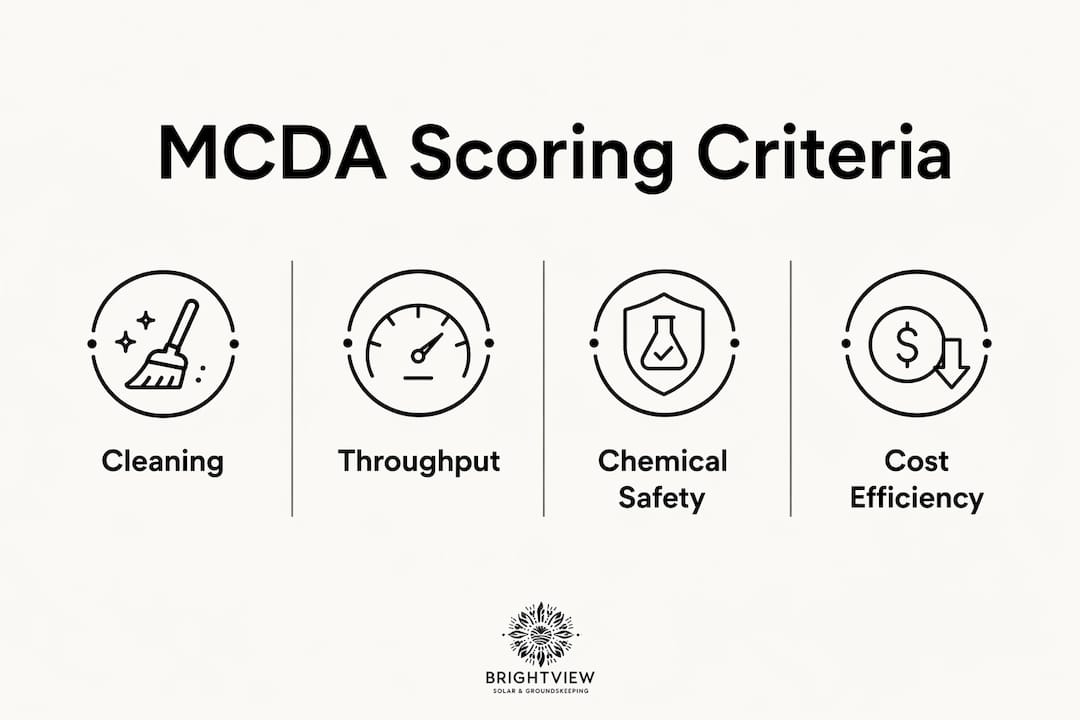
Score each vendor 0–5 per criterion, multiply by weight, and compare totals. A vendor who scores well on throughput but poorly on local support is a liability on a large site.
Procurement questions to ask every vendor:
- What is your demonstrated cleaning capacity in m²/hour on a comparable Australian site?
- What water quality do your machines require, and do you supply demineralised or RO water?
- How does your edge-detection system perform on our specific roof pitch and panel layout?
- Can your brush widths be reconfigured on-site for mixed panel formats?
- Where are your spare parts held, and what is your on-site response time?
- What does your pilot programme include, and what success metrics will you report?
Red flags during vendor evaluation:
- No pilot offer or refusal to share before/after energy data
- Vague safety certifications with no documentation
- Spare parts sourced only from overseas with no local stock
- SLA defined only as “best efforts” with no cleanliness KPI
What throughput and frequency should you realistically expect?
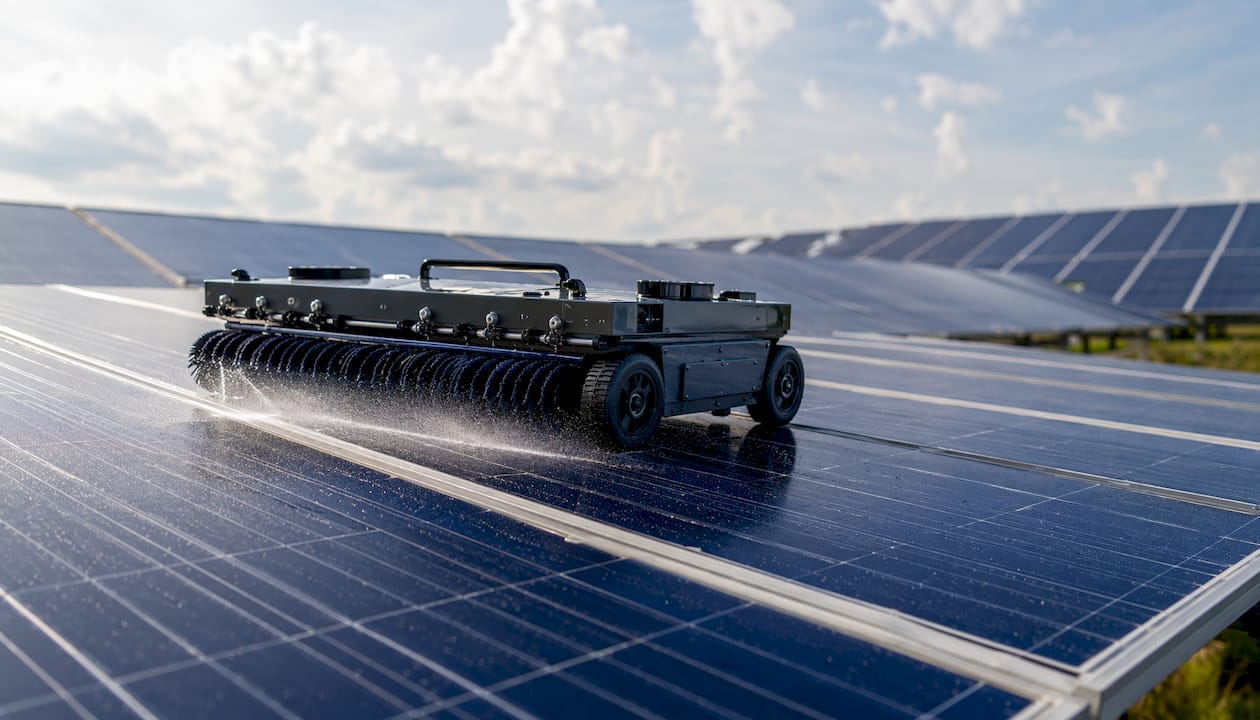
Professional photovoltaic cleaning robots report practical cleaning capacities of 500–1,100 m²/hour under normal soiling conditions, with modular brush configurations pushing throughput toward 1,800 m²/hour in optimal setups. For procurement purposes, use the 500–1,100 m²/hour band as your planning baseline and ask vendors to demonstrate their figure on a test area.
For large commercial arrays, the real bottleneck is often setup and manoeuvring time rather than raw cleaning speed. Modular robots with variable brush widths reduce on-site labour hours materially compared with fixed-width machines, particularly on mixed-layout roofs.
Optimal cleaning cycles are condition-triggered, not calendar-driven. Monitor kWh output continuously and use performance dips as the primary signal to schedule a clean, rather than defaulting to a fixed date.
Recommended cleaning frequency by site type
| Site profile | Baseline frequency | Triggers for increased cadence |
|---|---|---|
| Low-soiling (coastal, low traffic) | Once per year | Visible soiling, output drop >5% |
| Standard commercial | 1–2 times per year | Dust events, bird activity, pollen season |
| High-soiling (near industry, arid) | Quarterly or more | Continuous output monitoring recommended |
Professional cleaning is particularly valuable for large commercial arrays where manual access is unsafe and repeatable before/after measurement is required. Rainfall alone does not maintain output at commercial scale.
Pilot design: what good looks like
- Trial area: minimum 10% of total array, representative of worst-soiling zones
- Duration: one full clean cycle with monitoring for 2–4 weeks post-clean
- Before/after metrics: kWh output, cleanliness KPI (visual or sensor-based), water L/m² consumed
- Success threshold: measurable output recovery against pre-clean baseline, agreed in writing before the pilot starts
Performance metrics to track throughout the contract:
- Cleaning throughput (m²/hr achieved vs. quoted)
- Water consumption per m² cleaned
- Change in kWh output before and after each service
- Cleanliness KPI (agreed standard, e.g. <0.5% soiling loss)
- Downtime during service (array offline hours)
What safety and best practices must you require?
Safety systems: non-negotiable requirements
- Edge-detection sensors with certified autodrive: robots on rooftop installations must demonstrate test results, not just spec-sheet claims
- Emergency stop accessible to on-site personnel at all times
- Remote supervision capability with real-time alerts
- Operator training records and WHS compliance documentation
- Public liability and professional indemnity insurance, current certificates on file
- Permit-to-work process for rooftop access, coordinated with your site safety plan
What to prohibit outright:
- High-pressure washers: these can damage panel surfaces and void manufacturer warranties
- Bleach, ammonia, or generic household detergents: they leave residues that accelerate resoiling and degrade coatings
- Cleaning during peak production hours or when panels are thermally stressed (typically midday in Australian summer)
Pro Tip: Schedule cleaning during cooler parts of the day, early morning or late afternoon, to avoid thermal shock from cold water on hot glass. Coordinating solar cleaning with other scheduled building maintenance, similar to how facilities teams schedule HVAC service around business hours, reduces operational disruption and keeps your site running smoothly.
Purpose-made, low-residue solar cleaners and demineralised or reverse-osmosis water are the standard for professional robotic systems. Generic soaps leave limescale and soap film that attract dust faster, shortening the interval before the next clean is needed. Low-water robotic systems operating at under 200 L/hour are available and worth specifying for sites with limited water access.
“Avoid high-pressure cleaners and harsh chemicals such as bleach or ammonia. Use low-residue, purpose-designed solar cleaners and demineralised or RO water to prevent limescale and rapid resoiling.” — Best-practice guidance consistent across manufacturer and industry sources.
How does Brightview Solar & Groundskeeping’s service work?
Brightview Solar & Groundskeeping operates on a contracted and project-based model, deploying autonomous robotic machines across commercial and industrial arrays throughout Australia. The service covers solar panel efficiency recovery through repeatable, measurable cleaning cycles, with machines configured for varied array layouts including fixed rooftop, ground-mount, and difficult-access installations.
The pilot programme is structured around your site’s specific conditions. Brightview Solar & Groundskeeping conducts a site survey, defines a representative trial area, and establishes before/after energy monitoring so you have real performance data, not a sales presentation. Trial duration, success metrics, and reporting format are agreed before the pilot begins.
Operational deliverables include defined cleanliness KPIs, response time SLAs, maintenance cadence, and local spare-parts availability. Safety documentation, including WHS compliance records and current insurance certificates, is supplied as standard.
Pro Tip: Ask Brightview Solar & Groundskeeping to supply case-study data from comparable Australian commercial sites during the assessment phase. Before/after kWh output figures from a similar array type give you a realistic benchmark for your own pilot success threshold.
To request a site assessment, contact Brightview Solar & Groundskeeping directly through brightviewpty.au. The assessment is no-obligation and includes a written pilot proposal with defined metrics.
Key takeaways
Robotic solar-panel cleaning for Australian commercial sites requires site-specific frequency, verified throughput, and a structured pilot with before/after energy data before any contract is signed.
| Point | Details |
|---|---|
| Soiling losses are measurable | Dust can reduce energy output by several percent on average each year; a pilot with before/after kWh data quantifies your actual loss. |
| Use MCDA for vendor selection | Weight throughput, water use, safety systems, and local support; score vendors 0–5 per criterion. |
| Baseline frequency: 1–2 times per year | High-soiling sites near industry or in arid zones need more frequent, condition-triggered cleaning. |
| Require a structured pilot | Agree success metrics in writing before the trial; minimum 10% of array, 2–4 weeks of post-clean monitoring. |
| Brightview Solar & Groundskeeping | Offers contracted robotic cleaning with site assessment, pilot programme, and safety documentation for Australian commercial sites. |
Why the pilot is the only honest starting point
Most property managers reviewing solar panel cleaners focus on price per panel or cleaning frequency. Those are the wrong starting points. The number that actually matters is kWh output recovered per dollar spent on cleaning, and you cannot calculate that without a baseline measurement from your own array under your own soiling conditions.
Generic industry averages do not account for your roof pitch, your proximity to a quarry or a highway, or the specific dust profile of your region. A vendor who refuses to run a structured pilot with agreed success metrics is telling you something important: they are not confident their results will hold up to scrutiny on your site.
Brightview Solar & Groundskeeping’s approach of running condition-specific pilots with documented before/after energy data is the right model, not because it is unusual, but because it is the only way to make a procurement decision that holds up to board-level scrutiny. The automation of solar farm maintenance is no longer experimental technology; the question is whether the vendor can prove performance on your specific asset.
Brightview Solar & Groundskeeping: request your site assessment
Fewer unplanned output losses, documented performance data, and a cleaning programme built around your array’s actual soiling conditions: that is what a Brightview Solar & Groundskeeping pilot delivers for Australian commercial and industrial property managers.
The pilot includes a full site survey, a defined trial area, before/after energy monitoring, a safety and compliance checklist, and a written report with performance data. No guesswork, no generic schedules.
Explore the full robotic solar cleaning provider guide to see how Brightview Solar & Groundskeeping compares on the criteria that matter, then contact the team at brightviewpty.au to request your no-obligation site assessment.
FAQ
How often should commercial solar panels be cleaned in Australia?
The baseline is 1–2 times per year, but sites near industrial areas, in arid zones, or with heavy bird activity often need more frequent cleaning. Output monitoring should drive the schedule rather than a fixed calendar.
What throughput should a robotic solar cleaner achieve?
Professional robotic systems report practical cleaning capacities of 500–1,100 m²/hour under normal soiling, with modular configurations reaching around 1,800 m²/hour in optimal conditions.
What chemicals are safe to use on commercial solar panels?
Low-residue, purpose-made solar cleaners with demineralised or reverse-osmosis water are the standard. Bleach, ammonia, and generic dish soaps leave residues that damage coatings and accelerate resoiling.
What should a robotic cleaning pilot include?
A structured pilot covers a site survey, a representative trial area (minimum 10% of the array), agreed success metrics, before/after kWh monitoring, and a written performance report. Brightview Solar & Groundskeeping includes all of these as standard.
How do I evaluate robotic solar cleaning vendors in Australia?
Use an MCDA scoring matrix weighted across throughput, water usage, safety systems, array compatibility, local support, and contract model. Require documented safety certifications, current insurance, and a pilot offer with defined metrics before signing any contract.

