
Robotic precision spot-spraying is a viable, contractable service for most Australian commercial grounds and solar farms. If your site has routine vegetation pressure across open terrain, a site survey and short pilot trial are the right next steps. The verdict is clear: this approach works, the local evidence backs it, and the procurement path is straightforward.
What to do now:
- Commission a site survey covering terrain, access points, sensitive areas, and weed pressure mapping
- Define a pilot zone of one solar array or 1–5 ha with agreed success metrics (treated area percentage, hit rate, chemical volume versus baseline)
- Request pilot reporting in treatment map format with run logs and anomaly records
- Evaluate the pilot against a defined acceptance threshold before committing to an ongoing SLA
CSIRO trials confirm robotic platforms can navigate large-scale solar sites safely, and Western Australian case studies show treated area reductions that procurement teams can cite directly in internal briefs.
Pro Tip: Track two metrics in any pilot: treatment hit rate (weeds detected and sprayed versus total weeds counted in a reference plot) and chemical volume used versus your blanket-spray baseline. Together they tell you whether the robot is accurate and whether the savings are real.

Table of Contents
- What does “selective weed spraying” actually mean in this guide?
- Why robotic spot-spraying outperforms blanket spraying for asset managers
- Which sites suit robotic spot-spraying, and where does it fall short?
- How deployment works: from site survey to scaled operations
- What to ask vendors and what to include in a trial brief
- Australian regulatory and environmental obligations to check first
- Local evidence: what Western Australian trials and CSIRO research show
- Key takeaways
- The case for piloting before you commit to anything
- Brightview Solar & Groundskeeping: contracted robotic spraying for commercial and solar sites
- Useful sources and further reading
- FAQ
What does “selective weed spraying” actually mean in this guide?
Most of the internet uses “selective weed spraying” to mean herbicide chemistry that kills certain plant types while leaving others unharmed. That is not what this guide covers.
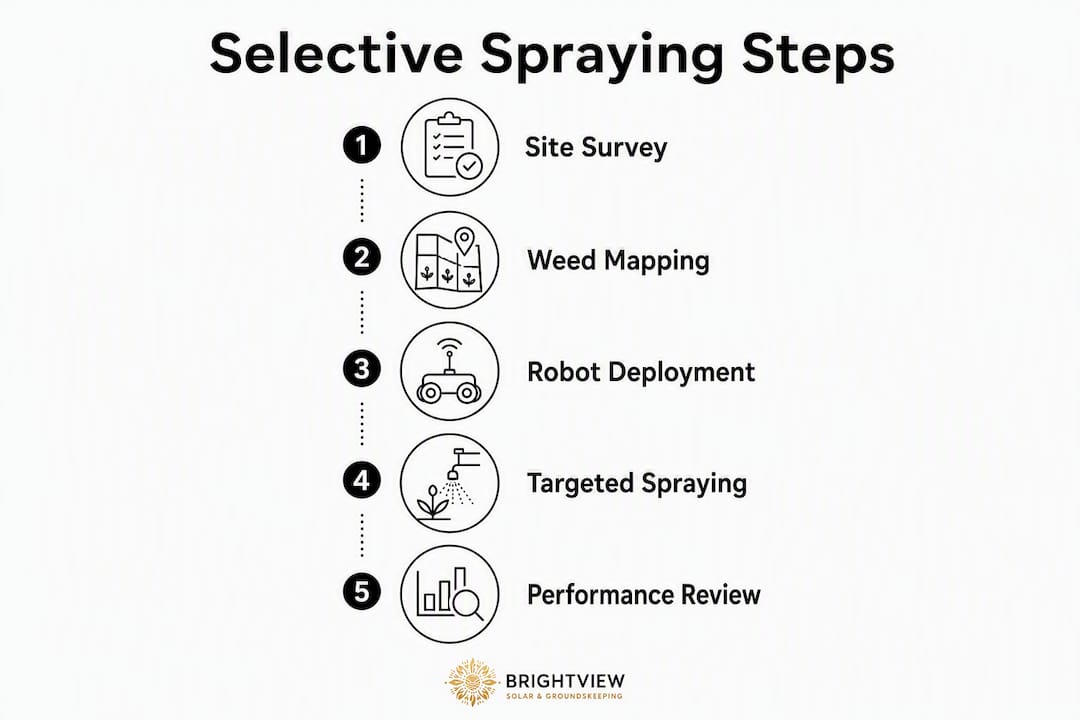
Here, selective weed spraying means contracted robotic precision spot-spraying: autonomous machines that detect individual weeds using sensors and AI, then apply herbicide only to those specific targets. Nothing is broadcast. Nothing is blanket-applied. The robot finds the weed, sprays it, and moves on.
The core components of the service are:
- Detection system: sensors (RGB cameras, LiDAR, or fluorescence detection) combined with AI plant-identification models
- Autonomous mobility platform: a self-navigating robot capable of operating across open terrain, including contoured ground and solar arrays
- Targeted spray delivery: individual nozzles or micro-spray heads that activate only over a detected weed
- Cloud reporting: treatment maps, run logs, hit/miss data, and chemical volume records delivered after each run
Service models vary. A one-off project suits a site with a seasonal weed flush. A scheduled maintenance contract suits solar farms and commercial grounds with ongoing pressure. A hybrid pilot-to-scale model is the most common entry point: a defined trial that converts to an SLA once performance thresholds are met.
This guide does not cover selective herbicide chemistry, product labels, or broadleaf-versus-grass formulations. Those are procurement inputs, not the service itself.
Why robotic spot-spraying outperforms blanket spraying for asset managers
The headline benefit is chemical reduction. Grower reports from Australian operations cite roughly 70% less herbicide used in fallow management after switching from blanket application to robotic detection and spot-spraying. For a solar farm or commercial property with large open areas, that reduction translates directly into lower chemical costs, fewer resupply runs, and a smaller environmental footprint.
Beyond chemistry, the operational advantages compound:
- Earlier intervention: robots can be deployed quickly and repeatedly, targeting small weeds before they set seed. AUSVEG practitioner reports confirm this improves kill rates compared with delayed blanket timing
- Night operations: WeedSmart notes that night runs reduce evaporation and improve treatment effectiveness for certain chemistries, and robots operate safely after hours without additional labour cost
- Reduced ground compaction: lightweight robotic platforms cause less soil disturbance than tractor-mounted sprayers, allowing earlier site access after rain and less disruption to ground cover between solar arrays
- Safety and access gains: steep embankments, restricted zones, and live electrical infrastructure become accessible without putting operators at risk
- Resistance management: by targeting young weeds precisely, you reduce seed set and slow herbicide resistance development across seasons, which WeedSmart identifies as the primary long-term driver for adoption
Statistic callout: Western Australian trials at Scaddan recorded the robot treating approximately 4% of one paddock block and 8% of another versus what blanket spraying would have covered. That is the scale of chemical saving available on open terrain.
Which sites suit robotic spot-spraying, and where does it fall short?
Solar farms are the clearest fit. Open rows between arrays, predictable terrain, and high weed-pressure risk to panel efficiency make them near-ideal. Commercial car parks, sports fields, fence lines, and large managed grounds also suit the service well.
Sites that may not be a good match:
- Dense woody regrowth taller than the robot’s sensor height, where detection accuracy drops
- Wetlands, waterways, and protected native remnant vegetation where chemical application is restricted or prohibited
- Terrain with slopes beyond the robot’s rated operating gradient (confirm the specification with your vendor)
- Sites with no practical water access for spray mix preparation and refill logistics
Operational constraints worth checking early include restricted chemical approvals in certain council or EPA zones, GIS or asset map availability for route planning, and whether the site has reliable connectivity for cloud data upload.
Pro Tip: For marginal terrain, run a small instrumented trial on a 0.5 ha test plot before committing the full pilot. Log detection accuracy, missed weeds, and any terrain-related interruptions. That data tells you whether the robot spec matches your site before you sign a contract.
How deployment works: from site survey to scaled operations
Deployment follows a predictable sequence. Get this right and a pilot converts to a contracted service without surprises.
- Site survey: map terrain, access routes, fill points, sensitive areas, slope gradients, and existing weed pressure. The survey deliverable should be a written report with annotated maps.
- Technology selection: match sensor type and spray head configuration to your dominant weed species and canopy height. Confirm the robot’s rated slope tolerance against your site survey data.
- Pilot design: define the pilot area (one array or 1–5 ha), duration (typically 4–8 weeks), and acceptance criteria (minimum hit rate, maximum missed-weed count, reporting format).
- Logistics setup: confirm fill points for water and chemical, charging or refuelling locations, and access gate arrangements.
- Scheduled runs: agree day versus night scheduling. Night runs suit sites where daytime access is restricted or where herbicide efficacy improves in cooler conditions.
- Reporting and evaluation: after each run, the vendor delivers treatment maps, hit/miss accuracy data, chemical volume used, run hours, and anomaly logs.
The Scaddan WA operation logged approximately 1,200 engine hours in a 12-month period, which gives a realistic benchmark for annual run-hour expectations on a large commercial site. Primary cost drivers are site complexity, refill frequency, required run cadence, and the number of robots needed to cover the area within your treatment window.
What to ask vendors and what to include in a trial brief
Start with the site survey deliverable. Any vendor who cannot produce a written survey report with annotated maps before quoting is not ready to run a pilot.
Buyer’s checklist:
- Written site survey report with terrain, access, and sensitive-area annotations
- Defined pilot acceptance criteria (minimum hit rate, reporting format, chemical volume target)
- Proof of operator certification and chemical handling qualifications
- Current public liability and professional indemnity insurance certificates
- Chemical label compliance documentation for the proposed actives on your site
- Drift management plan and buffer zone specifications
- Escalation SLA: response time if a robot fails mid-run or a treatment anomaly is flagged
- Performance guarantee for hit rate and reporting frequency written into the contract
Vendor scoring table:
| Dimension | What to ask | Minimum standard |
|---|---|---|
| Coverage accuracy / hit rate | What is your demonstrated hit rate on comparable terrain? | Vendor provides pilot data, not just claims |
| Terrain and access capability | What is the rated slope gradient and minimum clearance height? | Matches your site survey data |
| Chemical options and delivery | Can you accommodate non-glyphosate actives? | Yes, with label compliance documentation |
| Scheduling and responsiveness | How quickly can you deploy after a treatment trigger? | Defined in SLA with escalation clause |
| Data and reporting | What does the post-run report include? | Treatment maps, hit/miss log, chemical volume, run hours |
| Safety and compliance | Provide operator certs, insurance, and spray risk assessment | All three, in writing, before pilot starts |
| Contract model and SLAs | Is there a pilot-to-SLA conversion pathway? | Clear acceptance criteria and conversion terms |
Australian regulatory and environmental obligations to check first
The short answer: confirm your vendor operates under applicable state EPA rules, holds current chemical operator credentials, and can demonstrate label compliance for every active used on your site. Require a documented spray risk assessment before the pilot starts.
Compliance checklist:
- Operator credentials: current chemical use licence or equivalent state certification (requirements vary by state; confirm with your state EPA or agriculture department)
- Chemical label compliance: the proposed herbicide must be registered and labelled for the application method and site type under the APVMA framework
- Drift management: documented nozzle selection, operating pressure, and buffer zone distances from waterways, roads, and sensitive vegetation
- Threatened flora check: confirm no listed threatened species are present in the treatment zone before any chemical is applied
- Record keeping: treatment logs, chemical batch records, and run reports must be retained for audit purposes (check your state EPA’s minimum retention period)
- Environmental targets: WeedSmart’s integrated management guidance positions precision spraying as a tool for herbicide-reduction and resistance management programmes, which supports corporate sustainability reporting
For final sign-off, consult your state EPA’s vegetation management guidelines and the APVMA’s label database directly.
Local evidence: what Western Australian trials and CSIRO research show
The WA and CSIRO data give procurement teams concrete numbers to include in internal briefs.
| Source | Key metric | Finding |
|---|---|---|
| Scaddan WA farm trial | Treated area vs paddock | ~4% on one block, ~8% on another |
| Scaddan WA farm trial | Operational durability | ~1,200 engine hours in 12 months |
| CSIRO solar farm trials | Sensing capability | LiDAR, RGB, and thermal sensors for fault detection and vegetation management combined |
| CSIRO BEAR robot | Safety outcome | Removes workers from high-risk inspection and maintenance tasks on large-scale PV sites |
Statistic callout: The Scaddan trial treated roughly 4–8% of paddock area compared with what blanket spraying would have covered. On a 500 ha solar farm, that scale of reduction represents a substantial drop in chemical volume and application cost per treatment cycle.
CSIRO’s research also demonstrates that robots using LiDAR, thermal, and RGB sensors can map assets and locate panel faults while performing vegetation tasks, which increases the return on investment for solar farm operators who bundle inspection with weed control.
Key takeaways
Robotic selective weed spraying is a proven, contractable service for Australian commercial and solar assets when scoped with a site survey, a defined pilot, and clear acceptance criteria.
| Point | Details |
|---|---|
| Start with a site survey | A written survey with terrain maps is the non-negotiable first step before any pilot or contract. |
| Track hit rate and chemical volume | These two pilot metrics tell you whether the robot is accurate and whether the savings are real. |
| WA trials show treated area as low as 4% | Compared with blanket coverage, that reduction is the core financial and environmental case for adoption. |
| Compliance must be documented upfront | Require operator credentials, insurance, and a spray risk assessment before the pilot starts, not after. |
| Brightview Solar & Groundskeeping | Offers a site survey to SLA pathway for commercial and solar assets across Australia. |
The case for piloting before you commit to anything
The most common mistake asset managers make with robotic spraying is skipping the pilot and going straight to a multi-year contract based on vendor claims alone. The WA and CSIRO evidence is compelling, but your site is not a paddock in Scaddan and it is not a CSIRO test environment. Terrain, weed species mix, access constraints, and chemical approvals all vary, and a vendor who cannot show you pilot data from a comparable site should not be getting a long-term contract.
The pilot is not a courtesy. It is the mechanism that converts vendor claims into verified performance on your specific asset. Insist on a minimum hit rate threshold written into the pilot acceptance criteria. If the vendor pushes back on that, treat it as a red flag.
What the evidence also shows is that the long-term value of this approach is not just the chemical saving on the first run. By targeting young weeds before seed set, you reduce the weed seed bank over successive seasons, which means each subsequent treatment cycle covers less area and uses less chemical. That compounding benefit is what makes a well-scoped robotic spraying contract genuinely worth the investment over three to five years.
Brightview Solar & Groundskeeping: contracted robotic spraying for commercial and solar sites
Brightview Solar & Groundskeeping delivers contracted robotic spot-spraying for solar farms, commercial grounds, and industrial properties across Australia. The service follows a clear sequence: site survey, pilot trial with defined acceptance criteria, then an ongoing SLA with regular treatment maps, run logs, and compliance records.
Where traditional spraying puts operators on foot across live electrical infrastructure or steep embankments, Brightview Solar & Groundskeeping’s autonomous platforms handle those zones safely. The reporting package covers chemical volume used, hit/miss accuracy, and anomaly logs after every run, giving asset managers the audit trail they need for environmental compliance and board reporting.
For solar farm owners who want to bundle vegetation management with panel inspection, Brightview Solar & Groundskeeping’s automated weed control solutions and solar energy robotics services can be scoped together in a single contract.
To start, request a site survey. Provide your site location, approximate area, terrain description, and any known chemical restrictions. Brightview Solar & Groundskeeping will deliver a survey report and pilot proposal with defined acceptance criteria.
Useful sources and further reading
- CSIRO: Robots & AI take the heat for solar farms — Technical detail on robotic sensing, LiDAR, and combined inspection and vegetation management for solar assets. Consult for technology specification and safety justification.
- CSIRO news: Robot solar farm trial — Summary of the BEAR robot trial outcomes and safety case for removing workers from large-scale PV maintenance.
- Farm Weekly: Autonomous farming in Scaddan — Primary source for the WA treated-area and engine-hour data cited in this guide.
- WeedSmart: Does weed detection and spot-spraying machinery pay off? — Industry guidance on ROI, resistance management, and integrated programme design.
- WeedSmart: Better weed control on contoured farms — Practical notes on night operations, ground compaction, and herbicide reduction data.
- AUSVEG: SA onion grower case study — Practitioner evidence on early intervention, kill rates, and chemical savings.
Due diligence note: always collect the vendor’s site survey report, pilot acceptance criteria, and compliance documentation as part of your procurement file. Published case studies set the benchmark; your site survey confirms whether that benchmark applies to your asset.
FAQ
What is robotic selective weed spraying?
Robotic selective weed spraying uses autonomous machines equipped with AI and sensors to detect individual weeds and apply herbicide only to those targets, leaving surrounding vegetation untreated. It is a contracted service, not a herbicide product.
How much can robotic spot-spraying reduce chemical use?
Western Australian trials recorded treated areas of about 4–8% of total paddock area compared with blanket coverage, and grower reports cite approximately 70% less herbicide used after switching to robotic detection and spot-spraying.
What should I include in a pilot brief for a vendor?
Define the pilot area (1–5 ha or one solar array), duration, minimum hit rate threshold, reporting format (treatment maps and run logs), and require operator credentials, insurance, and a spray risk assessment before the pilot starts.
Is robotic spraying suitable for solar farms in Australia?
Yes. CSIRO trials confirm robotic platforms can navigate large-scale solar sites safely, combining vegetation management with panel inspection using LiDAR, RGB, and thermal sensors, which improves ROI for solar asset operators.
How does Brightview Solar & Groundskeeping structure its service?
Brightview Solar & Groundskeeping follows a site survey to pilot to SLA pathway, delivering treatment maps, chemical volume records, and run logs after each operation to support compliance reporting and contract performance reviews.

