
Robotic and autonomous systems are a safe, effective option for commercial safe access landscaping in Australia — provided you require engineered safety features, a documented site assessment, and WHS evidence from your supplier before a single machine turns a wheel. The first step is straightforward: run a site suitability check and request a safety pack that includes emergency stop behaviour, remote monitoring protocols, and any third-party certifications. Brightview Solar & Groundskeeping operates under this framework, with documented WHS processes and autonomous machines built for the terrain and compliance demands of Australian commercial sites. Autonomous robotic mowers remove the need for human operators on steep slopes, directly reducing WHS exposure where traditional crews face the greatest risk.
Table of Contents
- What does safe access landscaping with robotics actually cover?
- What safety features should you require from any supplier?
- How do you assess a site before deploying autonomous equipment?
- How do you integrate robotics into your existing maintenance workflows?
- What are your WHS and insurance obligations in Australia?
- What does a realistic rollout timeline look like?
- How do you manage risk and respond to incidents?
- Key takeaways
- The case for treating robotics as infrastructure, not equipment
- Brightview Solar & Groundskeeping: request a site assessment or pilot
- Useful Australian sources and templates
- FAQ
What does safe access landscaping with robotics actually cover?
“Safe access landscaping” is a practical term for maintaining grounds and assets in areas where putting a human operator creates unacceptable risk: steep embankments, solar arrays in remote heat, high-traffic zones, and sensitive sites like aged-care facilities or school campuses. With autonomous systems, the scope covers robotic mowing, robotic solar panel cleaning, and autonomous spraying — each replacing a task that previously required a person in a hazardous position.
On Australian commercial sites, the most common use cases are large open turf areas and sports fields, steep grass embankments alongside roads or retaining walls, utility-scale and rooftop solar arrays, and grounds at aged-care residences and school campuses where noise and fumes matter as much as safety. Consistent scheduled robotic cleaning prevents soiling adhesion on solar panels, which is particularly relevant in Australia where dust-driven yield losses are a real operational cost.
Scope boundary: Robotics handles repetitive, area-based tasks well. Fine-detail horticulture, complex arboriculture, and high-risk manual cleaning of elevated structures still require qualified human specialists. Autonomous systems complement skilled crews — they do not replace them entirely.
What safety features should you require from any supplier?
This is where procurement decisions get made or unmade. A machine without the right engineered controls is a liability, not an asset.
Minimum safety feature checklist:
- Emergency stop: hardwired physical stop and remote kill switch, both testable before commissioning
- Redundant sensors: LiDAR, ultrasonic arrays, and 360° cameras working in combination — not a single-sensor system
- Geofencing and RTK GPS: RTK navigation and LiDAR allow near-infrastructure operation without boundary wires, with auto-stop triggered by detected motion
- Blade and payload encasements: physical guards that prevent ejection risk in public-adjacent zones
- Remote monitoring and telemetry: real-time status, automated alerts, and logged operational data
- Perimeter controls: fenced exclusion zones, lockable gates, and compliant signage during operation
- Secure over-the-air updates: documented firmware update windows with change logs
On the certification side, ask suppliers to provide evidence of third-party safety certifications — look for CE Machinery Directive compliance, EN 18031 RED cybersecurity certification, and ETL marks as indicators that the machine has been independently assessed, not just self-declared safe.
Pro Tip: Never accept vendor-only safety claims. Ask for independent field trial reports or third-party certification documents as a condition of procurement — the same way you would for any other plant and equipment on site.

How do you assess a site before deploying autonomous equipment?
A scored site assessment before any pilot prevents the most common deployment failures. Use this table to map each zone and assign a suitability rating.
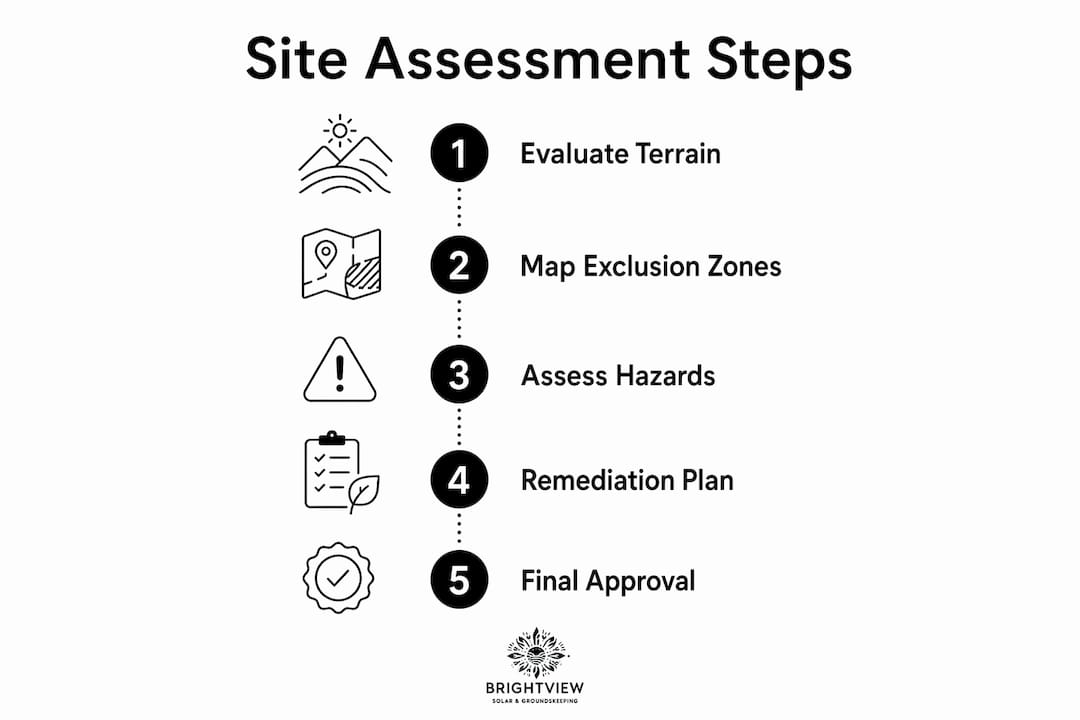
| Site factor | Assess for | Rating options | Typical remediation |
|---|---|---|---|
| Terrain grade | Slopes exceeding machine-rated angle | Suitable / Mitigatable / Unsuitable | Regrade or exclude zone |
| Pedestrian flows | Peak foot traffic times and crossing points | Suitable / Mitigatable / Unsuitable | Timed scheduling, signage, physical barriers |
| Vehicle access | Shared driveways, loading zones, car parks | Suitable / Mitigatable / Unsuitable | Exclusion zone fencing, scheduling windows |
| Drainage and retention | Wet ground, ponding, irrigation heads | Suitable / Mitigatable / Unsuitable | Drainage works, sensor calibration |
| Solar array layout | Row spacing, cable runs, panel edge clearance | Suitable / Mitigatable / Unsuitable | Adjust cleaning path mapping |
| Public interface points | Boundary fences, footpaths, public access gates | Suitable / Mitigatable / Unsuitable | Lockable perimeter, signage |
| Vegetation and debris | Dense canopy, leaf litter, sticks, mulch | Suitable / Mitigatable / Unsuitable | Pre-clear schedule, obstacle mapping |
For exclusion zone mapping, mark geofence boundaries in the machine’s control software to match physical perimeter fencing. Any zone rated “Unsuitable” should be excluded from autonomous operation entirely until remediation is confirmed. Consistent exterior maintenance and safety across all site zones reduces cumulative trip and access hazards that autonomous equipment can expose if left unmanaged.
How do you integrate robotics into your existing maintenance workflows?
Treat this as an operational infrastructure upgrade, not a hardware swap. The machines are the easy part; the workflow redesign is where most pilots succeed or stall.
- Pilot planning: select one or two zones that score “Suitable” on the site assessment; define KPIs before the machine arrives
- Stakeholder briefing: notify tenants, staff, and any relevant contractors about operating hours, exclusion zones, and who to contact if they have concerns
- Staff retraining: shift crews toward higher-value horticultural tasks — edging, detailing, plant health — rather than routine mowing or cleaning runs
- Mapping and commissioning: complete boundary mapping, geofence setup, and a witnessed test of all emergency stop functions
- CMMS integration: connect mower or cleaner telemetry to your facility management system so uptime, service history, and area coverage become measurable asset data
- Continuous improvement loop: review telemetry weekly in the first month, monthly thereafter; adjust scheduling based on incident logs and tenant feedback
Assign a dedicated internal owner for the robotic fleet. This person manages firmware updates, telemetry review, vendor coordination, and escalation. “Set and forget” is the most common failure mode in robotic deployments. Robotic mowers operating at ultra-low decibel levels also open up off-hours scheduling windows that reduce noise complaints at schools and aged-care sites without adding labour costs.
Pro Tip: Integrating mower telemetry with your CMMS turns routine maintenance into asset management data. Uptime, service history, and predictive maintenance signals become measurable financial inputs — which accelerates the ROI conversation with your finance team.
What are your WHS and insurance obligations in Australia?
Under Australia’s model Work Health and Safety laws, managed by Safe Work Australia, you retain a duty of care for plant and equipment operated on your site — including autonomous machines supplied by a contractor. That duty does not transfer to the vendor.
What this means in practice: your WHS obligations require you to verify that any autonomous landscaping equipment is fit for purpose, that risks have been assessed, and that controls are in place before operation begins. Supplier safety packs are not optional — they are part of your due diligence record.
Documents to request at procurement:
- Third-party safety certifications and test reports
- Supplier risk assessment specific to your site type
- Maintenance schedule and spare-parts commitment
- Incident logs from comparable deployments
- Operator training records for any personnel managing the fleet
Contract clauses to include: clear liability and indemnity boundaries, SLA for incident response time, and explicit data ownership terms covering telemetry access for your own WHS audits. Ask suppliers to reference applicable Australian Standards in their safety documentation — and treat a supplier who cannot do so as a risk flag.
What does a realistic rollout timeline look like?
Robotic mowing ROI typically becomes favourable after an initial setup period once mapping costs are absorbed. Plan your procurement cycle around that curve.
| Stage | Duration | Key milestones |
|---|---|---|
| Feasibility and site survey | 4 weeks | Site assessment scored, WHS evidence received, service model selected |
| Pilot deployment | 3–6 months | Machines commissioned, KPIs tracked, staff retrained |
| Pilot evaluation | 4–6 weeks | Area covered, incident count, noise profile, uptime, labour hours reallocated reviewed |
| Scaled deployment | 6 months | Additional zones onboarded, CMMS integration live, contract reviewed |
Service model options:
- In-house ownership: full control, higher upfront capital, requires internal technical capability
- Vendor-managed fleet: lower capital commitment, supplier handles maintenance, less operational flexibility
- Hybrid managed service: internal owner coordinates with a service partner like Brightview Solar & Groundskeeping for maintenance, updates, and incident response — the most common model for mid-to-large Australian commercial sites
For solar farms specifically, autonomous cleaning platforms can reduce required onsite personnel significantly compared with manual or tractor-mounted approaches, with remote supervision handling fleet oversight.
How do you manage risk and respond to incidents?
Immediate safeguards to have in place before go-live:
- Physical exclusion during any public events or high-pedestrian periods
- Lockable perimeter gates with signage meeting site safety standards
- Tested remote kill switch accessible to the internal fleet owner
- Emergency stop procedure documented and communicated to all site staff
Incident response checklist:
- Activate emergency stop and secure the scene
- Record telemetry data immediately — do not reset the machine before data is captured
- Notify the internal safety officer and the vendor within the SLA window
- Isolate the asset and log the incident with time-stamped vendor data
- File an insurance report and retain all telemetry records for audit
Maintenance protocols that prevent incidents from occurring: scheduled sensor calibration at manufacturer-specified intervals, firmware update windows with documented change logs, and preventive part replacement before wear thresholds are reached. Autonomous units upload logs and reports automatically, which makes compliance evidence far easier to produce than with traditional manual maintenance records.
Pro Tip: Include telemetry retention periods and automated alert thresholds in your SLA before signing. If an incident occurs, time-stamped telemetry is your strongest defence in both a WHS investigation and an insurance claim.
Key takeaways
Robotic safe access landscaping on Australian commercial sites is viable and WHS-compliant when you require engineered safety features, appoint an internal owner, and run a scored pilot before scaling.
| Point | Details |
|---|---|
| Require engineered safety evidence | Demand third-party certifications, redundant sensors, and geofencing before any machine is commissioned. |
| Appoint a dedicated internal owner | “Set and forget” fails; one person must own telemetry, firmware updates, and vendor coordination. |
| Run a scored pilot first | Use the site assessment table to rate zones and track KPIs for 3–6 months before scaling. |
| Integrate telemetry with your CMMS | Connecting machine data to your facility system turns maintenance into measurable asset performance. |
| Brightview Solar & Groundskeeping | Offers robotic mowing, autonomous solar cleaning, and managed maintenance contracts with documented WHS processes for Australian commercial sites. |
The case for treating robotics as infrastructure, not equipment
The framing that holds most facilities teams back is thinking of a robotic mower or solar cleaner as a piece of equipment you buy and deploy. It is not. It is an operational system that requires mapping, governance, staff realignment, and ongoing data management to deliver its value. The teams that get the most from autonomous landscaping are the ones that redesign workflows around the machine’s capabilities rather than bolting it onto existing routines.
The sustainability case is also stronger than most procurement briefs acknowledge. Quieter operations, zero direct emissions during mowing, predictable maintenance intervals, and reduced contractor reliance all contribute to ESG reporting in ways that traditional grounds contracts cannot. That is a conversation worth having with your finance and sustainability leads before the next contract renewal, not after.
Brightview Solar & Groundskeeping: request a site assessment or pilot
Commercial grounds and solar assets maintained by autonomous systems perform more consistently, with lower safety exposure and better compliance records than sites relying on traditional crews alone. Brightview Solar & Groundskeeping delivers that outcome through robotic mowing, autonomous solar panel cleaning, and managed maintenance contracts designed for Australian commercial and industrial properties.
The engagement model is straightforward: a site survey to score suitability, a scoped pilot with defined KPIs, and a path to scaled deployment with full telemetry access and documented WHS processes. Brightview Solar & Groundskeeping also provides safety packs covering certifications and maintenance schedules at procurement, so your compliance records are complete from day one. For solar-specific requirements, the solar panel cleaning robot options cover everything from rooftop arrays to utility-scale farms. Contact Brightview Solar & Groundskeeping to book a site assessment and get a pilot scoped for your property.
Useful Australian sources and templates
- Safe Work Australia: model WHS legislation, codes of practice, and plant and equipment guidance — the primary reference for any autonomous equipment deployment
- CSIRO autonomous robot trials near Dubbo: field trial evidence for AI-equipped robots on Australian solar farms, including LiDAR, thermal imaging, and fault detection capability
- Solar Energy Robotics Australia (SERAUS): Australian supplier of autonomous solar cleaning robots with mining-sector field history and HSE risk elimination documentation
- Verdion Vanguard PV Cleaning Robot: Australia’s first fully unmanned self-charging solar cleaning robot; useful as a capability benchmark when scoping solar cleaning tenders
- Green by Nature and RC Mowers case study: Australian commercial deployment example at Essendon Fields, Victoria — practical evidence for workflow redesign and crew reallocation outcomes
- Supplier document templates to request: site-specific risk assessment, maintenance schedule, incident log format, operator training records, and telemetry data retention policy
- Brightview Solar & Groundskeeping site assessment template: contact Brightview to request a procurement checklist and site assessment template tailored to Australian commercial properties
FAQ
Is robotic landscaping equipment legally compliant under Australian WHS law?
Autonomous landscaping equipment can be deployed compliantly under Australia’s model WHS laws, provided the duty holder verifies the plant is fit for purpose, risks are assessed, and controls are documented before operation. Safe Work Australia’s plant and equipment guidance sets the baseline requirements.
What certifications should I request from a robotic mowing or cleaning supplier?
Ask for CE Machinery Directive compliance, EN 18031 RED cybersecurity certification, and any ETL marks, plus a site-specific risk assessment and maintenance schedule. Third-party certification documents carry more weight than vendor self-declarations.
How long before robotic landscaping delivers a return on investment?
Robotic mowing ROI typically becomes favourable by year two, once initial mapping and commissioning costs are absorbed. Solar cleaning returns can arrive sooner where soiling-driven yield losses are significant.
Can Brightview Solar & Groundskeeping manage the full deployment?
Yes. Brightview Solar & Groundskeeping handles site assessment, pilot scoping, robotic mowing, autonomous solar cleaning, and ongoing managed maintenance contracts, with safety packs and telemetry access included.
Which Australian site types are best suited to autonomous landscaping?
Large open turf areas, steep embankments, sports fields, solar farms, aged-care grounds, and school campuses consistently deliver the strongest results. Dense tree canopy zones and obstacle-heavy areas are less efficient and should be assessed individually.

