
A robotic lawn mowing service is defined as an autonomous, app-controlled mowing system that cuts your grass on a regular schedule without you lifting a finger. Unlike a traditional mow-and-go visit, these services use AI-guided mowers that work continuously, trimming little and often for measurably healthier turf. A University of Florida 2026 study found that autonomous mowers produce denser, more disease-resistant lawns compared to conventional weekly mowing. That result alone is changing how Australian homeowners and property managers think about lawn care automation. Brightview Solar & Groundskeeping has built its entire groundskeeping model around this technology, bringing professional-grade robot lawn mowing to residential and commercial properties across Australia.
What does a robotic lawn mowing service require before you start?
Getting the most from automated lawn care starts well before the mower takes its first pass. Your property needs to meet a few clear conditions, and skipping this step is the most common reason homeowners run into problems.
Lawn size and terrain
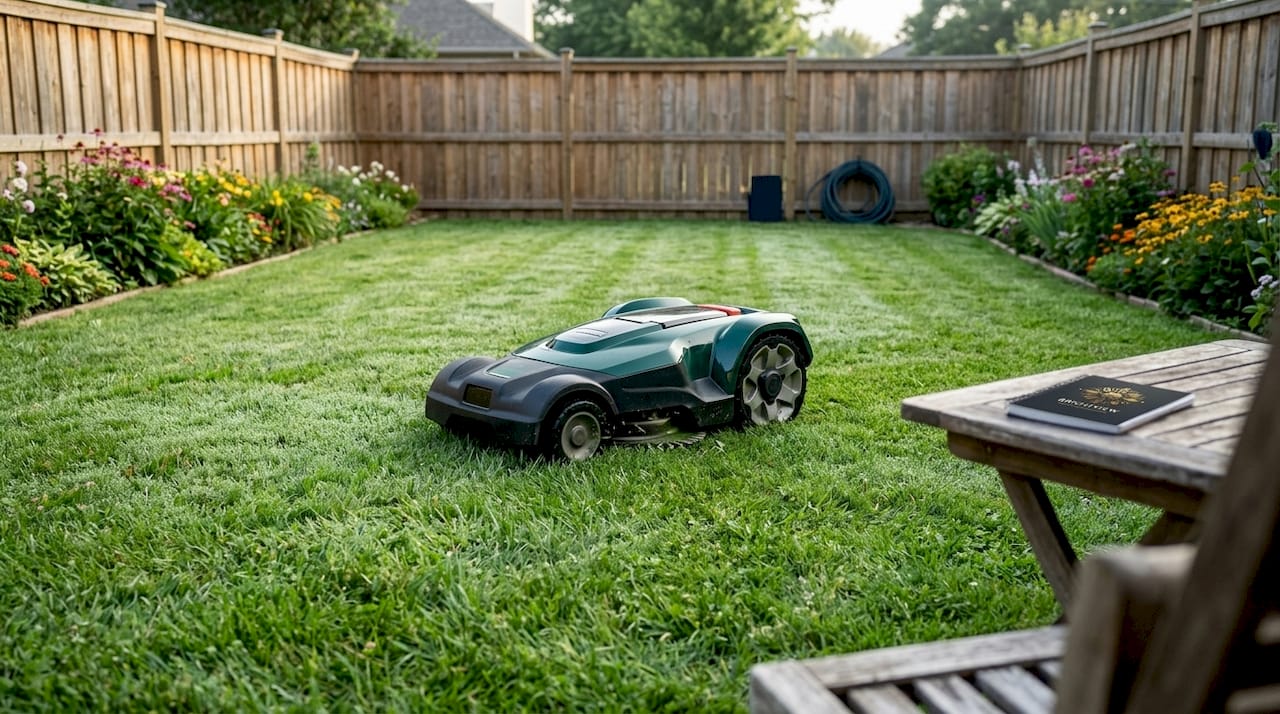
Wire-free robotic mowers work best on flat to moderately sloped ground. Slopes above 18 degrees exceed the operational limits of most models, so steep banks or terraced gardens need a manual alternative. Measure your slope before committing to a service.
Grass type and height
Not every grass variety suits robotic mowing. Couch, kikuyu, and buffalo grasses common across Australia generally respond well. Zoysia and St. Augustine varieties can present challenges because of their density and growth habit. Grass must also be under 9 cm tall before the mower begins. If your lawn has been neglected, a manual cut first is not optional.
Physical setup requirements
Clear the lawn of stones, toys, garden furniture, hoses, and pet waste before each session. The base station needs a flat, sheltered surface with a straight exit path so the mower can dock and undock cleanly. A stable Wi-Fi or 4G connection at the station location is non-negotiable for remote scheduling and monitoring.
Here is a quick checklist before your first run:
- Slope confirmed at 18 degrees or less
- Grass cut to below 9 cm manually if overgrown
- Lawn cleared of all obstacles and debris
- Base station positioned on flat ground with a clear path
- Wi-Fi or 4G signal confirmed at the station location
- Smartphone app downloaded and account created
- Fire ant treatment applied near the docking station if relevant to your region
| Prerequisite | Requirement |
|---|---|
| Maximum slope | 18 degrees |
| Maximum grass height before start | 9 cm |
| Connectivity | Stable Wi-Fi or 4G |
| Base station surface | Flat, sheltered, clear exit path |
| Obstacle clearance | Full lawn clear before each session |
Pro Tip: Treat the area around your docking station for fire ants before installation. Fire ant mounds near docking stations can damage equipment and disrupt charging cycles, particularly in warmer parts of Queensland and New South Wales.
How does a robotic lawn mowing service work step by step?
Understanding the process removes the mystery and helps you get the best results from day one.
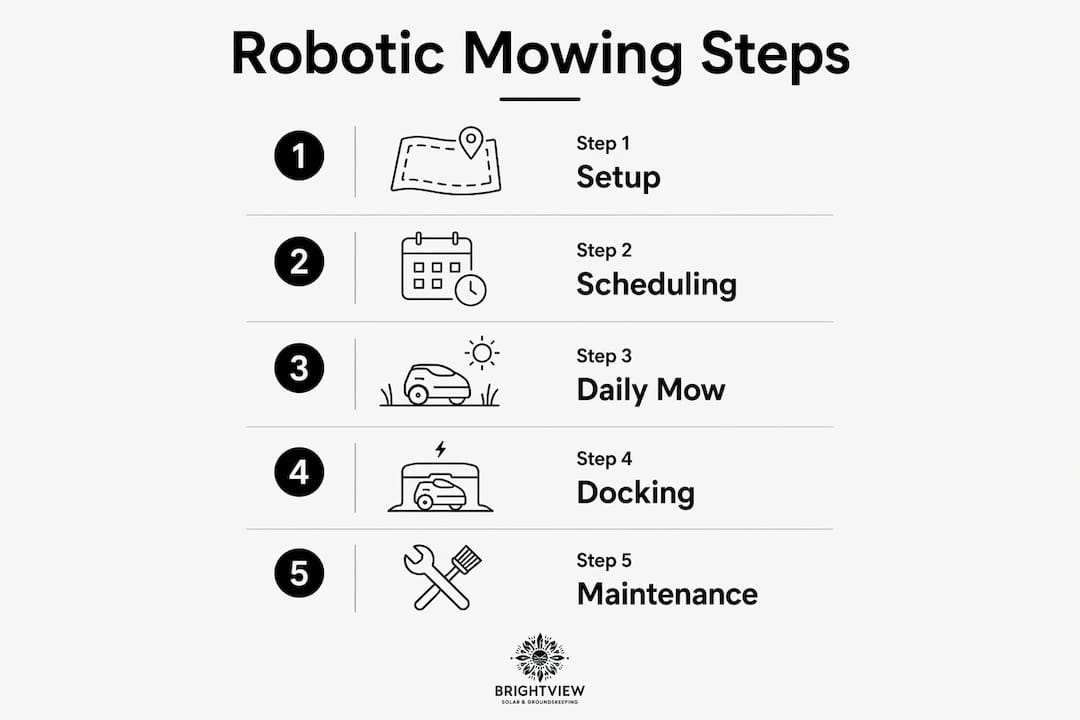
Position the base station. Place it on flat ground near a power outlet, with a clear, straight path onto the lawn. The station is where the mower charges between sessions and returns to in bad weather.
Connect power and network. Plug in the station and connect it to your home Wi-Fi or a 4G SIM. Stable connectivity is what allows remote scheduling, status alerts, and software updates to reach the mower.
Map the lawn. Modern wire-free mowers use AI vision or GPS to map your property on the first run. No boundary wire is needed. The mower builds a digital map of your lawn, including obstacles it detects along the way.
Set your schedule. Use the smartphone app for scheduling and zone management. You can set mowing times, define no-go zones around garden beds or water features, and adjust cutting height for each area.
Let the mower run. The mower navigates using its onboard sensors, avoiding obstacles and adjusting its path in real time. For complex properties, multi-zone mowing lets it handle separate lawn areas in sequence.
Monitor via the app. Check mowing progress, battery status, and any alerts from your phone. Most systems send a notification if the mower gets stuck or is lifted unexpectedly.
Automated charging and resumption. When the battery runs low, the mower returns to the base station, charges, and then resumes exactly where it left off. You do not need to intervene.
Adjust as needed. Tweak cutting height, no-go zones, and schedules through the app as seasons change and grass growth rates shift.
The shift from weekly heavy mowing to daily light mowing is the core operational change that makes robotic mowing work. The mower clips only a small amount each pass, which naturally mulches the clippings back into the soil and feeds the lawn without any extra effort.
Pro Tip: Schedule mowing for early morning on weekdays. Robotic mowers operate at around 59 dB, which is quieter than a normal conversation, so they rarely disturb neighbours. Early sessions also mean the lawn looks its best by the time you get home.
What are the most common problems with robotic mowing services?
Every technology has its limits, and robotic grass cutters are no exception. Knowing what to expect means you can fix issues quickly rather than letting them affect your lawn quality.
Tall or neglected grass is the most frequent problem. Robotic mowers cannot handle overgrown lawns. If the grass exceeds 9 cm, manual intervention is required before the autonomous system can take over. Think of the mower as a maintenance tool, not a rescue tool.
Obstacles left on the lawn cause the mower to stop, reroute, or get stuck. Stones, fallen branches, pet toys, and garden hoses are the usual culprits. A quick five-minute lawn check before each scheduled session prevents most of these issues.
Connectivity drops interrupt scheduling and remote monitoring. If your Wi-Fi signal is weak at the base station, a Wi-Fi extender or a dedicated 4G SIM subscription solves the problem. The mower will still complete its current session, but you lose remote control until the connection restores.
Rain and low-light conditions trigger an automatic recall. The mower returns to base when it detects rain or insufficient light, which protects both the equipment and your lawn. This is a feature, not a fault. Reschedule the session for the next suitable window.
Robotic mowers are maintenance tools, not recovery tools. A lawn that has been allowed to grow well past 9 cm needs a manual cut first. Once the mower takes over regular maintenance, that situation rarely repeats itself.
Seasonal adjustments matter more than most owners expect. Grass grows faster in spring and summer, so you may need to increase mowing frequency or lower the cutting height slightly. In winter, many Australian lawns slow dramatically, and you can reduce sessions or pause the schedule entirely.
Routine maintenance tasks keep the mower performing well:
- Sharpen or replace blades every 1–3 months depending on lawn size
- Clear debris from the undercarriage after each session
- Wipe sensors clean to maintain accurate obstacle detection
- Apply software updates via the app as they become available
What benefits do homeowners and property managers get from robotic mowing?
The case for lawn care automation is stronger than most people realise before they try it.
Healthier turf is the headline benefit. Frequent, light clipping keeps grass at a consistent height and mulches fine clippings back into the soil. The University of Florida study confirmed that this approach produces denser, more disease-resistant turf compared to traditional weekly mowing. Denser turf also crowds out weeds naturally.
Time savings are real and immediate. Once the system is set up and scheduled, your involvement drops to occasional checks and minor maintenance. Property managers overseeing multiple sites find this particularly valuable, as one person can monitor several lawns remotely through a single app.
Quieter, cleaner operation sets robotic mowers apart from petrol alternatives. At around 59 dB, they produce far less noise than a standard petrol mower. They also produce zero direct emissions during operation, which matters for properties near schools, hospitals, or noise-sensitive neighbours.
Consistent appearance is another clear advantage. Because the mower runs on a fixed schedule, the lawn never reaches the shaggy, uneven state that comes from skipping a weekly mow. Edges and defined zones stay tidy through the app’s no-go zone settings.
Cost over time compares favourably to traditional lawn care services. Robotic mowing reduces manual labour and eliminates the fuel and transport costs associated with regular contractor visits. The upfront investment in equipment and setup pays back through reduced ongoing service fees.
- Denser, pest-resistant turf through daily light mowing
- Significant time savings for homeowners and property managers
- Quiet operation at approximately 59 dB
- Zero direct emissions during mowing
- Consistent lawn appearance without manual scheduling
- Remote monitoring and control via smartphone app
Key takeaways
A robotic lawn mowing service delivers healthier turf, genuine time savings, and lower emissions by replacing infrequent heavy cuts with daily, automated light mowing.
| Point | Details |
|---|---|
| Lawn preparation is non-negotiable | Cut grass to below 9 cm manually before the robotic mower begins its first session. |
| Slope limits apply | Robotic mowers operate reliably on slopes up to 18 degrees; steeper terrain needs a different solution. |
| Frequent light mowing improves turf | Daily clipping produces denser, more disease-resistant grass than weekly heavy mowing. |
| App control is central to the service | Scheduling, no-go zones, and real-time monitoring all run through the smartphone app. |
| Routine maintenance keeps performance consistent | Blade sharpening, sensor cleaning, and software updates prevent most common issues. |
What I have learned from working with robotic mowing every day
The technology works. That is the short version. The longer version is that the biggest barrier to success is not the mower itself. It is the lawn preparation that owners skip because they assume the machine will handle everything from day one.
At Brightview Solar & Groundskeeping, we have seen the same pattern repeatedly. A property owner installs the system on a lawn that has not been cut in weeks, the mower struggles or stops, and they conclude the technology is unreliable. The mower was never designed to rescue an overgrown lawn. It is designed to maintain a lawn that is already in reasonable shape.
Once that first manual cut is done and the schedule is running, the results speak for themselves. Lawns that used to look patchy and uneven between weekly visits start looking consistently good within a few weeks. The mulching effect from daily light clipping genuinely feeds the turf. You can see the difference in colour and density within a month.
My honest advice: treat the setup week as seriously as you would treat any other home improvement project. Get the lawn to the right height, clear the obstacles, confirm your connectivity, and spend an hour learning the app before you hand control to the mower. After that, the system genuinely does run itself.
The technology will keep improving. Wire-free mapping is already far better than it was two years ago, and AI obstacle detection has reduced stuck-mower incidents significantly. For Australian homeowners dealing with large blocks, irregular shapes, or multiple lawn zones, this is the direction lawn care is heading.
— BrightView
Brightview Solar & Groundskeeping: robotic lawn care for Australian properties
Brightview Solar & Groundskeeping brings professional robotic lawn mowing to homeowners and property managers across Australia, handling everything from initial setup and lawn mapping to ongoing service and maintenance.

Every engagement includes base station installation, connectivity setup, app configuration, and a first-session walkthrough so you know exactly how the system operates. Brightview Solar & Groundskeeping’s team also handles the initial manual cut where needed, so your lawn is ready for autonomous maintenance from day one. The result is a consistently healthy, well-presented lawn without the time cost of traditional lawn care. To find out what a robotic lawn care service from Brightview Solar & Groundskeeping looks like for your property, visit the website and get in touch with the team directly.
FAQ
What is a robotic lawn mowing service?
A robotic lawn mowing service uses autonomous, app-controlled mowers to cut your grass on a regular schedule without manual effort. The mower navigates, charges, and resumes automatically, maintaining your lawn through frequent, light clipping.
How steep can my lawn be for robotic mowing?
Most robotic mowers operate safely on slopes up to 18 degrees. Terrain steeper than this exceeds the operational limits of standard models and requires a different approach.
Does the mower work in the rain?
Robotic mowers automatically return to their base station when rain or low-light conditions are detected. This protects the equipment and prevents damage to wet turf.
How often does a robotic mower need maintenance?
Blades need sharpening or replacement every 1–3 months depending on lawn size and usage. Sensors should be wiped clean regularly, and software updates applied through the app as they are released.
Can a robotic mower handle an overgrown lawn?
Robotic mowers cannot start on grass taller than 9 cm. An initial manual cut is required to bring the lawn to a manageable height before the autonomous system takes over regular maintenance.

