
Robotic lawn mower safety is defined as the combination of built-in sensor technology, internationally recognised design standards, and responsible owner practices that together minimise injury and operational risk. Modern autonomous mowers comply with IEC 60335-2-107, the primary international standard that mandates documented testing of obstacle detection distance and emergency stop response times. Advanced sensors including LiDAR, ultrasonic detectors, and AI vision systems underpin safe operation. Owners must actively maintain and correctly install their mowers. Brightview Solar & Groundskeeping works with Australian homeowners and property managers who want to get this balance right from day one.
What are the key safety features of robotic lawn mowers?
Robotic mowers are safer than traditional petrol mowers by design, not by accident. Every credible model on the market builds multiple redundant safety systems into its hardware and software. Understanding what those systems do helps you assess whether your mower is working as it should.
Lift and tilt sensors
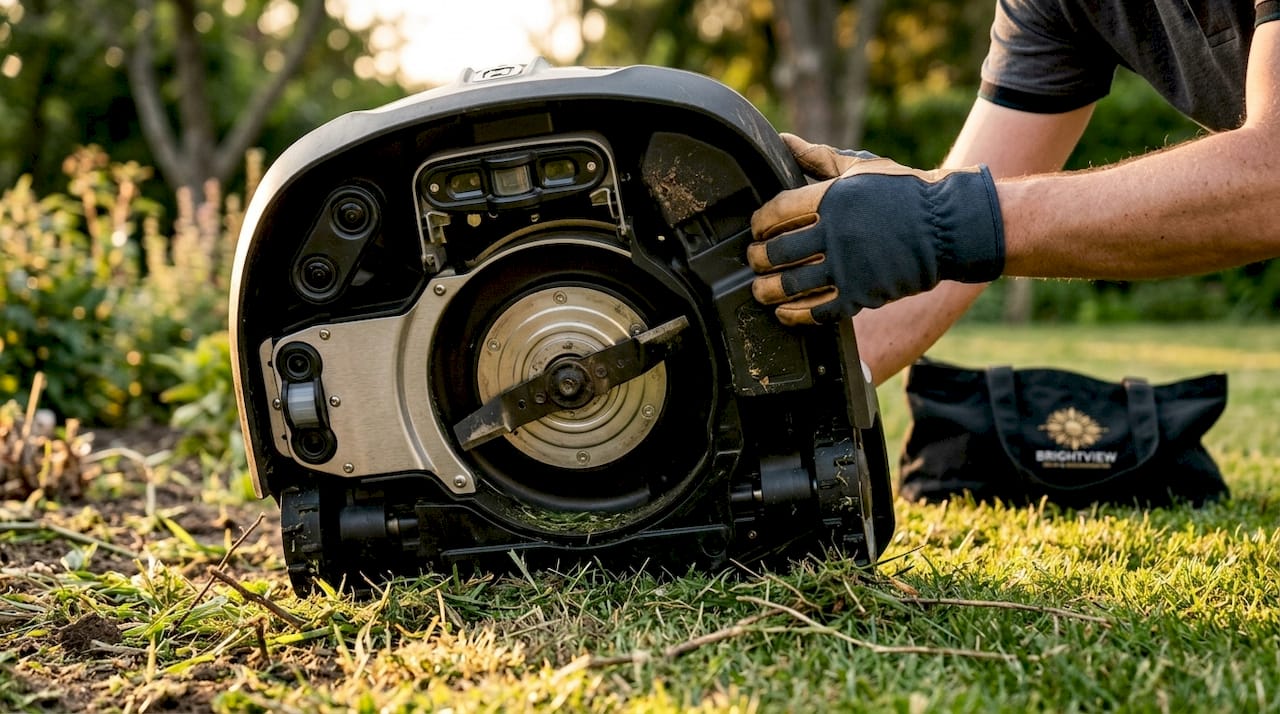
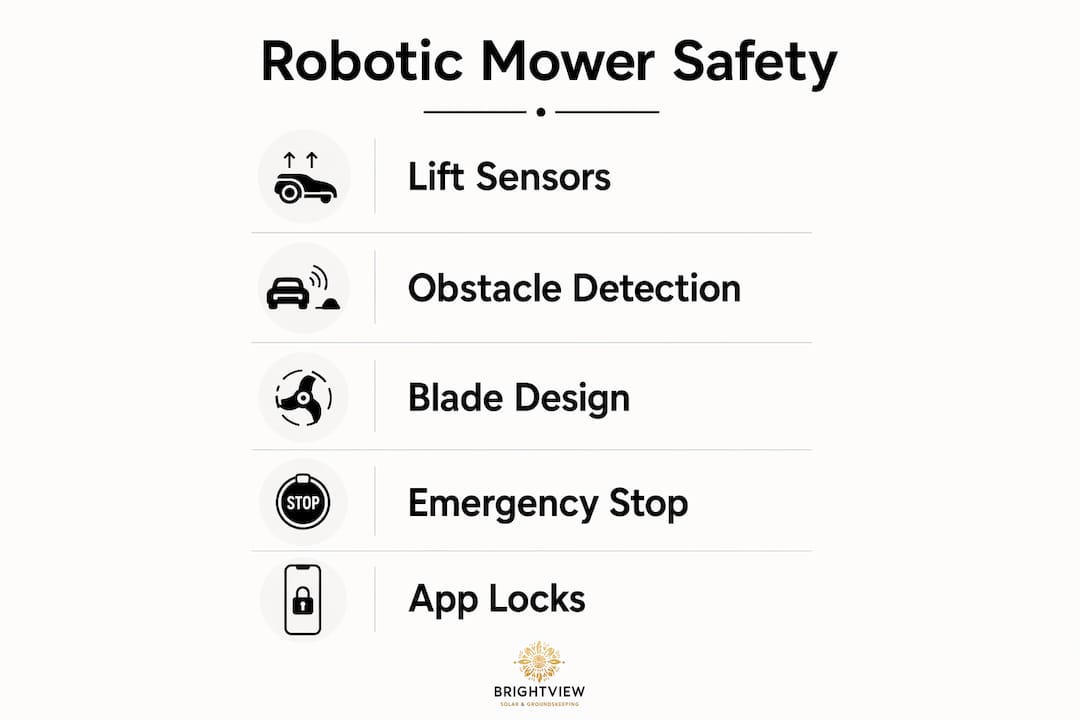
Lift and tilt sensors stop the blades within milliseconds when the mower is picked up or tips sideways. That response time is fast enough to prevent contact injuries in most real-world scenarios. The sensor triggers a full blade shutoff, not just a speed reduction. This single feature is responsible for preventing the majority of hand and foot injuries associated with robotic mowers.
Obstacle detection systems
Modern robomower safety features rely on layered detection. Entry-level models use bump sensors that react on contact. Mid-range units add ultrasonic sensors that detect objects at a short distance before impact. Advanced models integrate AI vision cameras and multi-sensor fusion to identify pets, children, and irregular terrain in real time. No single sensor type is infallible, which is why layered systems matter.
Blade design
Robotic mower blades are recessed inside the body and significantly smaller than traditional rotary blades. They cut grass through high-speed rotation across a narrow arc, not a wide sweep. This design limits the energy transferred in any accidental contact. The blades are also designed to pivot or break away on hard impact, reducing the force directed at an obstruction.
Emergency stop
Emergency stop features activate within milliseconds during a hazard event. Most models include a physical button on the unit and a remote stop function through a companion app. The app-based stop is particularly useful when you spot a hazard from a window and cannot reach the mower quickly.
Pro Tip: Test your mower’s lift sensor monthly by picking the unit up during operation. The blades should stop before your hand reaches the underside. If there is any delay, contact the manufacturer immediately.
Key safety precautions for robotic mowers also include:
- Checking that the emergency stop button is accessible and unobstructed before each mowing session
- Confirming the app connection is active so remote stop functions are available
- Reading the model-specific safety manual, as sensor configurations vary between units
How should you install and operate a robotic mower safely?
Correct installation is the most overlooked aspect of robot lawn mower precautions. A mower with excellent sensors will still cause problems if the boundary is set up incorrectly or the charging station is placed in the wrong spot.
Install the boundary correctly. Whether your mower uses a physical perimeter wire or virtual GPS mapping, the boundary must account for water features, garden beds, steep inclines, and any area where the mower should not travel. Physical barriers reduce accidents where virtual mapping may fail, particularly on complex terrain. Add buffer zones of at least 0.5 metres around hazards like ponds and retaining walls.
Place the charging station correctly. The charging station requires 60 cm to 1 m clearance on all sides to prevent overheating and electrical shorts during docking. Place it on a flat, dry surface away from direct sun exposure. Never position it under a deck or in an enclosed space where heat cannot dissipate.
Avoid wet conditions. Operating a robotic mower on wet grass reduces traction and degrades sensor accuracy. Moisture can also enter sensor housings over time, causing navigation errors. Schedule mowing for dry periods, particularly relevant during Australia’s summer storm season.
Avoid operating at dusk or overnight. Operating mowers at dusk or overnight increases risk to nocturnal wildlife. Animals like possums and echidnas may freeze under threat and are not reliably detected by standard sensors. Set your schedule to daylight hours only.
Schedule around children and pets. App scheduling and child locks increase safety control significantly. Set mowing windows when children are at school and pets are indoors. Use PIN locks or child locks in the app to prevent unauthorised operation.
Clear the lawn before each session. Remove toys, hoses, branches, and any debris before the mower starts. Dense grass can hide obstacles that even advanced sensors miss. A two-minute walk of the lawn before mowing prevents the majority of stuck-mower incidents.
What maintenance keeps a robotic mower safe?
Routine maintenance is not optional. Neglecting maintenance leads to sensor malfunction and increased collision risk, which means a well-designed mower can become a hazard simply through neglect.
Key maintenance tasks include:
- Replace blades every 6–8 weeks depending on lawn size and grass type. Blunt blades increase motor load and reduce cutting quality, but more critically, they can cause the mower to push rather than cut through obstacles.
- Inspect and clean cameras and sensors regularly. Grass clippings, mud, and spider webs accumulate on sensor housings. A blocked ultrasonic sensor reads as clear space, which defeats the purpose of the detection system entirely.
- Use only manufacturer-approved batteries and chargers. Third-party batteries can deliver inconsistent voltage, which shortens battery life and, in rare cases, creates fire risk at the charging station.
- Switch the mower off before any maintenance. Never clean blades or inspect the underside with the mower powered on. The lift sensor stops blades during normal operation, but it does not activate when the mower is stationary on a flat surface.
- Check cables and connectors for wear. Perimeter wire damage is a leading cause of boundary failures. Inspect the full wire run after heavy rain or any garden work near the boundary.
Pro Tip: Keep a maintenance log with the date of each blade replacement and sensor clean. This makes it easy to spot when a service interval has been missed and gives you a record if a warranty claim becomes necessary.
How do you handle common safety challenges?
Even well-installed mowers encounter problems. Knowing how to respond quickly reduces the risk of injury or equipment damage.
Robotic mower safety is a layered concept combining technology, design, and user behaviour. No single feature makes a mower risk-free. Human vigilance remains the most reliable safety layer, regardless of how advanced the onboard systems are.
AI assists safety but is not infallible. Owners who treat their mower as fully autonomous and walk away permanently are the ones most likely to encounter avoidable incidents.
When the mower stops unexpectedly
A mower that stops mid-session has detected a problem. Check the app for an error code before approaching the unit. Common causes include a lifted wheel on uneven ground, a blocked sensor, or a boundary signal interruption. Never restart the mower without identifying the cause first.
Managing pets safely
Pets require an acclimation period to robotic mowers and should be physically separated during operation. Dogs in particular may chase or bite the unit, which risks injury to the animal and damage to the mower. Advanced models detect pets using AI vision, but physical separation remains the safest approach. Introduce the mower to pets gradually while it is stationary before allowing unsupervised operation.
Managing children safely
Child safety with robotic mowers depends on both technology and supervision. Use the app’s PIN lock to prevent children from restarting the mower after it has been stopped. Create a clear household rule that no one approaches the mower while it is operating. For younger children, a physical fence or gate around the mowing zone provides a reliable barrier that no sensor failure can compromise.
Complex terrain and hidden obstacles
Dense grass and unclear boundary signals can hide obstacles that sensors miss. In areas with heavy ground cover or irregular terrain, create physical stay-out zones using garden edging or temporary fencing. This is particularly relevant for Australian properties with native garden beds, rock features, or sloped lawns.
The safety gap most owners miss
At Brightview Solar & Groundskeeping, we see the same pattern repeatedly. Owners invest in a well-specified mower with excellent sensors, read the quick-start guide, and assume the technology handles everything from that point forward. The mower runs for a few weeks without incident, and complacency sets in.
The safety gap is almost never the technology. It is the boundary installation that was done quickly on day one, the blade that has not been replaced in four months, or the mowing schedule that drifts into dusk because it is more convenient. Integrating app controls with physical safety measures offers the best defence against accidents, but only when both are actively maintained.
The nocturnal wildlife risk is one that Australian owners underestimate more than most. Possums, bandicoots, and echidnas are common in suburban gardens across the east coast. A mower running at 10 PM will encounter them. No current sensor system reliably detects a stationary echidna in long grass. Restricting operation to daylight hours costs nothing and eliminates that risk entirely.
Advancements in AI and LiDAR have genuinely improved safety outcomes over the past three years. But the owners who get the best results are the ones who treat their mower like any other piece of powered equipment: with respect, regular checks, and clear operating rules for everyone in the household.
— BrightView
Safe robotic mowing services from Brightview Solar & Groundskeeping
Brightview Solar & Groundskeeping provides professional robotic mower installation, safety assessments, and ongoing maintenance for Australian homeowners and property managers.

Every installation includes a full boundary setup with hazard buffer zones, charging station placement, and a hands-on walkthrough of the safety features specific to your model. Brightview Solar & Groundskeeping also offers scheduled maintenance visits covering blade replacement, sensor cleaning, and cable inspection, so your mower stays safe between seasons. If you want expert guidance on getting your robotic mower set up correctly from the start, visit Brightview Solar & Groundskeeping to request a safety assessment or book a consultation.
FAQ
What safety standard applies to robotic lawn mowers?
IEC 60335-2-107 is the primary international safety standard for robotic lawn mowers. It requires documented testing of obstacle detection distance and emergency stop response times.
How safe are robotic lawn mowers around children?
Robotic mowers include lift sensors, blade shutoff, and app-based child locks that significantly reduce injury risk. Physical supervision and PIN locks in the companion app provide the strongest protection for young children.
Is it safe to run a robotic mower at night?
Operating a robotic mower at night increases risk to nocturnal wildlife and reduces sensor accuracy in low-light conditions. Restricting operation to daylight hours is the safest practice for Australian gardens.
How often should robotic mower blades be replaced?
Blades should be replaced every 6–8 weeks depending on lawn size and grass conditions. Worn blades increase motor load and reduce the mower’s ability to respond correctly to obstacles.
What should I do if my robotic mower gets stuck?
Check the companion app for an error code before approaching the unit. Identify the cause of the stoppage, clear any obstruction, and confirm the boundary signal is intact before restarting the mower.
Key takeaways
Robotic lawn mower safety requires IEC 60335-2-107 compliance, layered sensor systems, correct installation, and consistent maintenance to remain effective over time.
| Point | Details |
|---|---|
| International standards matter | IEC 60335-2-107 sets mandatory testing requirements for obstacle detection and emergency stop response. |
| Sensors work in layers | Lift, tilt, ultrasonic, and AI vision sensors each cover different hazard types; no single sensor is sufficient alone. |
| Boundary installation is critical | Incorrect boundary setup is the leading cause of safety failures; always include buffer zones around hazards. |
| Maintenance prevents sensor failure | Replace blades every 6–8 weeks and clean sensors regularly to prevent navigation errors and collision risk. |
| Human oversight remains essential | App scheduling, child locks, and daylight-only operation reduce risks that technology alone cannot eliminate. |

