
Autonomous mowing systems built for commercial scale, commonly called robotic lawn mower farms, are now the practical choice for Australian property managers running large sites. These systems use GNSS-RTK positioning and sensor fusion technologies including LiDAR and stereo vision to mow precisely, repeatedly, and without a crew on the ground. The core advantages are clear:
- Precision at scale: centimetre-level navigation handles complex layouts, slopes, and irregular boundaries without manual intervention.
- Labour savings: automated lawn care removes the most repetitive groundskeeping tasks from your staffing equation.
- Environmental responsibility: micro-mulching returns fine clippings to the soil, reducing fertiliser demand and eliminating clipping disposal.
- Safety: machines work in hazardous or hard-to-access areas where sending a person creates risk.
- Integrated maintenance: robotic mowing pairs naturally with automated spraying and solar panel cleaning as part of a single site maintenance programme.
Brightview Solar & Groundskeeping delivers all three of these robotic services to commercial and industrial properties across Australia, including sites where terrain or access makes traditional groundskeeping impractical.
Table of Contents
- How robotic lawn mowers work on commercial farm sites
- Operational benefits that change how you run a site
- How to manage a robotic mower fleet effectively
- Safety, compliance, and what Brightview Solar & Groundskeeping brings to the table
- Cost and return on investment for robotic mowing on farms
- Real-world applications on Australian commercial sites
- Challenges and limitations worth knowing before you commit
- Brightview Solar & Groundskeeping: contracted robotic maintenance for your site
- Key takeaways
- FAQ
How robotic lawn mowers work on commercial farm sites
The technology inside an industrial robotic mower is what separates it from a residential unit. GNSS-RTK navigation delivers centimetre-level positioning accuracy, allowing machines to hold precise mowing lines even on slopes up to steep gradients considered challenging for many commercial mowers. That matters on solar farms, orchards, and embankments where uneven terrain is the norm, not the exception.
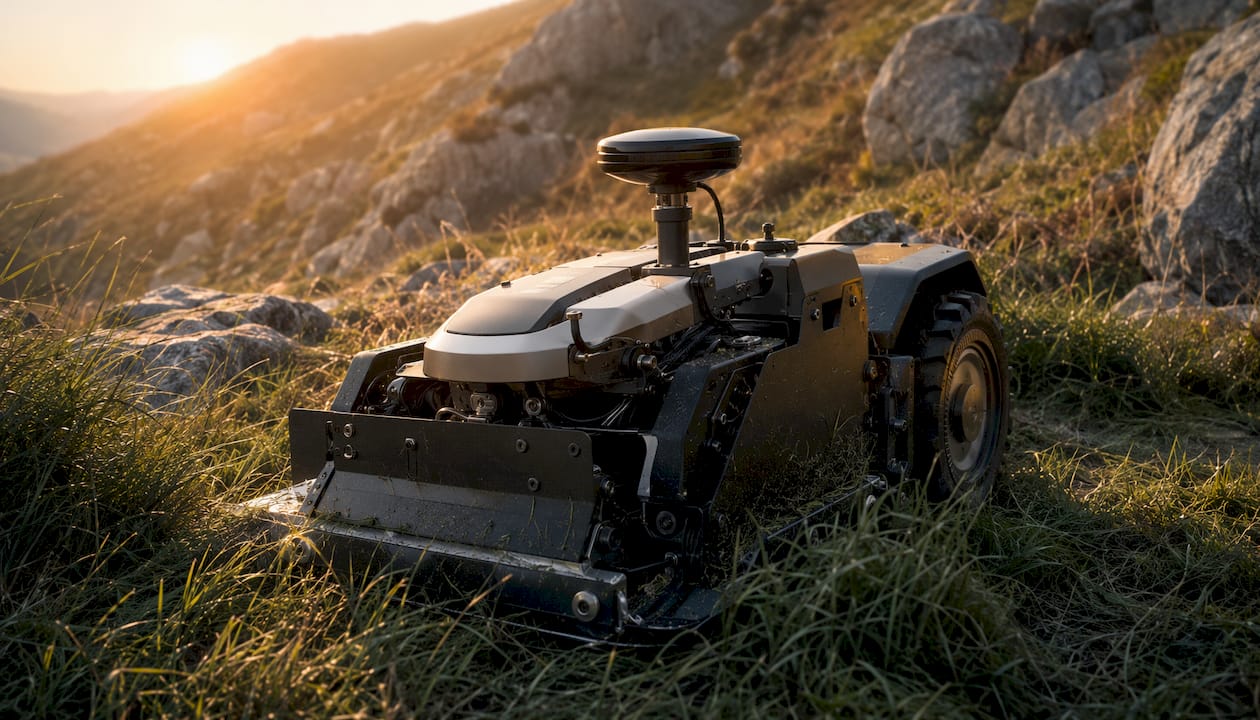
Sensor fusion is the other half of the equation. LiDAR, stereo vision, and ultrasonic sensors work together for live obstacle avoidance and edge cutting precision down to 3cm, which cuts manual trimming requirements significantly. Under tree canopy or near buildings where satellite signals weaken, hybrid navigation combining RTK with LiDAR and vision sensors keeps the machine on track.
Key operational parameters for commercial-grade units:
- Multi-map management: store and switch between multiple field or zone maps for large, complex properties.
- Wire-free operation: no perimeter wire installation or maintenance required.
- Remote monitoring: cloud-based platforms deliver real-time alerts, camera feeds, and performance data without on-site presence.
- Battery systems: exchangeable lithium iron phosphate (LiFePO₄) packs allow extended operation across large areas.
Operational benefits that change how you run a site
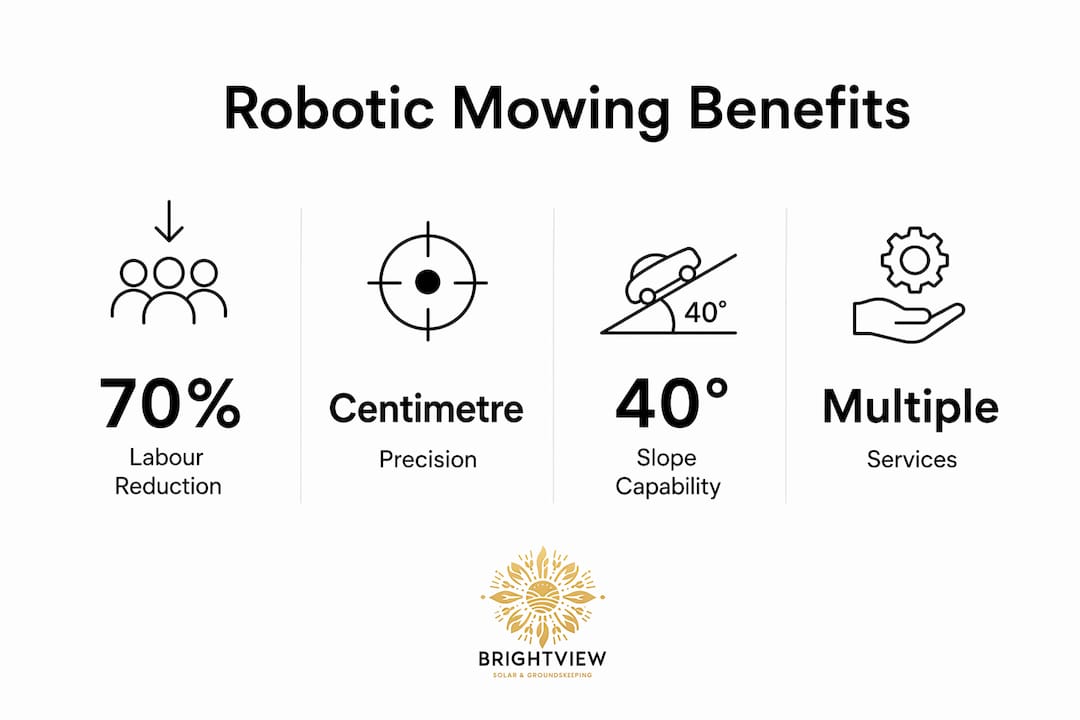
The headline figure is significant labour cost reduction through automating repetitive mowing cycles by automating repetitive mowing cycles. That is not just a cost saving. It frees your team to focus on tasks that actually require human judgement.
Turf health improves too. Robotic mowers cut frequently and remove only the tip of each grass blade. Micro-mulching returns fine clippings to the soil, reducing nitrogen demand and lowering turf stress compared to infrequent heavy cuts. On solar farms, this matters because dense, unmanaged grass reduces panel output.
The adaptability of commercial units across terrain types is worth noting:
- Steep embankments and terraced orchards where ride-on mowers are unsafe.
- Solar farm inter-row strips where precision matters and panel damage is a real risk.
- Industrial grounds with irregular layouts and mixed surface conditions.
Complementary robotic services for spraying and solar panel cleaning slot into the same maintenance programme, giving property managers a single contracted solution rather than coordinating multiple crews.
How to manage a robotic mower fleet effectively
Fleet performance starts before the machines arrive. A thorough site audit covering slope gradients, ground conditions, choke points, and accessibility gaps directly affects how well autonomous mowers perform. Clearing obstacles and uneven ground before deployment reduces machine rescues and downtime.
Once deployed, the work shifts to oversight rather than operation:
- Map updates: satellite and sensor data should be reviewed regularly to reflect site changes such as new infrastructure or seasonal vegetation growth.
- Scheduling: align mowing cycles with site activity, weather patterns, and grass growth rates.
- Troubleshooting: even well-configured systems encounter edge cases. Designating a staff member responsible for monitoring alerts keeps issues from compounding.
- Cloud monitoring: remote fleet oversight via real-time dashboards means you do not need someone on-site to know what every machine is doing.
Pro Tip: Adjust cutting height seasonally. Raising the blade height during dry Australian summers reduces heat stress on turf and extends blade life, while lowering it in cooler, wetter months keeps growth in check without bogging the machine.
Safety, compliance, and what Brightview Solar & Groundskeeping brings to the table
Commercial robotic mowers carry multiple safety systems as standard. Obstacle detection via LiDAR and stereo vision stops the machine before contact. Geofencing keeps units within defined boundaries. Anti-theft measures including GPS tracking and alarm systems protect the asset. Automatic shutoffs activate on tilt or lift, so blades stop the moment a machine is moved unexpectedly.
Australian property managers also need to consider compliance with relevant workplace health and safety obligations. Robotic systems reduce the number of workers exposed to mowing hazards, but the machines themselves must be operated and maintained within documented safety protocols. Staff training on monitoring, fault response, and scheduled maintenance is not optional. It is what keeps uptime high and incidents low.
Brightview Solar & Groundskeeping builds safety and environmental responsibility into every service contract. Their autonomous maintenance approach covers mowing, spraying, and solar panel cleaning with machines suited to difficult access areas, backed by published safety guides and operational protocols.
Cost and return on investment for robotic mowing on farms
The upfront cost of commercial robotic mowing equipment is higher than traditional alternatives. That is the honest starting point. But the return on investment calculation shifts quickly when you account for ongoing labour, fuel, and equipment maintenance costs that traditional mowing carries indefinitely.
Labour reductions of up to 70% are the primary driver. On a large commercial property requiring regular mowing cycles, that saving compounds over a contract term. Add reduced fertiliser spend from micro-mulching, lower fuel costs from electric operation, and the elimination of clipping disposal, and the total cost of ownership looks different from the purchase price alone.
For solar farm operators specifically, the ROI case includes panel output. Unmanaged vegetation reduces solar efficiency. Consistent robotic mowing keeps inter-row grass controlled without the scheduling gaps that come with crew-based maintenance.
Real-world applications on Australian commercial sites
Australian solar farms, orchards, and industrial properties are already running autonomous mowing programmes. The common thread across these sites is terrain complexity. Flat, simple sites are easy to manage with traditional equipment. It is the steep embankments, irregular layouts, and hard-to-access zones where robotic systems prove their value.
On solar farms, robotic mowers handle inter-row strips without risk of panel damage, operating on schedules that align with generation cycles. Orchards benefit from wire-free autonomous navigation that maintains accuracy under tree canopy, a known weak point for GPS-only systems. Industrial grounds with mixed surfaces and access restrictions suit the geofencing and multi-map capabilities of current commercial units.
Properties pairing robotic mowing with automated weed control and solar panel cleaning report the clearest operational gains, because the maintenance programme runs continuously rather than in reactive bursts.
Challenges and limitations worth knowing before you commit
No technology is without constraints, and commercial robotic mowing is no exception. Satellite signal degradation under dense canopy or near large metal structures remains a genuine issue. Hybrid navigation addresses it, but sites with extensive shading or complex infrastructure need careful system selection and mapping.
Initial setup takes time. Accurate site mapping, zone configuration, and staff familiarisation are not plug-and-play processes on a large commercial property. Budget for that commissioning period. Ongoing map maintenance is also required as sites change.
Very rough or waterlogged ground can exceed the terrain capability of some units. Machines rated for slopes up to 40 degrees (84% grade) handle most Australian agricultural terrain, but sites with extreme gradients or boggy conditions need a site-specific assessment before deployment. Artificial turf areas require a different approach entirely. If your property includes artificial turf sections, those zones need to be excluded from robotic mowing maps.
Brightview Solar & Groundskeeping: contracted robotic maintenance for your site
Property managers who want autonomous mowing without the capital outlay, commissioning complexity, or ongoing fleet management have a direct alternative. Brightview Solar & Groundskeeping contracts robotic mowing, spraying, and solar panel cleaning as a managed service for commercial and industrial sites across Australia.

The concrete difference from buying and running your own equipment: you get maintained, compliant, professionally operated machines without carrying the asset, the liability, or the training burden. Brightview Solar & Groundskeeping’s autonomous systems access difficult terrain safely, and their service contracts cover the full maintenance cycle. For solar farm operators, combining robotic mowing with panel cleaning under one provider removes a coordination headache entirely.
Get in touch with Brightview Solar & Groundskeeping to discuss a robotic mowing service contract for your property.
Key takeaways
Robotic lawn mower farm systems deliver up to 70% labour cost reduction, high precision mowing with centimetre-level accuracy as supported by advanced positioning, and measurable turf health improvements when deployed with proper site preparation and human oversight.
| Point | Details |
|---|---|
| Navigation precision | GNSS-RTK delivers centimetre-level accuracy on slopes up to 40 degrees (84% grade), with hybrid LiDAR support under canopy. |
| Labour savings | Automated mowing reduces labour costs by up to 70% compared to traditional crew-based groundskeeping. |
| Turf and soil health | Micro-mulching returns clippings to soil, reducing fertiliser demand and lowering turf stress. |
| Site preparation matters | Clearing choke points and conducting terrain audits before deployment directly reduces machine downtime. |
| Brightview Solar & Groundskeeping | Offers contracted robotic mowing, spraying, and solar panel cleaning for Australian commercial and industrial sites. |
FAQ
What is a robotic lawn mower farm?
A robotic lawn mower farm is a commercial-scale autonomous mowing system deployed across large properties such as solar farms, orchards, and industrial sites, using GNSS-RTK and sensor technologies for precision, wire-free operation.
How do robotic mowers handle steep slopes?
Industrial robotic mowers can operate on slopes up to 40 degrees (84% grade), using centimetre-level RTK GPS positioning combined with LiDAR and stereo vision sensors to maintain stability and accuracy on uneven terrain.
What labour savings can property managers expect?
Robotic mowing systems can reduce labour costs by up to 70% by automating repetitive mowing cycles, though human oversight for scheduling, mapping, and fault response remains necessary.
Does Brightview Solar & Groundskeeping offer robotic mowing as a managed service?
Yes. Brightview Solar & Groundskeeping provides contracted robotic mowing, spraying, and solar panel cleaning for commercial and industrial properties across Australia, including sites with difficult terrain or access constraints.
What are the main limitations of robotic mowers on large agricultural sites?
Satellite signal degradation under dense canopy, initial setup complexity, and terrain limitations on extremely rough or waterlogged ground are the primary constraints. Hybrid navigation systems and thorough site audits address most of these issues.

