
Manual landscaping, operator-steered commercial equipment, and smart irrigation systems are the three main robotic landscaping alternatives available to Australian commercial property managers in 2026. Each addresses different maintenance needs, but all carry limitations that autonomous solutions are increasingly designed to overcome. Labour shortages, rising fuel costs, and tighter environmental regulations are pushing the industry toward automation faster than most managers anticipated.
At a glance — the three main alternatives:
- Manual landscaping: Human crews handling mowing, trimming, and spraying. High labour dependency, physical risk, and inconsistent output.
- Operator-steered equipment: Stand-on mowers and ride-on machinery. Faster than manual crews but still fuel-intensive and operator-dependent.
- Smart irrigation systems: Automated water management using sensors and weather data. Efficient for water use but covers only one maintenance function.
Brightview Solar & Groundskeeping sits outside these categories entirely, deploying autonomous robotic machines for mowing, spraying, and solar panel cleaning across commercial and industrial sites.
Table of Contents
- What do robotic landscaping alternatives actually involve on a commercial site?
- How do smart irrigation systems fit as an automated garden solution?
- What robotic landscaping delivers beyond replacing labour
- How does cost-effectiveness compare across methods?
- Where has robotic landscaping proven effective in practice?
- What should you ask when choosing a robotic landscaping partner?
- Brightview Solar & Groundskeeping covers what alternatives cannot
- FAQ
- Key takeaways
What do robotic landscaping alternatives actually involve on a commercial site?
Traditional methods still dominate many Australian commercial properties, but their operational costs are climbing. Manual landscaping crews handle mowing, edging, chemical application, and general grounds upkeep. The work is physically demanding, and removing workers from hazardous outdoor tasks is increasingly a compliance priority under Australian workplace safety frameworks.
Operator-steered commercial equipment, particularly stand-on mowers, offers speed advantages on large open areas. However, these machines run on petrol or diesel, and electric robotic equipment is now preferred in commercial zones where noise and emissions limits apply.
Key drawbacks of traditional alternatives:
- Ongoing fuel and labour costs with no ceiling
- Operator fatigue and injury exposure
- Inconsistent output across large or complex sites
- Difficulty accessing steep slopes, solar arrays, or confined industrial areas
How do smart irrigation systems fit as an automated garden solution?
Smart irrigation is the most widely adopted landscaping automation system in Australian commercial properties today. These platforms use the FAO56 evapotranspiration standard combined with local climate data, soil moisture sensors, and plant-specific requirements to regulate water precisely. Users have reported significant water consumption reductions compared with manual watering schedules.
Smart irrigation integrates well with existing property management infrastructure and can connect to building management systems. For sites with artificial turf installation or mixed surface types, zoned controllers allow different watering profiles across a single property. The limitation is scope: irrigation automation handles water only, nothing else.
What robotic landscaping delivers beyond replacing labour
The efficiency gains from autonomous landscaping go well past headcount reduction. Robotic systems can operate extended hours, optimise travel routes across a site, and eliminate idle time entirely. For solar panel maintenance specifically, robotic cleaning restores panel output directly, making it a revenue-linked maintenance task, not just a cost.
Autonomous machines also act as a force multiplier. A single contracted robotic service covers ground that would require multiple manual crews, with consistent precision that human teams find difficult to replicate across large industrial footprints.
How does cost-effectiveness compare across methods?
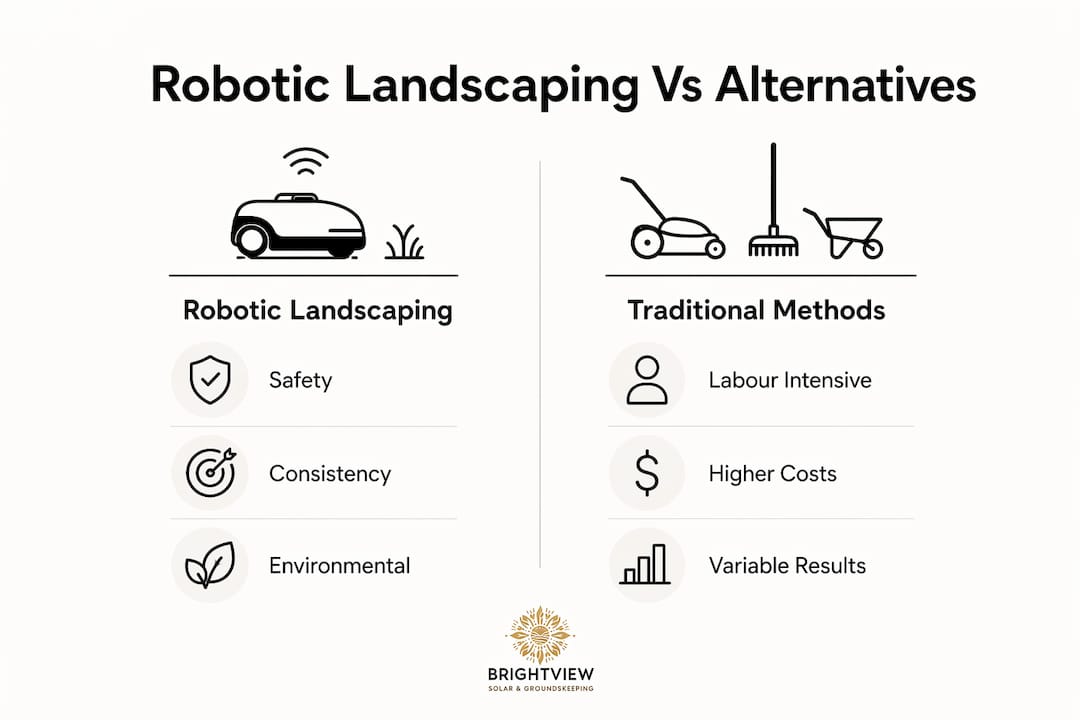
Manual and operator-steered methods carry compounding costs: wages, fuel, equipment servicing, and workers’ compensation exposure. Robotic solutions shift the cost structure toward contracted service fees with predictable scheduling and no fuel overhead. For robot lawn care on large commercial sites, the operational consistency also reduces remediation costs from uneven or missed maintenance.
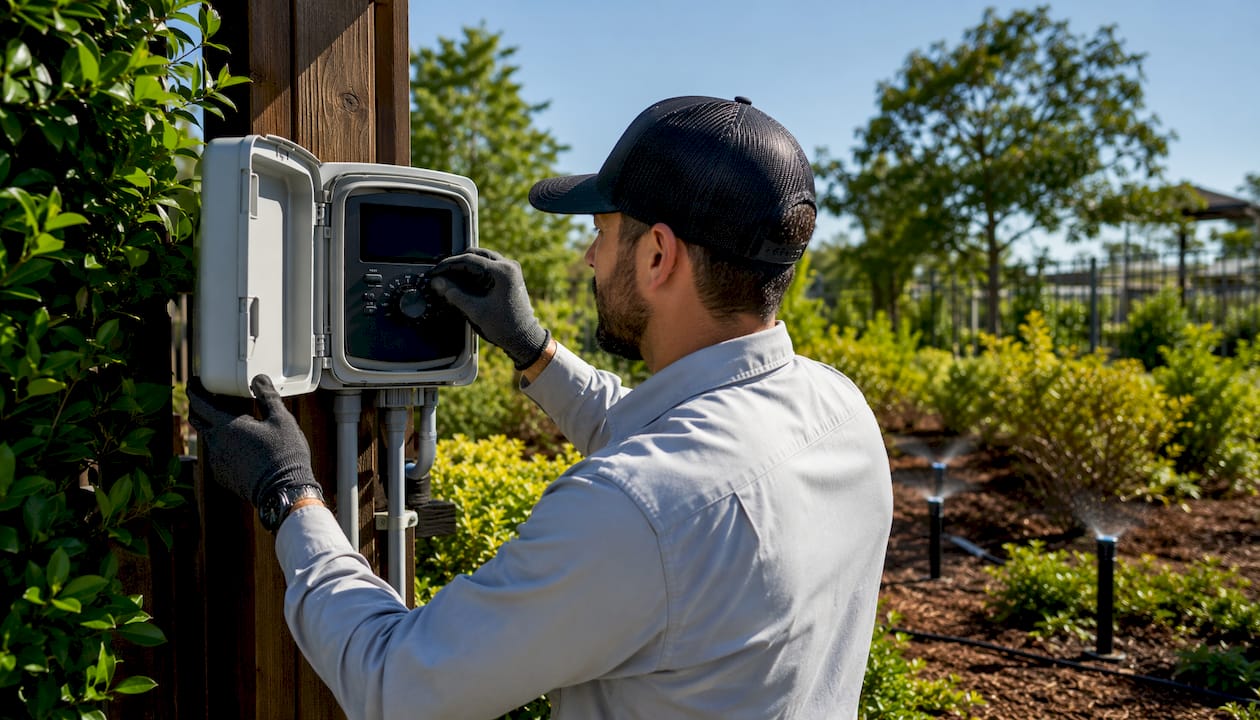
Smart irrigation delivers strong ROI on water bills but does not address mowing, spraying, or panel cleaning. Combining it with robotic grounds maintenance covers the full site.
Where has robotic landscaping proven effective in practice?
Commercial and industrial property managers across Australia are deploying robotic mowers on large campus-style sites, logistics precincts, and solar farms where access is difficult and manual crews face genuine safety risks. Solar panel cleaning robots restore generation efficiency by removing dust and debris, a measurable output improvement rather than an aesthetic one. Robotic spraying reduces chemical use through precision application, which directly supports compliance with environmental licence conditions on industrial sites.
Successful deployments share one characteristic: site mapping and GPS signal optimisation completed before deployment, ensuring autonomous machines navigate complex environments without disruption to site operations.
What should you ask when choosing a robotic landscaping partner?
Provider selection comes down to five practical questions:
- Can the provider access difficult areas? Slopes, solar arrays, and confined industrial zones require machines built for that terrain, not adapted residential units.
- What safety certifications apply? Australian workplace safety standards require documented obstacle avoidance and redundant safety systems.
- How is scheduling managed? AI-driven scheduling should coordinate around site traffic and workforce presence, not just daylight hours.
- Does the provider cover solar panel maintenance? Grounds and panel cleaning from one contractor simplifies contracts and accountability.
- What reporting is provided? Output data, coverage maps, and service records matter for compliance and asset management reporting.
Brightview Solar & Groundskeeping covers what alternatives cannot
The gap every alternative leaves is whole-site autonomous maintenance. Manual crews, stand-on mowers, and smart irrigation each address one part of the problem.
Brightview Solar & Groundskeeping deploys robotic mowing, spraying, and solar panel cleaning across commercial and industrial properties in Australia, including sites where manual access is hazardous or impractical. The autonomous machines operate with precision on difficult terrain, reduce employer liability, and support environmental compliance without the fuel overhead of traditional equipment. Get in touch with Brightview Solar & Groundskeeping to discuss a contracted robotic maintenance programme for your property.
FAQ
What are the main alternatives to robotic landscaping?
Manual labour crews, operator-steered commercial mowers, and smart irrigation systems are the three primary alternatives. Each covers a different maintenance function with varying cost and safety profiles.
How much water can smart irrigation save compared to manual watering?
Smart irrigation platforms using the FAO56 evapotranspiration standard have delivered water consumption reductions of up to 50% compared with manual watering schedules.
Why are Australian commercial managers moving toward robotic landscaping in 2026?
Labour shortages, rising fuel costs, and stricter environmental regulations are the main drivers. Robotic solutions reduce human exposure to hazardous tasks and meet noise and emissions limits in commercial zones.
Does Brightview Solar & Groundskeeping handle both grounds and solar panel maintenance?
Yes. Brightview Solar & Groundskeeping provides robotic mowing, spraying, and solar panel cleaning under contracted service arrangements for commercial and industrial properties across Australia.
Key takeaways
Robotic landscaping outperforms every alternative across safety, consistency, and environmental compliance for Australian commercial sites in 2026.
| Point | Details |
|---|---|
| Three main alternatives | Manual crews, operator-steered equipment, and smart irrigation each cover only part of commercial maintenance needs. |
| Smart irrigation water savings | Platforms using the FAO56 standard have reduced water use by up to 50% versus manual watering. |
| Labour and safety costs | Removing workers from hazardous outdoor tasks reduces employer liability and supports Australian workplace safety compliance. |
| Robotic operational advantage | Autonomous systems operate extended hours, optimise site routes, and deliver consistent output across large industrial footprints. |
| Brightview Solar & Groundskeeping | Provides contracted robotic mowing, spraying, and solar panel cleaning for commercial and industrial properties across Australia. |

