
AI-based maintenance planning applies machine learning, IoT sensors, and data analytics to predict equipment failures before they happen and schedule repairs at the right moment. Rather than waiting for a breakdown or following a fixed calendar, organisations shift to condition-based interventions that protect asset lifespan and cut costs. Predictive maintenance AI moves maintenance from guesswork to a data-driven discipline, with measurable results across manufacturing, infrastructure, and facilities management.
The core functions of AI maintenance planning include:
- Continuous monitoring via IoT sensors tracking vibration, temperature, and pressure in real time
- Anomaly detection that flags deviations from a machine’s normal operating signature
- Remaining useful life estimation so teams can schedule repairs during planned production lulls
- Automated work order generation triggered by AI alerts at the edge or cloud level
- Spare parts forecasting based on predicted failure timelines rather than estimated schedules
Australian industry bodies and standards such as AS/NZS ISO 55001 for asset management increasingly align with AI-driven approaches, giving local organisations a clear regulatory framework for adoption.
Which Australian providers offer maintenance planning AI?
Four verified Australian providers cover the main segments of the market, from enterprise software to hands-on consulting.

| Provider | Primary AI maintenance services | Industry focus | Geographic availability | Google rating | Compliance focus |
|---|---|---|---|---|---|
| AI CONSULTING GROUP | Advanced analytics, tailored AI consulting, maintenance optimisation | Cross-industry, Sydney-based | National (Sydney HQ) | 5★ (15 reviews) | Local compliance and analytics expertise |
| Asset Vision | Enterprise asset management platform, AI-driven asset lifecycle tools | Government, councils, infrastructure | National | 5★ (5 reviews) | Public sector standards, infrastructure compliance |
| Maintenance Experts Pty Ltd | AI-enabled maintenance software, field service management | Trades, field services, Queensland | Queensland-focused, national software | 4.7★ (3 reviews) | Trades compliance, field service SLAs |
| SOLVE8 IT Services | AI automation, predictive maintenance, system integration | Manufacturing, trades, construction, healthcare | National | 5★ (2 reviews) | Australian privacy, ABN-verified, no lock-in contracts |

AI CONSULTING GROUP focuses on tailored analytics engagements for businesses that need a consultant to design and implement a maintenance AI strategy from scratch. Their Sydney presence suits organisations wanting face-to-face project delivery with local compliance expertise baked in.
Asset Vision targets government bodies and infrastructure providers. As Australia’s fastest-growing asset management platform in the public sector, it handles roads, utilities, and facilities through an integrated software environment with AI asset lifecycle capabilities. Councils and infrastructure managers who need a single platform covering spatial data, condition assessments, and maintenance scheduling will find it purpose-built for that context.
Maintenance Experts Pty Ltd suits Queensland-based trade and field service companies looking for AI-enabled maintenance software with a hands-on service approach. Their MEX platform is built around work orders, preventive maintenance scheduling, and field technician management.
SOLVE8 IT Services takes an end-to-end automation angle, covering AI strategy, software integration, and custom solutions across manufacturing, construction, and healthcare. Their outcome-based pricing and 14-day free trial lower the entry barrier for businesses testing AI maintenance automation for the first time.
How does AI actually work in predictive and preventative maintenance?
The process runs as a continuous loop. IoT sensors installed on equipment capture physical parameters such as vibration, heat, acoustics, and pressure. Machine learning models then establish a baseline “normal” operating signature by analysing historical data. Once that baseline exists, the system scans incoming sensor readings for deviations.
“AI-powered predictive maintenance is like a sophisticated wearable health tracker. It continuously monitors vital signs and provides early warning of potential problems weeks before they manifest, allowing for proactive maintenance without interrupting broader facility workflows.” — IBM
Two model types do most of the work. Unsupervised anomaly detection flags outliers without needing labelled failure data. Supervised deep learning models calculate remaining useful life by comparing current readings to past failure events, giving engineers a concrete timeline rather than a vague warning.
Australian industrial operations increasingly pair this with digital twins and GIS, creating a centralised view of widely dispersed assets. A water utility managing pump stations across a region, for example, can monitor all assets from one dashboard and receive geo-tagged alerts when a specific station shows early signs of bearing wear.
Key technologies in the stack:
- Edge computing processes sensor data locally in milliseconds, triggering automated responses before a human operator sees the alert
- Digital twins mirror physical assets in software, letting engineers simulate failure scenarios and test maintenance strategies without touching live equipment
- AI scheduling tools like Timefold balance technician skills, parts availability, and compliance requirements, reducing idle time by up to 10%
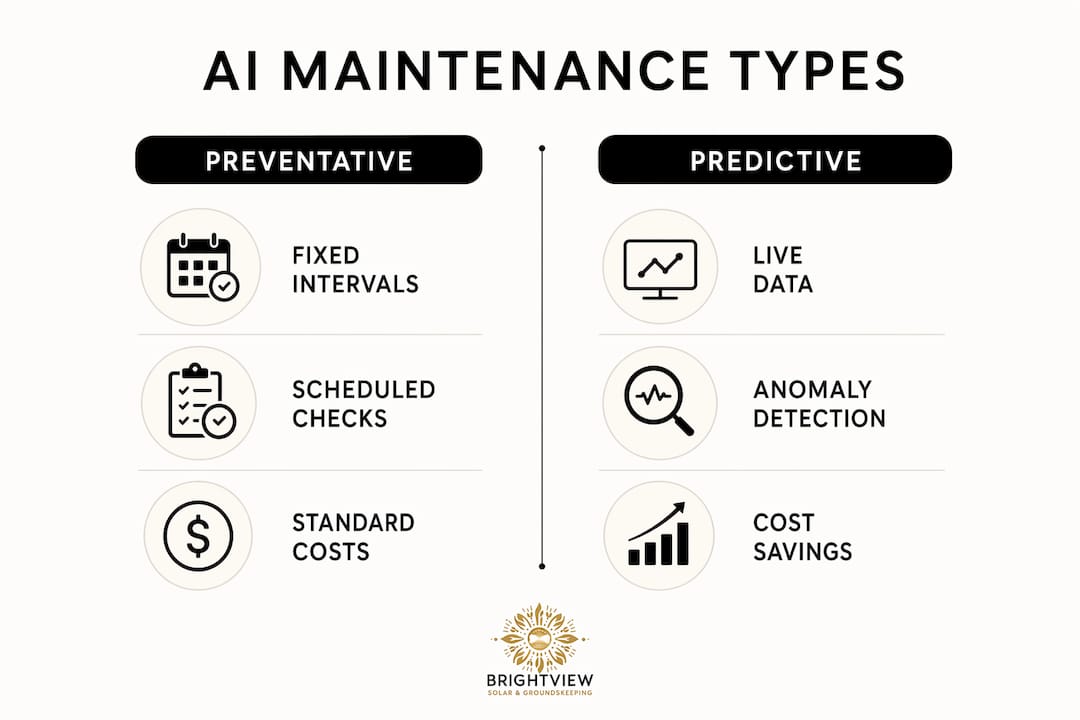
Preventative maintenance sets fixed service intervals regardless of actual condition. Predictive maintenance uses live data to intervene only when the evidence warrants it. AI handles both: it can enforce calendar-based tasks while simultaneously monitoring for condition-based triggers that override the schedule when a fault is developing faster than expected.
What measurable benefits do Australian businesses see?
The numbers from IBM’s research are the clearest benchmark available: AI-driven predictive maintenance reduces maintenance costs by 25–30% and cuts unplanned downtime by 35–45%.
Stat: Moving from preventive to predictive maintenance delivers a considerable reduction in maintenance costs and a significant reduction in unplanned downtime.
Beyond cost, the operational gains compound across several areas:
- Worker safety improves because AI prevents the catastrophic breakdowns that put technicians in emergency repair situations
- Spare parts inventory shrinks as components are ordered against forecast need rather than estimated schedules
- Energy efficiency recovers when AI identifies machines consuming excess power due to internal wear, prompting repairs that restore peak performance
- Asset lifespan extends because interventions happen at the right moment, not too early or too late
For Australian infrastructure managers operating under AS/NZS ISO 55001, AI-driven condition monitoring directly supports the standard’s requirement for evidence-based asset decisions. That regulatory alignment makes the business case easier to present to boards and procurement committees.
How do you choose the right AI maintenance provider in Australia?
Start with the asset class and industry context. A government council managing road infrastructure needs a platform like Asset Vision with spatial data integration. A Queensland trades business needs field-service-aware software. A manufacturer wanting a bespoke AI strategy needs a consulting engagement.
Evaluation criteria worth applying to every shortlist:
- Service scope: does the provider cover strategy, software, integration, and ongoing support, or only one layer?
- Industry certifications: are they ABN-verified, compliant with Australian privacy law, and familiar with your sector’s regulatory requirements?
- Explainability: can the AI show maintenance planners why it flagged an asset? Explainable AI drives adoption among experienced planners who distrust black-box alerts
- Data integration: does the provider connect to your existing CMMS, ERP, or sensor network without a full system replacement?
- Geographic support: can they deliver on-site when needed, or is the engagement fully remote?
Questions to ask any provider before signing: How long does initial model training take with your existing data? What does the handover process look like for your internal team? How do you handle model drift as equipment ages?
Pro Tip: Pilot AI on your highest-criticality assets first. A focused pilot generates measurable ROI quickly, builds organisational confidence, and gives your team real data to justify broader rollout.
What challenges come with integrating AI into existing maintenance systems?
Legacy data is the most common blocker. Inconsistent maintenance records, gaps in sensor history, and equipment data stored across multiple systems make it hard for machine learning models to establish reliable baselines. Reconciling that historical data before deployment is not optional; it is the foundation the models depend on.
Change management is the second challenge. Experienced maintenance planners often resist AI recommendations they cannot interrogate. Choosing a system with transparent reasoning, one that explains which sensor readings triggered an alert and why, closes that trust gap faster than any training programme alone.
Integration complexity varies widely. Connecting AI tools to SAP PM or IBM Maximo is well-trodden territory; connecting to older proprietary CMMS platforms often requires custom middleware. Scoping that integration work accurately at the start prevents cost blowouts mid-project.
What data do you need for AI maintenance planning?
At minimum, AI maintenance models need maintenance performance history from a CMMS: work order records, failure events, and repair logs covering several years of operation. The richer the history, the faster the model reaches reliable predictions.
Additional data sources that improve model accuracy include operational logs, operator inspection rounds, condition monitoring outputs, and live sensor feeds. AI document management tools can help consolidate maintenance records from disparate sources into a clean, structured dataset before model training begins.
Data quality matters more than data volume. A smaller, clean dataset outperforms a large, inconsistent one. Prioritise standardising equipment identifiers, failure codes, and timestamp formats across all source systems before engaging a provider.
What does AI maintenance planning cost, and how do you estimate ROI?
Costs vary by engagement type. A consulting project with AI CONSULTING GROUP or SOLVE8 IT Services is scoped per engagement. Asset Vision and Maintenance Experts Pty Ltd operate on software subscription models, with SOLVE8 offering a 14-day free trial and outcome-based pricing for AI software products.
ROI estimation starts with your current maintenance spend and downtime cost. Apply the 25–30% cost reduction and 35–45% downtime reduction benchmarks as conservative targets, then compare against implementation and licensing costs over a 24-month horizon. Most Australian industrial operators see payback within the first year on high-criticality asset pilots.
How do you upskill your workforce to work with AI maintenance tools?
AI augments maintenance workers rather than replacing them. The practical role of AI is as a knowledge assistant: it surfaces relevant manuals, historical failure data, and repair procedures instantly, freeing technicians to focus on hands-on work rather than documentation searches.
Upskilling works best when it is role-specific. Planners need to understand how to interpret AI alerts and override recommendations with documented reasoning. Technicians need mobile-first interfaces that present work orders with AI-generated context. Managers need dashboards that translate model outputs into operational decisions.
The EIT’s Professional Certificate in Advanced Plant Maintenance and AI-Driven Predictive Technologies is one formal pathway for Australian maintenance professionals building AI literacy. Pairing formal training with a live pilot project accelerates competency faster than classroom learning alone.
Brightview Solar & Groundskeeping: a different kind of maintenance automation
The providers compared above focus on AI software, consulting, and platform solutions. Brightview Solar & Groundskeeping takes a different route to the same goal: deploying autonomous robotic machines that physically carry out maintenance tasks on solar panels, lawns, and commercial grounds, removing the need to schedule human labour for those surfaces at all.

For asset managers and property managers whose maintenance burden includes solar panel cleaning and grounds upkeep, Brightview Solar & Groundskeeping removes those tasks from the scheduling queue entirely. Robotic solar panel cleaning maintains panel output efficiency without manual intervention, and autonomous mowing handles difficult or large-scale areas that would otherwise require repeated contractor visits. If you are exploring solar energy robotics as part of a broader asset maintenance strategy, Brightview Solar & Groundskeeping is worth a direct conversation.
FAQ
Will AI replace maintenance workers?
No. AI acts as a knowledge assistant that surfaces data, flags anomalies, and generates work orders, while technicians carry out the physical repairs. The role shifts toward data-informed decision-making rather than disappearing.
How is AI used in maintenance?
AI monitors equipment via IoT sensors, detects anomalies against a learned baseline, estimates remaining useful life, and triggers automated scheduling. The result is condition-based maintenance that replaces fixed-interval servicing.
What is Australia’s current approach to AI adoption?
Australia’s national AI strategy and frameworks such as AS/NZS ISO 55001 support responsible AI adoption in asset management. Local providers including Asset Vision and SOLVE8 IT Services build their solutions around Australian privacy law and compliance requirements.
What is the 30% rule in AI maintenance?
The commonly cited figure refers to the 25–30% reduction in maintenance costs achievable by moving from preventive to predictive maintenance, as documented by IBM’s research on AI-driven maintenance outcomes. This shift also delivers a reduction in unplanned downtime by 35–45%.
Key takeaways
AI-driven predictive maintenance reduces costs significantly and lowers unplanned downtime, making it one of the most measurable ROI levers available to Australian asset managers.
| Point | Details |
|---|---|
| Predictive vs preventative | AI enables condition-based interventions, replacing fixed schedules with data-triggered maintenance. |
| Cost and downtime impact | Predictive maintenance cuts maintenance costs by 25–30% and unplanned downtime by 35–45%. |
| Pilot first | Start AI deployment on high-criticality assets to generate measurable ROI before scaling. |
| Provider selection | Match provider type (consulting, platform, or automation) to your asset class and industry context. |
| Brightview Solar & Groundskeeping | Offers robotic solar panel cleaning and grounds maintenance as a physical automation alternative for property and asset managers. |

