
For Australian commercial and industrial property managers, the most effective alternative to John Deere mowers isn’t another brand of ride-on or zero-turn machine. It’s contracting a robotic grounds maintenance service that removes manual labour from the equation entirely.
Here’s why that shift makes sense in 2026:
- Robotic fleets operate autonomously, with no operator required on site during mowing cycles
- Electric-powered machines produce far less noise and zero direct emissions compared to gas-powered John Deere equipment
- Autonomous systems safely access sloped, uneven, or restricted terrain that traditional mowers cannot manage without risk
- Brightview Solar & Groundskeeping combines robotic mowing, spraying, and solar panel cleaning in a single contracted service
- Switching to a service model eliminates fuel purchasing, operator wages, and equipment maintenance from your operational budget
- Robotic systems meet safety and compliance standards suited to complex industrial layouts and solar arrays
Table of Contents
- What makes robotic grounds maintenance better than traditional mowers?
- How do the costs compare to owning traditional mowing equipment?
- What should a commercial robotic mowing contract actually include?
- What do Australian commercial clients actually experience?
- Brightview Solar & Groundskeeping: robotic grounds care for Australian properties
- FAQ
- Key takeaways
What makes robotic grounds maintenance better than traditional mowers?
Commercial property managers are moving away from gas-powered equipment like John Deere tractors for a straightforward reason: the labour model behind them is expensive and hard to manage at scale.
Robotic grounds maintenance works differently. Autonomous fleets are deployed across a site after initial mapping and infrastructure setup, then operate on scheduled cycles without a crew. A digital platform tracks coverage, flags anomalies, and logs service history. Your facilities team monitors outcomes rather than supervising operators.
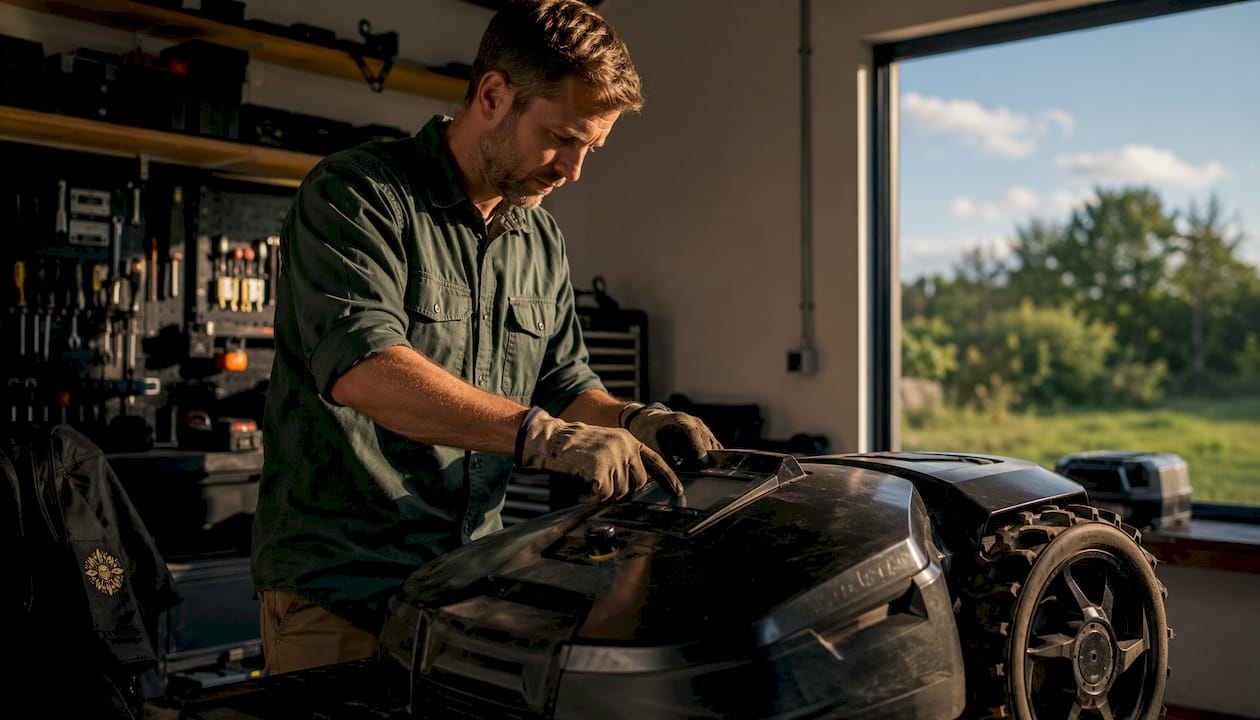
The safety advantage is real and specific. Traditional mowers require an operator on slopes, near drainage channels, around solar arrays, and in areas with restricted access. Robotic units handle all of those zones without putting anyone at risk. For industrial sites where safety compliance is non-negotiable, that distinction carries weight.
Brightview Solar & Groundskeeping integrates three services into one robotic contract: precision mowing, targeted spraying, and solar panel cleaning. That combination matters for asset managers running solar installations alongside grounds maintenance, since panel soiling directly affects energy output.
Key operational considerations before deployment:
- Site mapping: Accurate boundary and obstacle mapping is required before autonomous fleets can operate efficiently
- Deployment timeline: Initial setup involves site assessment, mapping, and infrastructure planning before live operation begins
- Service level agreements: Contracted services define coverage frequency, response times, and escalation procedures
- Maintenance support: The service provider handles fleet maintenance; you don’t carry parts inventory or workshop costs
Pro Tip: Treat robotic grounds maintenance as a facility management strategy, not a machinery purchase. The value compounds over time through consistent coverage, reduced incident risk, and eliminated labour overhead.
How do the costs compare to owning traditional mowing equipment?
Total cost of ownership is where the lawn mower comparisons between traditional equipment and robotic services diverge most sharply. A John Deere X-series tractor or commercial zero-turn carries an upfront purchase price, but that’s only the beginning. Fuel, operator wages, insurance, servicing, parts, and downtime during repairs all accumulate.
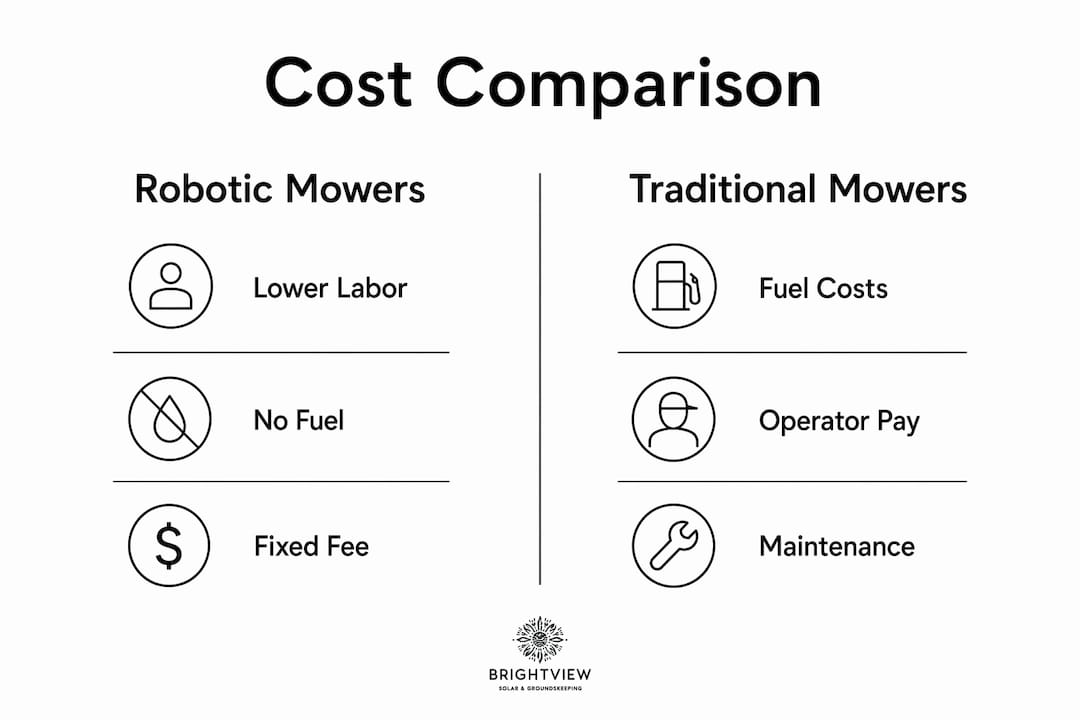
Robotic service contracts consolidate those variables into a single contracted fee. Labour costs disappear. Fuel is not your concern. Fleet maintenance sits with the provider. For multi-site property managers, that predictability has real budget value.
The transition does require upfront investment in site evaluation and mapping. That setup phase is where automated grounds maintenance providers earn their keep: a well-mapped site runs efficiently from day one, while a poorly planned deployment creates coverage gaps and call-outs.
What should a commercial robotic mowing contract actually include?
Not all service agreements are structured the same way. When evaluating providers, the contract terms matter as much as the technology.
A well-structured agreement for commercial robotic mowing should specify coverage area and frequency, response times for service interruptions, who holds liability for equipment damage or site incidents, and what happens at contract end regarding site infrastructure. Escalation procedures for missed cycles or equipment faults should be written in, not assumed.
Brightview Solar & Groundskeeping operates on contracted service terms designed for commercial and industrial clients, with clear obligations on both sides. For autonomous spraying solutions bundled into the same agreement, the same accountability framework applies.
What do Australian commercial clients actually experience?
Australian property managers adopting robotic grounds maintenance consistently report the same shift: grounds maintenance moves from a recurring operational problem to a background function. Sites that previously required scheduled crew visits, fuel logistics, and operator supervision run on automated cycles with minimal intervention.
Industrial sites with complex layouts, including those with solar arrays, benefit most. The ability to maintain vegetation around panel rows without manual access reduces both labour cost and the risk of panel damage from conventional equipment. You can review robotic mower provider options and the GC Signature Outdoors portfolio to see how modern grounds maintenance is being delivered across commercial sites.
Brightview Solar & Groundskeeping: robotic grounds care for Australian properties

Property managers who’ve spent years managing John Deere equipment, scheduling crews, and absorbing fuel costs know the model’s limitations. Brightview Solar & Groundskeeping offers a direct alternative: fully contracted robotic mowing, spraying, and solar panel cleaning for commercial and industrial sites across Australia.
The practical difference is that your team stops managing grounds maintenance and starts receiving it. No equipment ownership, no operator coordination, no fuel procurement. Brightview Solar & Groundskeeping handles fleet deployment, site mapping, and ongoing service, with safety and compliance built into every operation.
Get in touch with Brightview Solar & Groundskeeping to discuss your site’s requirements and find out how a robotic mowing service contract works for your property.
FAQ
Are robotic mowing services suitable for large industrial sites?
Yes. Robotic fleets are specifically suited to large, complex, or restricted sites where manual mowing creates safety and logistical challenges. Brightview Solar & Groundskeeping deploys autonomous systems across commercial and industrial properties of varying scale.
How long does deployment take for a new robotic mowing contract?
Deployment begins with site mapping and infrastructure planning, which must be completed before live operation. The timeline varies by site complexity, but proper setup is critical to achieving consistent coverage from the outset.
Do robotic mowing services meet Australian safety compliance requirements?
Autonomous robotic fleets are designed to meet safety and compliance standards for commercial and industrial environments, including sites with solar arrays and restricted-access zones.
What’s included in a robotic grounds maintenance contract?
A complete contract covers mowing frequency, coverage area, service response times, escalation procedures, and fleet maintenance. Brightview Solar & Groundskeeping also integrates robotic spraying and solar panel cleaning into a single service agreement.
Can robotic services replace John Deere mowers on sloped terrain?
Robotic systems are built to handle sloped, uneven, and difficult terrain that traditional mowers manage poorly or unsafely. That capability is one of the primary reasons commercial property managers make the switch.
Key takeaways
Robotic grounds maintenance is the most cost-effective and operationally sound alternative to traditional John Deere mowers for Australian commercial properties.
| Point | Details |
|---|---|
| Labour elimination | Robotic fleets operate autonomously, removing operator wages and crew scheduling from your costs. |
| Safety on complex sites | Autonomous systems access sloped, restricted, and hazardous terrain without putting operators at risk. |
| Contract-based cost model | A single service fee replaces fuel, maintenance, insurance, and labour as separate budget lines. |
| Deployment planning matters | Site mapping and infrastructure setup are required before robotic services deliver consistent coverage. |
| Brightview Solar & Groundskeeping | Offers contracted robotic mowing, spraying, and solar panel cleaning for Australian commercial and industrial properties. |

