
For commercial and industrial property managers, the most practical way to replace routine glyphosate use is an integrated weed management (IWM) strategy that combines prevention, mechanical control, and autonomous robotic services — robotic mowing, precision spot-spraying, and solar-panel cleaning — to scale non-chemical methods without blowing out labour costs.
Three things to understand before you start:
- Species and growth stage determine method. No single alternative works across all weed types at all life stages. Seedlings respond to contact herbicides and thermal treatment; established perennials with deep tap roots or rhizomes need repeated mechanical or systemic intervention across multiple seasons.
- Non-chemical methods cost more unless automated. Mechanical and thermal alternatives can raise GWP by up to 32 times compared with glyphosate when diesel-powered equipment is used. Electrified, autonomous platforms cut that climate cost substantially.
- Regulatory checks are non-negotiable. State and territory pesticide licences, workplace health and safety controls for autonomous machinery, and aquatic buffer rules all apply before you change a single spray programme.
Brightview Solar & Groundskeeping is the recommended partner for piloting and scaling robotic IWM on Australian commercial and industrial sites.
Table of Contents
- What glyphosate alternatives actually exist, and where do they work?
- How to choose the right mix for your commercial site
- A practical multi-year transition plan
- How autonomous robotics fit into an IWM strategy
- What results to expect and how to measure them
- How Brightview Solar & Groundskeeping supports the transition
- Key takeaways
- The case for robotics-led IWM is stronger than most property managers realise
- Brightview Solar & Groundskeeping: your next step
- FAQ
What glyphosate alternatives actually exist, and where do they work?
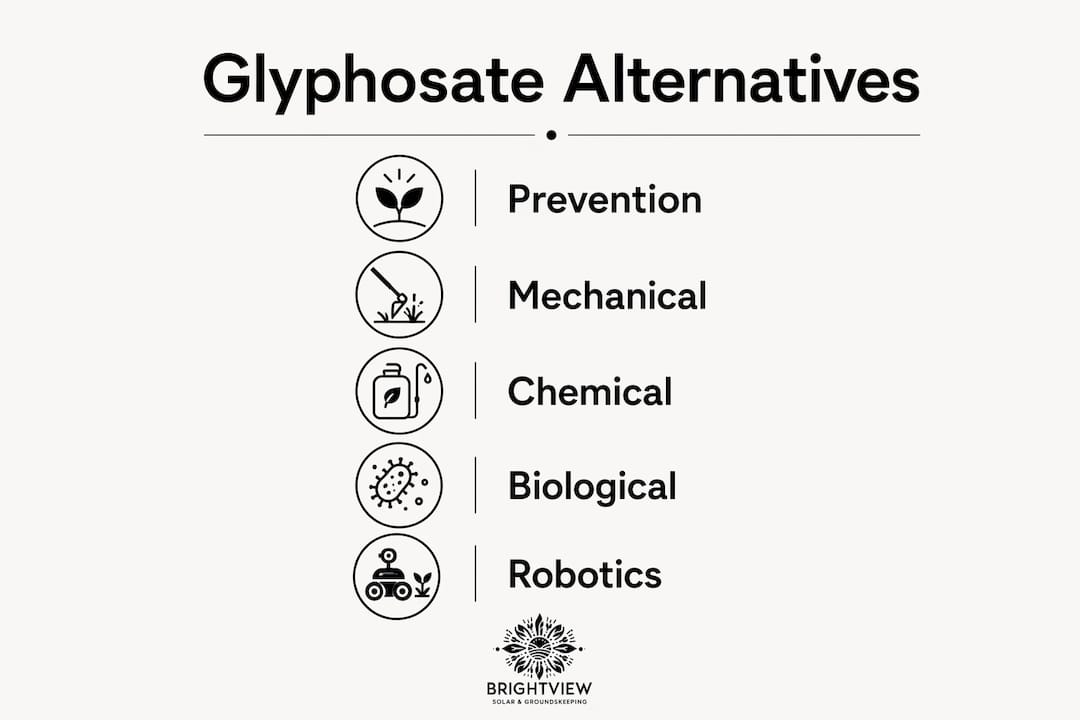
IWM combines prevention, targeted mechanical intervention, and precision technology — no single product replaces glyphosate’s broad-spectrum, systemic action. The categories below cover the full menu.
Chemical alternatives such as glufosinate and diquat offer broad-spectrum contact action but lack glyphosate’s systemic translocation. Selective herbicides (halosulfuron for sedges, fluazifop for grasses) work in specific niches. Chemical substitution often shifts risk rather than removes it, so treat these as targeted tools, not blanket replacements.
Contact organic herbicides — pelargonic acid, fatty-acid soaps, acetic acid — injure above-ground tissue only and succeed mainly on small annual seedlings. They are generally more expensive and require more applications than glyphosate, making them impractical as a standalone programme on large sites.
Thermal methods (steam, hot foam) kill seedlings on contact but are ineffective on deep tap roots and rhizomes without very high-frequency passes. Labour-intensive at scale.
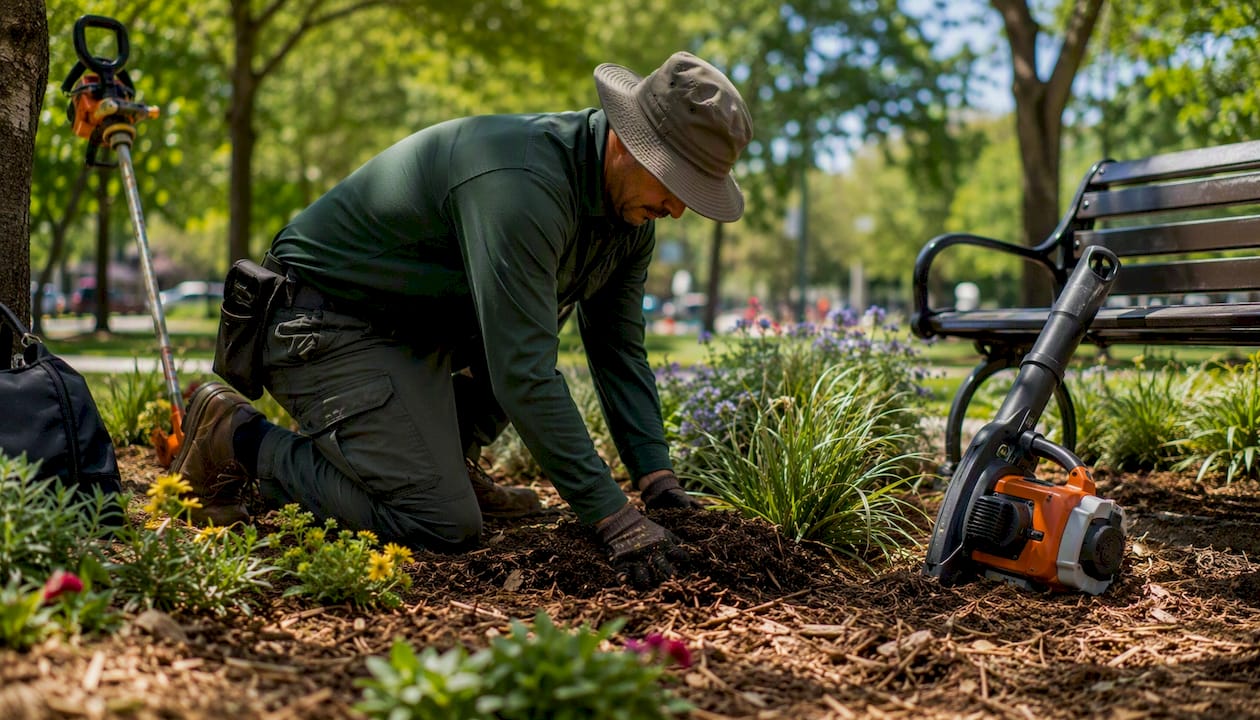
Mechanical control — mowing, brushcutting, excavation — reduces biomass and prevents seed set. Effective when timed to growth stage but resource-heavy unless automated.
Cultural and preventive measures — mulch, root barriers, dense groundcovers — suppress germination before it starts. The highest return on investment when installed correctly.
Biological control uses host-specific agents or bioherbicides to suppress target species with low off-target risk, though results are slower and species-specific.
Autonomous robotics — robotic mowers, spot-sprayers, solar-panel cleaners — are the practical enabler for scaling non-chemical methods on large commercial sites without proportional labour increases.
| Method category | Typical effectiveness | Scale suitability | Primary limits |
|---|---|---|---|
| Contact organic herbicides | Seedlings only | Low | Repeat applications; cost |
| Chemical alternatives (glufosinate, diquat) | Annual weeds; some perennials | Medium | Shifts risk; not systemic |
| Thermal (steam, hot foam) | Seedlings; shallow roots | Low–medium | Labour; energy; rhizomes |
| Mechanical (mowing, excavation) | Broad; growth-stage dependent | Medium | Labour cost at scale |
| Cultural/preventive (mulch, barriers) | Prevention only | High | Upfront install cost |
| Biological control | Species-specific | Medium | Slow; regulatory approval |
| Autonomous robotics | Broad; integrates other methods | High | Terrain limits; upfront capex |
How to choose the right mix for your commercial site
Start with a site audit before committing to any programme. Map weed species by zone — hardscape, landscape beds, solar arrays — and note soil conditions, drainage, access constraints, and safety hazards. Species identification and growth-stage timing are the single biggest determinants of whether any method works.
Questions to ask any supplier or internal team:
- Which species and growth stages were tested, and under what conditions?
- What is the spray width and target-detection accuracy of autonomous sprayers?
- How is chemical drift prevented near solar panels or ornamental plantings?
- What are the uptime commitments and maintenance schedules for robotic units?
- Who owns the detection-model data, and how is it updated for new weed species?
Red flags to watch for:
- No species monitoring plan — a programme without ongoing identification will drift off-target.
- No electrical or charging infrastructure plan for autonomous units.
- Assumptions that a single pass will control perennial rhizomes.
- Missing safety interlocks for machines operating near public access areas.
The most effective commercial programmes layer four elements: preventive mulch and root barriers, scheduled robotic mowing passes, targeted autonomous spot-spraying for persistent patches, and robotic solar-panel cleaning for array zones.
Pro Tip: Prioritise species ID before procurement. A robotic spot-sprayer trained on the wrong weed dataset will miss your dominant species entirely — confirm the detection model covers your site’s actual weed flora before signing a contract.
A practical multi-year transition plan
Year 0–1: Baseline and pilot
- Commission a full species survey and map high-risk zones (near panels, waterways, public access).
- Confirm state/territory pesticide licences and permitted chemicals for any residual spraying.
- Run small pilots of 1–3 ha using robotic mowing and targeted spot-spraying.
- Record baseline metrics: weed cover percentage, herbicide volume (L/ha), labour hours.
Year 2: Expand and refine
- Roll successful pilots into high-value zones and solar arrays.
- Introduce thermal or mechanical passes where robots cannot reach.
- Refine schedules based on growth-stage timing data from Year 1.
- Begin monthly KPI reporting against baseline.
Year 3+: Scale and embed
- Expand the robotic fleet and establish preventive plantings in cleared zones.
- Phase down routine blanket spraying to targeted interventions only.
- Embed service agreements covering maintenance, software updates, and spare parts.
Pro Tip: Contract explicitly for software updates and species-model retraining. A robotic sprayer’s detection accuracy degrades as weed populations shift — without a retraining clause, you are paying for yesterday’s data.
| Year | Key activities | Metrics to track |
|---|---|---|
| 0–1 | Species survey, compliance check, 1–3 ha pilot | Weed cover %, herbicide L/ha, labour hours |
| 2 | Pilot expansion, thermal/mechanical integration, monthly KPIs | Re-treatment frequency, cost per ha |
| 3+ | Fleet scale-up, blanket spray phase-down, service contracts | GWP proxy, panel energy yield, incident reports |
Non-chemical strategies at scale require financial and labour investment, and policy or funding support can accelerate uptake — worth exploring with state agriculture departments.
How autonomous robotics fit into an IWM strategy
Three robot types do the heavy lifting on commercial sites.
Robotic mowers run continuous biomass-reduction passes, preventing weed seed set across large turf and groundcover zones. They are most effective on flat to moderately sloped terrain and free up operator hours for higher-value tasks. Explore robotic landscaping options for property managers to understand deployment models.
Autonomous spot-sprayers use camera and LiDAR detection to identify individual weed plants and apply herbicide with millimetre-level accuracy. Off-target exposure drops sharply, which matters near solar panels, ornamentals, and waterways. Automated weed control at this precision level is where the real herbicide-volume reductions occur.
Robotic solar-panel cleaners maintain energy yield by removing soiling and vegetation shading from array surfaces — a task that is hazardous and slow when done manually.
Where robots excel: flat or gently sloped terrain, repetitive high-frequency tasks, high labour-cost sites, and zones with access or safety constraints.
Where they struggle: deep tap roots and subterranean rhizomes (still need systemic chemical or excavation), very steep or densely wooded terrain, and sites without reliable power or charging infrastructure.
Mechanical and thermal alternatives increased GWP by up to 32 times in some case studies when diesel platforms were used. Battery-electric autonomous platforms can cut that climate cost significantly, making electrification a core part of any credible glyphosate-reduction strategy.
Maintenance requirements are real: routine battery care, sensor calibration, software updates, and a service contract for spare parts. Budget for operator oversight — robots are not fully set-and-forget on complex commercial sites.
What results to expect and how to measure them
Visible seedling control typically occurs within weeks of the first robotic or thermal pass. Durable reduction for perennial and rhizomatous weeds normally requires repeated interventions across one to three seasons.
Metrics to track:
- Weed cover percentage (fixed quadrat surveys or photographic transects)
- Herbicide volume (L/ha) from purchase and usage logs
- Labour hours and cost proxies
- Number of re-treatments per zone per season
- Panel energy yield (solar sites)
- Incident and near-miss reports for machinery safety
- GWP proxy where electrified platforms replace diesel
Regulatory and safety checklist:
- Confirm current state/territory pesticide applicator licences
- Verify permitted chemicals and aquatic buffer distances near waterways
- Establish WHS controls and exclusion zones for autonomous machinery
- Install appropriate signage for public-access areas
- Document emergency stop procedures for all robotic units
Review robotic mower safety controls before deploying any autonomous equipment near public or mixed-use areas.
| KPI | Baseline | Month 3 | — | Threshold trigger |
|---|---|---|---|---|
| Weed cover (%) | Record at start | Target reduction | Sustained reduction | >10% regrowth → targeted intervention |
| Herbicide volume (L/ha) | Record at start | Decreasing | Minimal blanket use | Spike → audit spray zones |
| Labour hours (per ha) | Record at start | Reducing | Stable low | Increase → check robot uptime |
How Brightview Solar & Groundskeeping supports the transition
Brightview Solar & Groundskeeping delivers contracted robotic mowing, autonomous spot-spraying, and robotic solar-panel cleaning to commercial and industrial sites across Australia. The service model is built around safety, access to difficult zones, and compliance with state and territory regulatory requirements.
Typical pilot process:
- Site audit covering species mapping, zone classification, access constraints, and safety hazards
- Pilot deployment of robotic mowing and spot-spraying across a defined area with baseline KPI capture
- Monthly KPI review against agreed thresholds
- Scale plan developed from pilot data, with operator training and maintenance schedules included
What Brightview Solar & Groundskeeping aims to deliver:
- Measurable reductions in herbicide volume per hectare
- Labour-hour reductions on high-frequency maintenance tasks
- Improved panel energy yield through consistent robotic cleaning
- Safer access to confined, steep, or hazardous zones
Brightview Solar & Groundskeeping integrates with in-house grounds teams rather than replacing them — the robotic fleet handles repetitive, high-frequency tasks while your team focuses on species monitoring, compliance, and site management decisions.
Pro Tip: Ask for a data-reporting clause in any robotic service contract. Monthly telemetry on spray volume, mowing frequency, and weed cover gives you the evidence base to justify the programme to asset owners and regulators.
Key takeaways
An integrated weed management programme combining prevention, mechanical control, and autonomous robotics is the only scalable, commercially viable path away from routine glyphosate use on large Australian sites.
| Point | Details |
|---|---|
| IWM is the framework | No single product replaces glyphosate; combine prevention, mechanical, and precision methods. |
| Species ID comes first | Match method to weed species and growth stage before selecting any technology or chemical. |
| Automation offsets labour cost | Electrified robotic platforms reduce labour hours and can cut GWP versus diesel-based mechanical methods. |
| Plan for multiple seasons | Perennial and rhizomatous weeds require repeated interventions across one to three seasons, not a single pass. |
| Brightview Solar & Groundskeeping | Offers contracted robotic mowing, spot-spraying, and solar-panel cleaning with site audit and KPI reporting included. |
The case for robotics-led IWM is stronger than most property managers realise
The conventional framing of glyphosate alternatives as a product-swap problem misses the point entirely. The question is not which chemical to use instead — it is how to build a maintenance system that does not depend on any single input. Robotics makes that possible at commercial scale in a way that manual labour simply cannot.
The honest caveat: some species, particularly deep-rooted perennials and aggressive rhizomatous grasses, will still require targeted chemical intervention for years. Robotics is the scalable enabler of a reduced-chemical programme, not a guarantee of a chemical-free one. Property managers who expect a clean break from herbicides in Year 1 will be disappointed; those who treat robotics as the infrastructure for a multi-year transition will see genuine, measurable results.
The sites that get this right share one trait: they started with a proper species audit and set realistic KPIs before deploying any equipment. That discipline, more than the technology itself, is what separates a successful pilot from an expensive experiment.
Brightview Solar & Groundskeeping: your next step
Property managers who have read this far already know the answer: the transition away from routine glyphosate use requires a structured programme, not a product swap. Brightview Solar & Groundskeeping delivers exactly that — a contracted robotic service covering mowing, precision spot-spraying, and solar panel cleaning for commercial and industrial sites, with a site audit, KPI baseline, and compliance support built into every engagement.

The pilot scope is deliberately small: a defined area, a clear baseline, and a monthly reporting cadence so you have the data to justify scale-up to asset owners. Safety controls and state/territory regulatory alignment are handled as part of the service. To request a site audit or discuss a pilot deployment, contact Brightview Solar & Groundskeeping directly via brightviewpty.au.
FAQ
What is the best glyphosate alternative for large commercial sites?
There is no single best substitute. Effective glyphosate-free weed control at commercial scale requires an IWM programme combining prevention, mechanical control, and autonomous robotic spot-spraying tailored to the site’s weed species.
How long does it take to see results from non-chemical weed control?
Seedling control is often visible within weeks, but durable reduction of perennial and rhizomatous weeds typically requires repeated interventions across one to three seasons.
Do robotic mowers and sprayers require pesticide licences in Australia?
Robotic mowers do not, but any spraying — including precision spot-spraying — requires a current state or territory pesticide applicator licence and compliance with permitted-chemical lists and aquatic buffer rules.
Can autonomous robotics fully replace glyphosate on solar farms?
Robotic mowing and solar-panel cleaning can eliminate most routine spraying on solar arrays, but persistent perennial weeds in access corridors may still need targeted chemical intervention until the weed seed bank is depleted.
How does Brightview Solar & Groundskeeping support regulatory compliance?
Brightview Solar & Groundskeeping aligns its robotic services with Australian state and territory WHS and pesticide requirements, including safety interlocks, exclusion zones, and documentation for each deployment.

