
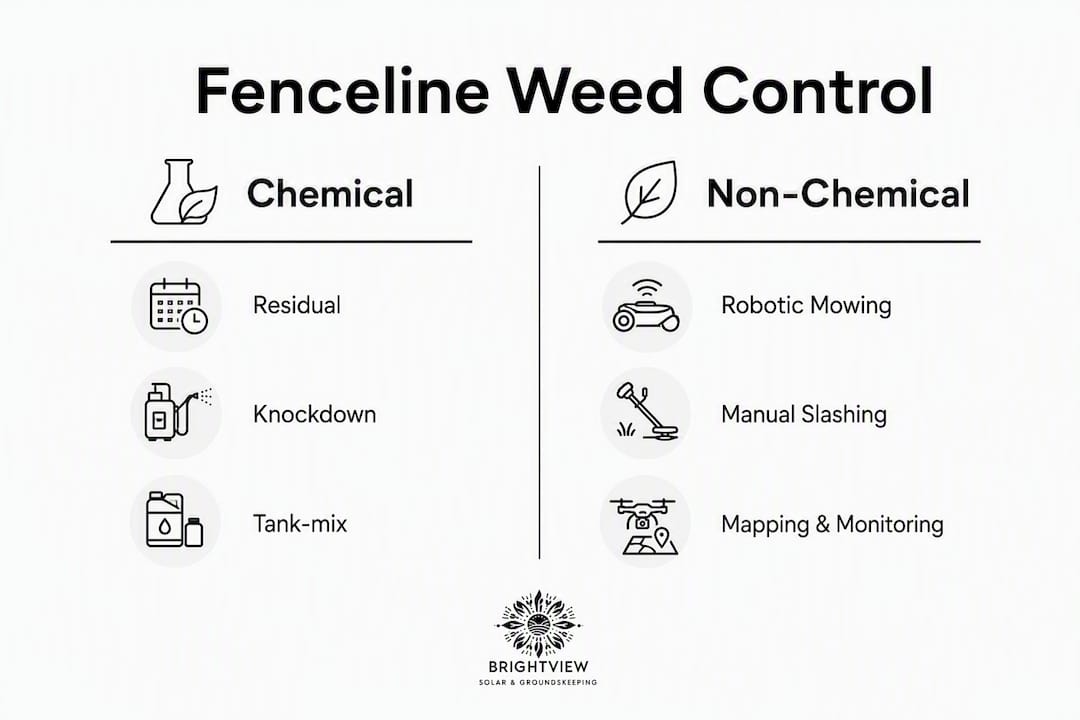
For Australian farms, the most reliable way to stop fencelines seeding paddocks is an early-autumn, pre-sowing pass that combines a registered residual herbicide with a knockdown to remove any weeds already emerged. Field trials show residuals like Alion (indaziflam), Terrain Flow (flumioxazin) and Uragan (bromacil) deliver at least six months of complete control when applied as labelled. That single well-timed pass, done before weeds set seed, does more for paddock hygiene than multiple reactive spot-sprays later in the season.
The short version:
- Timing: Apply in early autumn, before weeds exceed the two-leaf stage and before soil dries out.
- Residual: Choose a registered product for your site: Alion (Group 29), Terrain Flow (Group 14), or Uragan (Group 5). Rotate groups across years.
- Knockdown partner: Tank-mix with glyphosate or paraquat to remove emerged weeds at application. Check label compatibility first.
- Label and APVMA check: Alion and Uragan are registered for fenceline/non-crop use only. Terrain Flow has broader registrations. Always read the label before mixing.
- PPE: Full personal protective equipment (PPE) for mixing, loading and application. No exceptions.
- Monitor: Survey fencelines at 6–8 weeks post-application and again pre-harvest for survivors or new seedlings.
Pro Tip: Apply when 5–10 mm of rain is forecast within 7–10 days. Residuals need moisture to activate in the soil profile. Too dry and the chemistry sits on the surface; too much rain immediately after and you risk runoff into drainage lines.
Table of Contents
- Why fencelines are your biggest weed-management blind spot
- When is the best time to spray fencelines?
- Which residual herbicides work best on Australian fencelines?
- How do you set up your sprayer for reliable fenceline coverage?
- How do you manage herbicide resistance on fencelines?
- What non-chemical options work for fenceline vegetation control?
- How can robotic solutions support your fenceline programme?
- Regulatory and safety checks before you apply any herbicide
- How long does fenceline control last, and when should you re-treat?
- Pre-sowing fenceline spray checklist
- Key takeaways
- The case for treating fencelines as a first-order priority, not an afterthought
- Brightview Solar & Groundskeeping: integrated robotic fenceline maintenance
- Useful sources
- FAQ
Why fencelines are your biggest weed-management blind spot
Fencelines act as a persistent nursery for resistant weeds, and untreated margins re-seed paddocks season after season, quietly undoing whatever in-crop control you have invested in. At harvest, headers and chaser bins move along fencelines first, picking up seed from uncontrolled plants and spreading it across the paddock in a single pass. The problem compounds quickly.
The resistance angle is the one most growers underestimate. Relying solely on glyphosate in fence margins selects for glyphosate-resistant annual ryegrass and other species (per research findings), and once resistance is established in the margin it can contaminate cropped areas during the next harvest. Paraquat resistance has also been confirmed in some ryegrass populations, so a knockdown-only programme carries risk regardless of product used.
Beyond resistance, there are practical productivity reasons to keep fencelines clean:
- Harvest access: Overgrown fencelines slow header runs and increase header losses at the ends of rows.
- Firebreak maintenance: Dense vegetation along fences is a fire hazard in summer; a clean margin is easier to slash or graze as a firebreak.
- Fence longevity: Woody regrowth and climbing weeds accelerate fence-post rot and wire corrosion, adding replacement costs over time.
- Spray drift buffer: A clean, low-vegetation margin reduces the risk of off-target movement when you spray adjacent crops.
Six months of complete control is achievable with a single early-autumn residual application when products are used as labelled — a finding from field trials reported by WeedSmart.
When is the best time to spray fencelines?
Early autumn is the primary window. Weeds are small, soil moisture is typically adequate to activate residual chemistry, and you are treating before the critical seed-rain period that would otherwise re-infest paddocks through winter and spring. Treating in spring, by contrast, means weeds have already grown large (harder to kill with a knockdown), some have already set seed, and the residual has less time to work before summer heat degrades it.
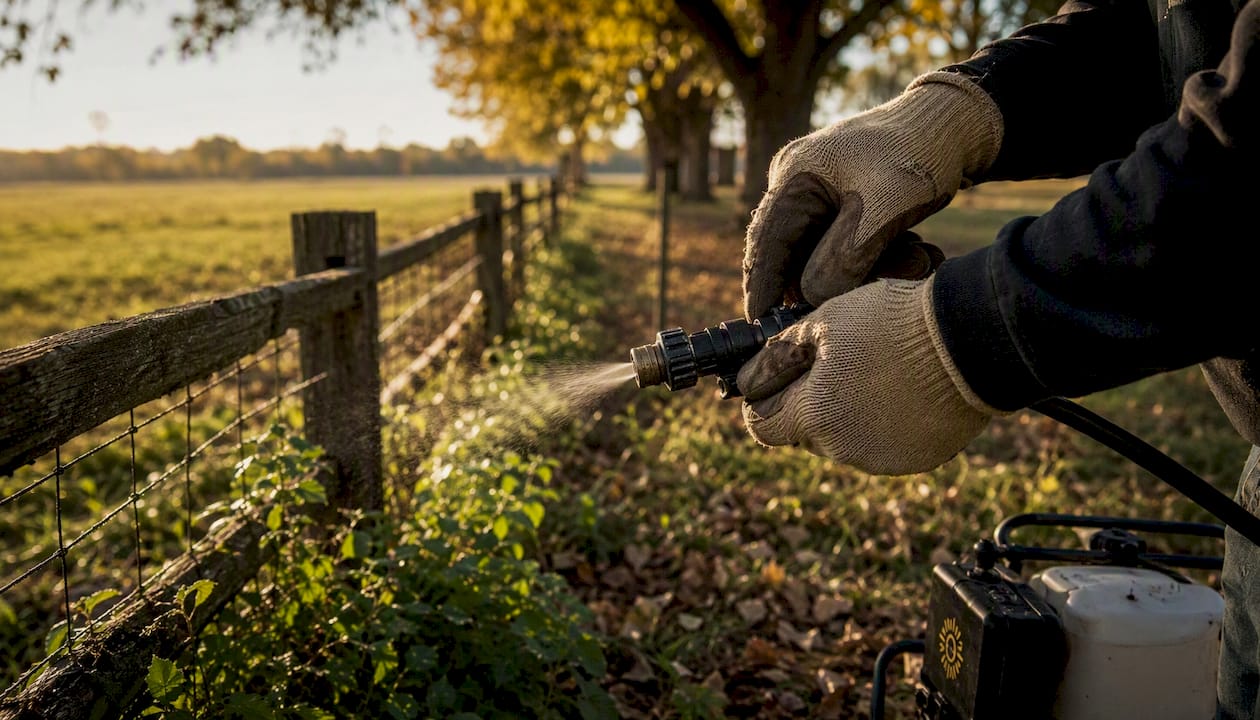
Applying herbicide before seed set is the key timing principle for both annual and perennial weed lifecycles. On Australian grain farms, that typically means targeting the March–May window depending on your region and expected break-of-season rainfall.
Planning steps before you spray:
- Walk and map fencelines in late summer. Note weed species, density, any sensitive trees or water features, and areas of previous resistance concern.
- Identify which residual product suits each zone (see the herbicide comparison below). Some products have tree-safety restrictions; others require specific soil moisture.
- Check the relevant APVMA registration and current product label for your chosen chemistry.
- Book a weather window: apply when light rain (5–10 mm) is forecast within 7–10 days, but not immediately before heavy rain.
- Calibrate your sprayer for the band width and water volume required.
- Prepare PPE and mixing equipment before the application day.
Pro Tip: Mark problem zones on a farm map with GPS or a simple sketch. A record of where you treated, what you used and when makes resistance monitoring and rotation planning far easier the following season.
Which residual herbicides work best on Australian fencelines?
The four products most commonly used for fence weed management in Australia are Alion, Terrain Flow, Uragan and Esplanade. Each has a different mode of action, registration scope and practical site requirement. Choosing the right one depends on your weed spectrum, soil type, proximity to trees, and whether you need a product that can also be used in-crop.
Registration differences are critical: Alion and Uragan are registered for fenceline and non-crop use only, while Terrain Flow has dual registrations that include in-crop uses. Always confirm the current label and APVMA registration before purchase and application.
Herbicide comparison for Australian fencelines
| Product (active ingredient) | Residual length | HRAC group | Registered use-sites | Grass vs broadleaf efficacy | Key restrictions | Knockdown compatibility |
|---|---|---|---|---|---|---|
| Alion (indaziflam) | ~6 months | Group 29 | Fenceline/non-crop only | Strong on grasses and broadleaves | Tree-safety buffers required; moist soil for activation | Compatible with glyphosate; check label |
| Terrain Flow (flumioxazin) | 3–4 months | Group 14 | Fenceline and in-crop (label-dependent) | Primarily broadleaf; limited grass activity | Avoid application near sensitive crops; re-entry restrictions apply | Compatible with glyphosate and paraquat |
| Uragan (bromacil) | 4–6 months | Group 5 | Fenceline/non-crop only | Broad spectrum; good on grasses | Moist soil required; leaching risk on sandy soils; tree damage risk | Compatible with glyphosate; paraquat check label |
| Esplanade | 4–6 months | Group 29 | Non-crop/industrial (label-dependent) | Broad spectrum | Check current APVMA registration for your state; tree buffers apply | Check label for compatibility |
Application notes:
- Alion: Apply at label rate to bare or knockdown-treated soil. Requires 5–10 mm of rainfall or irrigation within 7–14 days for activation. Maintain required buffer distances from desirable trees and shrubs.
- Terrain Flow: Useful where in-crop flexibility is needed. Primarily targets broadleaf weeds; pair with a grass-active knockdown where ryegrass is the primary target.
- Uragan: Effective on a broad weed spectrum including resistant ryegrass populations when tank-mixed with glyphosate. Avoid on sandy or gravelly soils with high leaching risk. Do not apply near desirable trees.
- Esplanade: Confirm current APVMA registration and label for your state before use. Registrations and approved use-sites can change.
Pro Tip: Read the label fine print for tree-safety buffers before you spray near shelter belts or remnant vegetation. Some residuals can move laterally in the soil profile and damage tree root zones well beyond the visible drip line. When in doubt, use a non-chemical method in those zones.
How do you set up your sprayer for reliable fenceline coverage?
Consistent, even soil coverage is what makes a residual herbicide work. Patchy application leaves gaps where weeds germinate freely, and over-application wastes product and increases runoff risk. Getting the sprayer right before you leave the shed is worth the time.
Calibration and setup checklist:
- Set boom height to achieve the correct overlap for your nozzle type, typically 50 cm above the target surface for flat-fan nozzles.
- Calibrate for the band width you are spraying. Fenceline passes are often 1–2 metres wide; calculate litres per hectare equivalent for that band, not the full boom width.
- Select nozzles that produce medium to coarse droplets for soil-applied residuals. Fine droplets increase drift risk without improving soil coverage.
- Check pressure settings against the nozzle manufacturer’s chart for your target droplet size and water volume.
- Confirm water volume: most residual applications require 80–100 L/ha equivalent for adequate soil coverage. Check the product label for minimum volumes.
Mixing order when combining a residual with a knockdown:
Fill the tank to 50% with clean water, add the knockdown (glyphosate or paraquat) first, agitate, then add the residual product, top up to volume and agitate again. Always check the label for specific mixing order instructions; some formulations have incompatibilities.
Drift management and weather windows:
- Apply when wind speed is 3–15 km/h and blowing away from sensitive areas.
- Avoid application when temperature inversion conditions are likely (early morning calm, cool nights).
- Do not spray when rain is forecast within 4 hours for foliar knockdowns, or immediately before heavy rain for residuals.
Pro Tip: Add a water-soluble marker dye to the tank on the first pass. It shows you exactly where you have sprayed, prevents double-application on overlapping passes, and makes it easy to spot missed sections before you pack up.
How do you manage herbicide resistance on fencelines?
The core rule is straightforward: do not rely on glyphosate alone. WeedSmart recommends a ‘mix and rotate’ approach for non-crop areas, rotating HRAC groups across years rather than only swapping knockdown partners. Rotating only the knockdown while keeping the same residual group year after year still builds selection pressure on the residual mode of action.
A practical multi-year rotation based on WeedSmart guidance:
- Years 1–2: Alion (Group 29) as the residual, tank-mixed with glyphosate knockdown.
- Year 3: Terrain Flow (Group 14) as the residual, with glyphosate or paraquat knockdown.
- Year 4: Uragan (Group 5) as the residual, with glyphosate knockdown.
- Year 5 onwards: Return to Group 29 or adjust based on weed-pressure monitoring and any confirmed resistance results.
This rotation keeps three different modes of action cycling through the fenceline, which significantly slows the selection of resistant biotypes compared with a single-product programme.
Practical resistance-avoidance actions:
- Spot-treat any survivors at 6–8 weeks post-application rather than waiting for a full re-spray. Survivors are the most likely resistant individuals.
- Clean headers, tillage equipment and vehicles before moving between paddocks. Resistant seed moves on machinery.
- Keep records of which product was applied where and when. Without records, rotation becomes guesswork.
- Avoid applying the same HRAC group to the same fenceline in consecutive years.
Warning signs of emerging resistance:
- Patches of survivors in areas that received a full-rate application.
- Weed populations that look stressed but do not die after a knockdown application.
- Increasing weed density in fencelines despite consistent treatment.
- Survivors concentrated near fence posts or in areas with soil disturbance (where seed may have been deposited from machinery).
Pro Tip: If you suspect resistance, collect seed heads from survivors before they shatter and send them to a herbicide-resistance testing service. Charles Sturt University’s herbicide resistance research programme and GRDC-supported testing labs can confirm resistance biotypes. Early confirmation lets you adjust your rotation before the problem spreads.
What non-chemical options work for fenceline vegetation control?
Non-chemical approaches are not a fallback for when herbicides fail. They are the right first choice in specific situations: near sensitive trees, along waterways, in biodiversity corridors, or where herbicide registration does not permit use. Mechanical and thermal techniques each have trade-offs worth understanding before you commit to a programme.
Mechanical options:
- Slashing and mowing: Effective for reducing biomass and preventing seed-set, but does not kill established perennial weeds. Requires repeat passes to be effective. Best used as a complement to a residual programme, not a replacement.
- Raising fences: Installing a mow strip or raising the fence line off the ground allows machinery to pass underneath, reducing the labour cost of hand-clearing.
- Cut-stump treatment: For woody regrowth and shrubby weeds, cut-stump herbicide application (a small volume of concentrated herbicide applied directly to the cut surface) is far more targeted than broadcast spraying and carries minimal drift risk.
- Hand-clearing: Labour-intensive but appropriate for small areas, sensitive zones, or where machinery access is impossible.
Cultural options:
Establishing competitive perennial pasture species along fence borders can suppress annual weed germination by closing the canopy and reducing bare soil. This works best as a long-term strategy after an initial knockdown and residual treatment has reduced the seed bank.
When to prefer non-chemical approaches:
- Within the root zone of remnant trees or shelter belts where residual herbicides pose a damage risk.
- Along waterways or drainage lines where runoff and leaching risk is high.
- In declared biodiversity corridors or areas with native vegetation obligations.
- Where operator safety or equipment access makes spraying impractical.
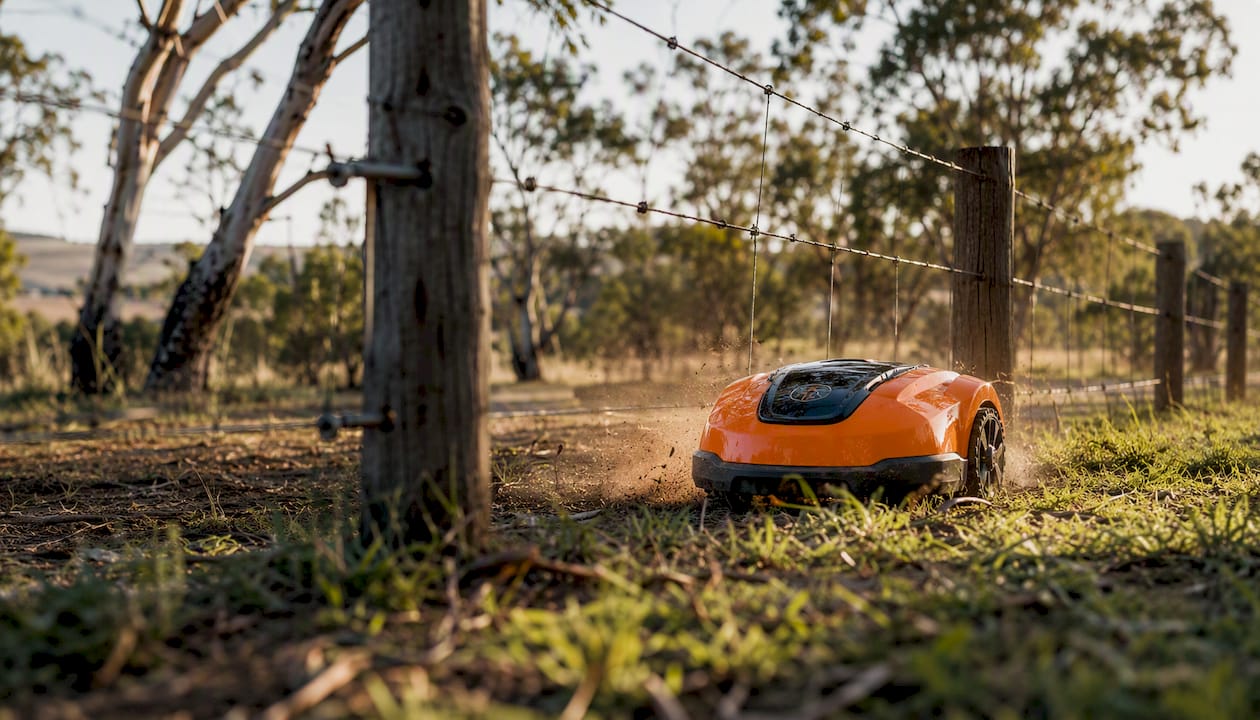
Pro Tip: Robotic mowing is particularly useful under low-clearance fences and in areas where a tractor-mounted slasher cannot safely operate. Brightview Solar & Groundskeeping’s robotic mowing service can be scheduled for repeat passes through the season, preventing seed-set without repeated herbicide inputs or operator exposure.
How can robotic solutions support your fenceline programme?
Robotic mowing and autonomous spraying reduce the two biggest operational costs in fenceline management: labour and rework from inconsistent coverage. Non-chemical robotic solutions can safely access difficult areas beneath fences and reduce drift risk compared with conventional spraying, and they integrate cleanly with a residual herbicide programme rather than replacing it.
Primary benefits of robotic fenceline maintenance:
- Consistent pass width and timing, removing the variability of manual slashing runs.
- Reduced operator exposure to herbicide residues and difficult terrain near fence posts and wires.
- Data capture for monitoring: scheduled passes can be logged with GPS, giving you a record of coverage and timing.
- Safe access under low fences, around posts, and on steep or uneven ground where tractor-mounted equipment is a safety risk.
Brightview Solar & Groundskeeping’s approach to a fenceline programme typically starts with a site assessment: mapping fenceline length, identifying weed species and density, noting sensitive features, and recommending a combination of pre-sowing residual application and scheduled robotic mowing passes. Follow-up visits confirm control and trigger re-treatment where needed.
For land managers who want to reduce the chemical component of their programme over time, automated weed control solutions that combine robotic mowing with targeted autonomous spraying offer a path to lower herbicide use without sacrificing control.
Pro Tip: Schedule robotic mowing passes at 6–8 week intervals through the growing season after your pre-sowing residual application. That frequency is enough to prevent seed-set on most annual species without requiring additional herbicide inputs between annual residual treatments.
Regulatory and safety checks before you apply any herbicide
The product label is the legal instruction for use in Australia. APVMA registration defines what a product can legally be applied to, at what rate, and under what conditions. Applying a product outside its label is an offence under Australian agricultural and veterinary chemicals law, regardless of whether it works.
Label checks before every application:
- Confirm the product is registered for fenceline or non-crop use in your state.
- Check tree-safety and no-spray buffer distances.
- Note required soil moisture conditions for activation (particularly for Uragan and Alion).
- Identify re-entry intervals and any withholding periods relevant to adjacent grazing areas.
- Confirm mixing compatibility if tank-mixing with a knockdown.
PPE for mixing, loading and application:
- Chemical-resistant gloves (nitrile or neoprene, not latex) for all mixing and loading.
- Face shield or chemical splash goggles when opening concentrate containers.
- Long-sleeved shirt and long trousers, or a chemical-resistant coverall.
- Chemical-resistant boots.
- Respirator where the label specifies (check the label’s safety data sheet for inhalation risk).
Environmental controls:
- Maintain required buffer distances from surface water, drainage lines and bores.
- Do not apply when rain is forecast to cause runoff.
- Dispose of rinse water and washdown water in a designated area away from waterways. Triple-rinse empty containers and puncture before disposal through an approved drum-muster programme.
- Never pour surplus spray mix or washdown water into drains, creeks or dams.
Pro Tip: Download the current label from the APVMA public chemical registration system (PubCRIS) before each season. Labels are updated, and the version you used last year may no longer be current. A five-minute check prevents a compliance issue.
How long does fenceline control last, and when should you re-treat?
Field trials show residual products deliver at least six months of complete control when applied as labelled, which covers the critical crop-establishment window from autumn through to harvest. That duration assumes correct application timing, adequate soil moisture for activation, and no major soil disturbance after application.
Monitoring schedule:
- 6–8 weeks post-application: First survey. Look for survivors (possible resistance indicators), areas of poor coverage, and any new seedlings in gaps.
- Pre-harvest (approximately 4–5 months post-application): Second survey. Check for seedheads on any plants that have escaped control. Note locations for targeted spot-spraying before harvest.
- Post-harvest: Record weed species and density in fencelines relative to paddock populations. This comparison helps identify whether fencelines are still acting as a seed source.
Re-treatment triggers:
- Visible seedheads on any plants in a treated zone.
- Regrowth or new seedlings covering more than 5–10% of the treated band in a mapped zone.
- Soil disturbance (grading, post replacement, flood damage) that has disrupted the residual layer.
- Post-disturbance germination flush following rainfall on disturbed soil.
Spot-spraying survivors promptly is more effective than waiting for a full re-spray. A targeted knockdown on a small patch of survivors costs far less than a full fenceline pass and removes the most likely resistant individuals before they set seed.
Pre-sowing fenceline spray checklist
Use this checklist on-farm to prepare, apply and follow up a pre-sowing residual treatment.
Preparation:
- Walk and map all fencelines. Note weed species, density, sensitive features (trees, waterways, biodiversity areas) and previous treatment history.
- Select the registered residual product for each zone. Confirm APVMA registration and read the current label.
- Decide whether a knockdown partner is needed (yes, if weeds have emerged). Confirm tank-mix compatibility on the label.
- Check the weather forecast: target a window with 5–10 mm of rain forecast within 7–10 days and no heavy rain immediately after application.
- Calibrate the sprayer for band width, water volume and nozzle selection.
- Prepare PPE: gloves, eye protection, coverall, boots, respirator if required.
Application:
- Fill tank to 50% with clean water.
- Add knockdown product first, agitate.
- Add residual product, top up to volume, agitate.
- Add marker dye if using.
- Apply at label rate in the correct weather window.
- Maintain required buffer distances from trees, water and sensitive areas.
Post-application:
- Triple-rinse the spray tank and boom. Dispose of rinse water in a designated area.
- Record: date, product, rate, water volume, weather conditions, and zones treated.
- Puncture and dispose of empty containers through an approved drum-muster programme.
- Schedule the 6–8 week monitoring survey in your calendar.
Emergency and clean-up:
- Spill on skin: remove contaminated clothing immediately, wash skin with soap and water for at least 15 minutes.
- Spill on ground: contain with absorbent material (sand or soil), collect and dispose of as chemical waste. Do not wash into drains.
- Equipment washdown: wash sprayer, boom and nozzles in a designated washdown area. Collect and manage washdown water appropriately.
Key takeaways
Early-autumn pre-sowing application of a registered residual herbicide, tank-mixed with a knockdown where weeds have emerged, is the single most effective approach to fenceline weed control on Australian farms.
| Point | Details |
|---|---|
| Timing is the critical variable | Apply in early autumn before weeds exceed two-leaf stage; treat when 5–10 mm of rain is forecast within 7–10 days. |
| Six months of control is achievable | Field trials confirm at least six months of complete control from registered residuals (Alion, Terrain Flow, Uragan) when applied as labelled. |
| Rotate HRAC groups every year | WeedSmart’s suggested rotation: Group 29 (years 1–2), Group 14 (year 3), Group 5 (year 4) to reduce resistance selection pressure. |
| Label and APVMA checks are mandatory | Alion and Uragan are fenceline/non-crop only; Terrain Flow has broader registrations. Confirm before every application. |
| Brightview Solar & Groundskeeping integrates robotic options | Scheduled robotic mowing and autonomous spraying complement residual programmes, reducing labour and operator exposure between annual spray passes. |
Pro Tip: Keep a simple fenceline treatment register: paddock name, fenceline ID, date, product, HRAC group, and monitoring results. After three seasons you will have a rotation record that is genuinely useful for resistance management and compliance.
The case for treating fencelines as a first-order priority, not an afterthought
Most growers treat fencelines reactively: spray when they look bad, slash when they get too tall, and move on. The problem with that approach is that by the time a fenceline looks bad, it has already set seed. The damage to the paddock seed bank has been done.
The autumn residual strategy works precisely because it inverts that logic. You treat before the problem is visible, when weeds are small and the residual can do its job in the soil profile. The six months of control that follows covers the entire crop-establishment window, which is when paddock weed pressure matters most.
What tends to get overlooked is the resistance dimension. Fencelines are not just a cosmetic issue or a harvest-access inconvenience. They are the place where resistant biotypes accumulate, survive, and then get redistributed across the farm at harvest. A glyphosate-only programme on fencelines is not just ineffective over time; it actively selects for the resistant populations that will defeat your in-crop programme. Rotating residual groups on the fenceline is, in that sense, as important as rotating in-crop herbicides.
The integration of robotic mowing into a fenceline programme is not about replacing chemistry. It is about filling the gaps between annual spray passes with a consistent, low-risk mechanical intervention that prevents seed-set without adding herbicide load. For properties where labour is tight or where operator safety near fences is a genuine concern, that combination of a single well-timed residual pass plus scheduled robotic mowing is the most practical programme available.
Brightview Solar & Groundskeeping: integrated robotic fenceline maintenance
Keeping fencelines clean through a full season takes more than one spray pass. Labour shortages, difficult terrain near fence posts, and the need for repeat mechanical passes between annual residual applications are real operational constraints for most farms and commercial properties.
Brightview Solar & Groundskeeping provides contracted robotic mowing and autonomous spraying services that slot directly into the programme this guide describes. Robotic mowers handle the repeat passes between annual residual applications, preventing seed-set without additional herbicide inputs or operator exposure in difficult terrain. Autonomous spraying can be deployed for targeted spot-treatment of survivors identified during monitoring surveys.

The process starts with a site assessment: fenceline mapping, weed-species identification, and a recommendation for the combination of pre-sowing residual application and scheduled robotic passes that suits your property. Follow-up visits confirm control and adjust the programme based on monitoring results.
For farm managers and commercial property operators who want a managed robotic mowing service that integrates with their existing herbicide programme, contact Brightview Solar & Groundskeeping to request an assessment and trial deployment.
Useful sources
The following authorities and resources are the most reliable places to check registrations, labels, and current guidance for fenceline weed management in Australia.
- APVMA PubCRIS (Public Chemical Registration Information System) — search current registrations, approved use-sites and label documents for all registered agricultural chemicals in Australia.
- UMN Extension: Weed management for pasture and fence line systems — lifecycle-based timing guidance applicable to Australian conditions.
- Brightview Solar & Groundskeeping: automated weed control solutions — robotic mowing and spraying services for integrated fenceline programmes.
- Brightview Solar & Groundskeeping: robotic lawn mowing for farms — farm-scale robotic mowing deployment and service information.
| Point | Details |
|---|---|
| Primary registration authority | APVMA PubCRIS is the definitive source for current label and use-site approvals in Australia. |
| Rotation and resistance guidance | WeedSmart and GRDC provide the most current Australian field-trial evidence for fenceline residual programmes. |
| State-specific conditions | Check your state agriculture department’s extension pages for local registration conditions and weed-pressure data. |
| Robotic integration | Brightview Solar & Groundskeeping offers assessment and contracted robotic services to complement chemical programmes. |
FAQ
What is the best weed killer for fence lines in Australia?
A registered residual herbicide tank-mixed with a knockdown gives the best results. Field trials show Alion (indaziflam, Group 29), Terrain Flow (flumioxazin, Group 14) and Uragan (bromacil, Group 5) each deliver around six months of control when applied as labelled in early autumn; rotate between groups across years to manage resistance.
How do you get rid of weeds along a fence line?
Apply a registered residual herbicide to bare or knockdown-treated soil in early autumn, before weeds exceed the two-leaf stage. Tank-mix with glyphosate or paraquat to remove emerged weeds at the time of application, then monitor at 6–8 weeks and spot-treat any survivors.
What is a good weed barrier for fence lines?
A soil-applied residual herbicide (Alion, Terrain Flow or Uragan) acts as a chemical barrier that suppresses germination for up to six months. Physical barriers such as mow strips or gravel bands reduce weed establishment mechanically and are useful near trees or waterways where herbicide use is restricted.
When is the best time to spray fence lines?
Early autumn is the primary window for Australian farms, treating when weeds are small and soil moisture is adequate to activate residual chemistry. Applying before seed-set prevents re-infestation of paddocks through winter and spring, and the residual covers the critical crop-establishment period.
Can robotic mowing replace herbicide on fencelines?
Robotic mowing prevents seed-set between annual spray passes but does not replace a residual herbicide programme for full-season control. The most effective approach combines a single pre-sowing residual application with scheduled robotic mowing passes at 6–8 week intervals, reducing total herbicide inputs while maintaining clean fencelines.

