
For commercial and industrial property managers in Australia, the most effective approach is to hire an environmentally friendly landscaping company that combines ecological design with low-impact robotic maintenance. That means a provider who applies the ‘right plant, right place’ principle, builds soil health from the ground up, manages water through rainwater harvesting and permeable surfaces, and deploys autonomous machines for mowing, spraying, and solar-panel cleaning. The result: measurable reductions in water use, chemical inputs, and operational risk, alongside consistent grounds and better solar yields.
Before you shortlist suppliers, run through these three steps:
- Audit your site — map current water use, chemical inputs, mowing frequency, and solar-panel soiling rates.
- Ask every candidate about robotic capability — can they deploy autonomous mowers, sprayers, and panel-cleaning units on your site?
- Request performance metrics — water saved, uptime records, and solar-efficiency gains from comparable sites.
Table of Contents
- What do environmentally friendly landscaping companies actually deliver on commercial sites?
- Why robotics and automation make sustainable maintenance work at scale
- What services should an eco-friendly landscaping company offer your site?
- How to choose the right green landscape contractor: a procurement checklist
- What does implementation actually look like, and when do results appear?
- What Brightview Solar & Groundskeeping delivers for Australian property managers
- Key takeaways
- Why automation-led ecological maintenance is the only honest answer
- Brightview Solar & Groundskeeping: request a site audit or pilot
- Useful sources
- FAQ
What do environmentally friendly landscaping companies actually deliver on commercial sites?
Sustainable landscaping services on commercial and industrial sites go well beyond swapping out a few plants. The foundation is three interlocking principles.
Right plant, right place is the starting point. Ecological landscaping centres on choosing species adapted to local climate, soil, and moisture conditions, which cuts irrigation, fertiliser, and pesticide demand significantly. On an Australian industrial campus, that typically means native groundcovers and hardy local grasses rather than water-hungry exotic turf.
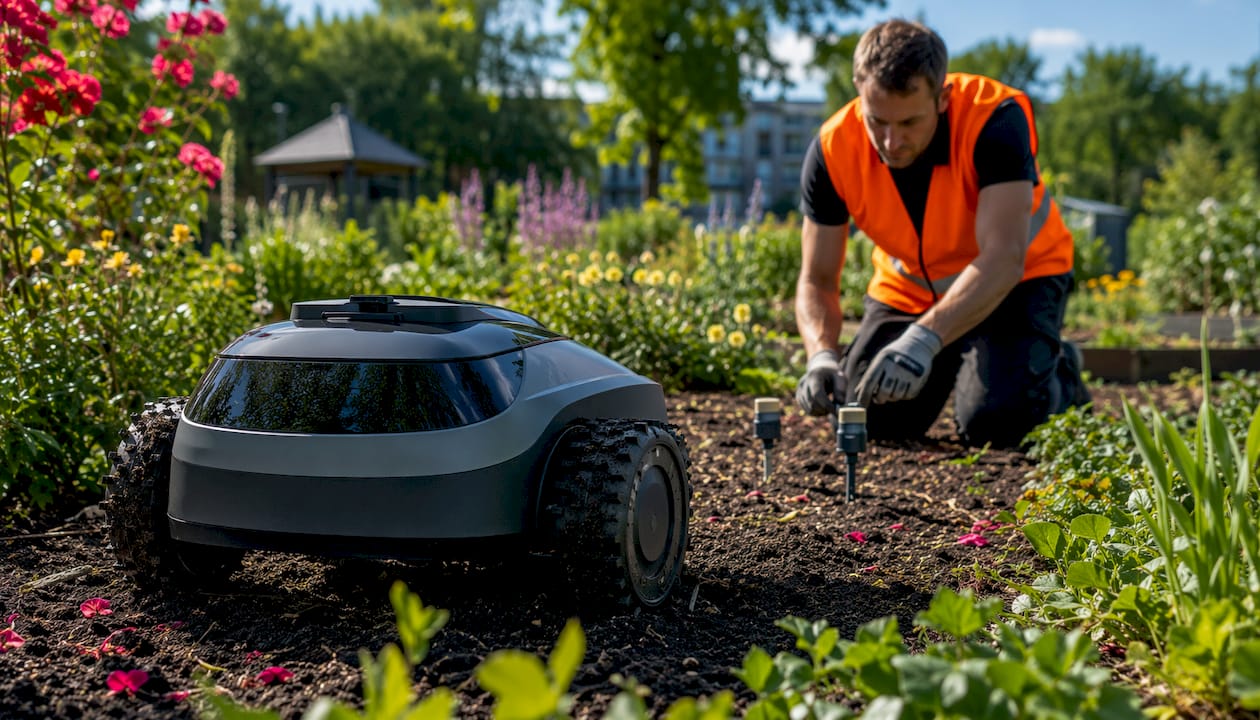
Soil health comes before everything else. No-dig approaches preserve soil structure, retain moisture, and reduce the carbon released by mechanical tillage. Protecting existing soil during any installation or maintenance work, using track mats or boards when machinery moves across wet ground, prevents the compaction that undermines long-term resilience.
Water-sensitive design closes the loop. Rainwater harvesting and permeable surfaces are high-impact improvements that lower runoff, reduce flood risk, and cut mains-water irrigation demand on commercial sites. Swales, rain gardens, and permeable paving let rain soak in rather than sheet off into stormwater drains, easing pressure on drainage infrastructure.
Pro Tip: Ask any candidate to show you their soil assessment methodology before signing a contract. A provider who cannot describe how they will test and improve your soil is unlikely to deliver long-term ecological outcomes.
One misconception worth addressing: sustainable does not mean scruffy. Precision ecological design can produce highly manicured results that outperform high-input traditional landscapes in both longevity and cost-efficiency.
Why robotics and automation make sustainable maintenance work at scale
The practical problem with ecological landscaping on large commercial sites is consistency. Traditional crews with ride-on mowers and boom sprayers intervene infrequently and heavily, compacting soil, over-applying chemicals, and missing the precise timing that keeps native plantings healthy.
Low-impact autonomous technology changes that equation. Robotic mowers operate continuously at low ground pressure, cutting little and often rather than scalping grass in a single pass. Autonomous sprayers apply product only where sensors detect a target weed, cutting chemical use sharply compared with blanket treatments. Robotic solar-panel cleaners run on scheduled cycles, maintaining panel efficiency without water waste or manual access to elevated or hazardous arrays.
The operational benefits for industrial sites are equally concrete:
- Consistent output — autonomous machines maintain the same cut height and spray pattern regardless of crew availability or weather windows.
- Safer access — robots can work on steep embankments, around live electrical infrastructure, and in areas where sending a person creates unacceptable risk.
- Reduced liability — fewer manual operators on hazardous terrain means fewer incidents and lower workers’ compensation exposure.
- Documented performance — modern autonomous systems generate logs of area covered, run time, and intervention rates, giving facilities teams the data they need for reporting and contract reviews.
For automated grounds maintenance at scale, the combination of ecological design and robotic delivery is not a premium add-on. It is the only model that reliably achieves both environmental and operational targets on large sites.
What services should an eco-friendly landscaping company offer your site?
| Service | Expected outcome |
|---|---|
| Robotic mowing | Consistent grass height, low ground pressure, minimal soil disturbance |
| Autonomous weed control/spraying | Targeted chemical application, reduced product use, documented coverage |
| Robotic solar-panel cleaning | Maintained panel efficiency, scheduled cycles, no manual access risk |
| Rainwater harvesting systems | Reduced mains-water demand, lower runoff, measurable water savings |
| Permeable paving and hardscape retrofits | Reduced surface runoff and flood risk; long-term cost savings |
| Soil restoration and no-dig maintenance | Improved soil structure, moisture retention, reduced carbon from tillage |
| Site audits and performance reporting | Baseline data, measurable KPIs, evidence for compliance and ESG reporting |
Supporting activities that separate credible providers from the rest: documented site audits before work begins, safety certification for autonomous equipment, and regular performance reports covering water saved, uptime, and solar-efficiency gains.
How to choose the right green landscape contractor: a procurement checklist
Follow this sequence when evaluating candidates.
- Scope audit — require a written site assessment before any proposal. A provider who quotes without walking the site is guessing.
- Technical capability — confirm they operate robotic mowers, autonomous sprayers, and robotic solar-panel cleaners, not just conventional equipment with an eco label.
- Safety and compliance — ask for documented safety procedures for autonomous equipment, operator training records, and evidence of compliance with Australian workplace health and safety requirements.
- Measurable KPIs and SLAs — insist on defined service levels: uptime targets, response times for faults, and environmental metrics (water use, chemical volume, solar output).
- Pilot period — stage the contract. Run a paid pilot on one zone or one solar array before committing to full-site rollout.
- Contracting and reporting — lock in quarterly performance reports and a review clause tied to KPI achievement.
Questions worth asking every candidate:
- What is your robotic equipment’s average uptime, and how do you handle breakdowns?
- How do your autonomous sprayers determine application zones, and what data do you provide post-treatment?
- Can you show performance data from a comparable Australian commercial site?
Red flags: no documented ecological design approach, no performance reporting from existing clients, inability to provide safety certification for autonomous equipment, and vague answers about how they measure outcomes.
Trust signals: site audit reports provided before contract, published case studies with measurable results, safety certificates for robotic equipment, and references from Australian commercial or industrial clients.
Pro Tip: Robotic lawn mowing safety documentation is a reliable proxy for overall operational maturity. If a provider cannot produce it, their compliance culture is probably thin across the board.
What does implementation actually look like, and when do results appear?
Permeable surfacing, rainwater harvesting, and no-dig soil care together produce measurable operational savings and improved resilience in developed sites — but the timeline matters. Early wins come from safety and consistency; the deeper environmental gains take months to compound.
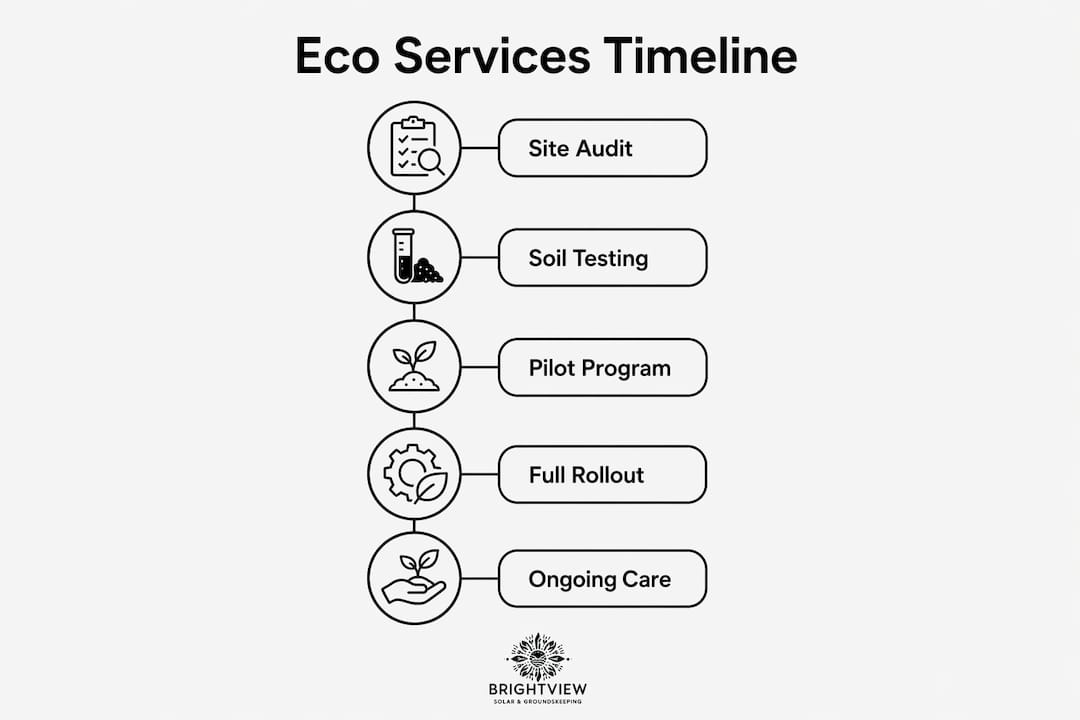
A realistic rollout for a commercial or industrial site runs through four phases:
Weeks 2–6: Audit and design. Site assessment, soil testing, water-use baseline, solar-panel soiling audit. The output is a written scope with ecological design specifications and robotic deployment plan.
Weeks 4–12: Pilot and optimisation. Robotic mowers and sprayers deployed on a defined zone. Solar-panel cleaning robots commissioned on one array. KPIs tracked weekly; settings adjusted.
Months 2–6: Full rollout. Phased expansion across the full site. Rainwater harvesting and permeable paving works scheduled where they deliver the highest runoff reduction, consistent with NSW BASIX guidance on prioritising these interventions early.
Ongoing: Quarterly optimisation and reporting. Soil health improves over 12–24 months as no-dig maintenance compounds. Solar yields stabilise at a higher baseline once regular robotic cleaning is established. Full return on investment typically becomes visible in the medium term as chemical, water, and labour costs fall.
Stage your contract to match this timeline. Pay for the pilot separately, then scale after measured success.
What Brightview Solar & Groundskeeping delivers for Australian property managers
Brightview Solar & Groundskeeping operates across Australia with a service model built specifically around autonomous maintenance for commercial and industrial sites. Their three core services, robotic mowing, robotic spraying, and robotic solar-panel cleaning, are designed to work together as an integrated programme rather than standalone offerings.
Autonomous machines allow Brightview Solar & Groundskeeping to access difficult areas safely and effectively — steep embankments, live electrical zones, elevated solar arrays — where sending manual operators creates unacceptable risk. That capability is not incidental; it is the core operational advantage for industrial sites.
The expected outcomes Brightview Solar & Groundskeeping emphasises are consistent landscape condition across large sites, improved solar-array efficiency through scheduled panel cleaning, and documented performance reporting that gives property managers the evidence they need for ESG and compliance purposes.
When engaging Brightview Solar & Groundskeeping, or any provider, request the following before signing: a written site audit report, safety certificates for all autonomous equipment, sample performance metrics from a comparable site, and a draft SLA with defined uptime and environmental KPIs.
Key takeaways
Automation-led ecological maintenance, combining robotic mowing, spraying, and solar-panel cleaning with soil-first and water-sensitive design, is the most reliable route to measurable environmental and operational gains on Australian commercial and industrial sites.
| Point | Details |
|---|---|
| Start with a site audit | Map water use, chemical inputs, and solar soiling before specifying any service. |
| Require robotic capability | Confirm autonomous mowers, sprayers, and panel cleaners are in the provider’s active fleet. |
| Stage contracts with pilots | Run a paid pilot on one zone before committing to full-site rollout. |
| Insist on safety documentation | Request compliance certificates and operator training records for all autonomous equipment. |
| Brightview Solar & Groundskeeping | Delivers integrated robotic mowing, spraying, and solar-panel cleaning for Australian commercial and industrial sites, with performance reporting included. |
Why automation-led ecological maintenance is the only honest answer
The conventional procurement instinct is to treat sustainability as a specification add-on: ask for native plants, tick the water-efficiency box, and move on. That approach consistently underdelivers because it leaves the maintenance model unchanged. A beautifully designed ecological planting scheme maintained by infrequent heavy machinery will degrade within two seasons.
The providers worth hiring are those who treat robotics as the delivery mechanism for ecological outcomes, not as a separate technology pitch. Frequent, low-impact autonomous interventions preserve the soil structure and plant health that make sustainable design work. Without that, you are paying for ecological design and getting conventional results.
For Australian property managers, the practical question is not whether to go eco. It is whether your provider can actually maintain ecological standards at the scale and consistency your site demands. That is where autonomous systems earn their place.
Brightview Solar & Groundskeeping: request a site audit or pilot
Commercial and industrial property managers who want measurable results, not just a greener specification, get the most from starting with a site audit. Brightview Solar & Groundskeeping offers robotic mowing, spraying, and solar-panel cleaning as an integrated service for Australian sites, with documented performance reporting from day one.

The practical next step is a site audit scoped to your grounds and solar assets. From there, a pilot on one zone or one array gives you real performance data before any full-site commitment. Explore Brightview Solar & Groundskeeping’s robotic lawn mowing service and solar energy robotics pages for service detail, then get in touch to request your audit.
Useful sources
| Source | What it covers |
|---|---|
| NSW Planning — BASIX | Australian planning guidance on water-sensitive design, rainwater harvesting, and permeable surfaces for commercial sites |
| Soil & Garden Alliance Australia | Soil-first and no-dig best practice for Australian landscapes |
| Landscape Design Institute Australia | Ecological landscaping principles including right plant, right place |
| Water by Design | Practical guidance on permeable surfaces, runoff control, and water savings |
| Renew | Sustainable design perspectives, including evidence that ecological design can achieve high aesthetic standards |
| National Wildlife Federation — ecological landscape design | Water techniques including permeable surfaces, swales, and rain gardens |
| Brightview Solar & Groundskeeping — automated grounds maintenance | BrightView’s Australian robotic grounds maintenance services and contact |
| Brightview Solar & Groundskeeping — robotic mowing service guide | Service detail and safety information for robotic mowing contracts |
FAQ
What makes a landscaping company genuinely eco-friendly?
A genuinely eco-friendly provider applies ecological design principles, including right plant, right place and soil-first maintenance, alongside measurable reductions in water use, chemical inputs, and emissions. Ask for documented performance data, not just a sustainability policy.
How does robotic maintenance reduce environmental impact on large sites?
Autonomous mowers and sprayers intervene frequently at low intensity, preserving soil structure and applying chemicals only where needed. That targeted approach cuts product use and ground compaction compared with conventional infrequent heavy-machinery visits.
When should a commercial site expect to see water savings?
Rainwater harvesting and permeable surfacing, the highest-impact early interventions according to NSW BASIX guidance, typically produce measurable reductions in mains-water demand within the first full season after installation.
Can Brightview Solar & Groundskeeping service industrial sites with solar arrays?
Yes. Brightview Solar & Groundskeeping’s robotic solar-panel cleaning service is designed for commercial and industrial arrays, including sites where manual access to panels creates safety or operational risk.
What contract terms should property managers require from eco landscaping providers?
Require a pilot period before full-site commitment, defined SLAs covering uptime and environmental KPIs, quarterly performance reports, and documented safety certification for all autonomous equipment.

