
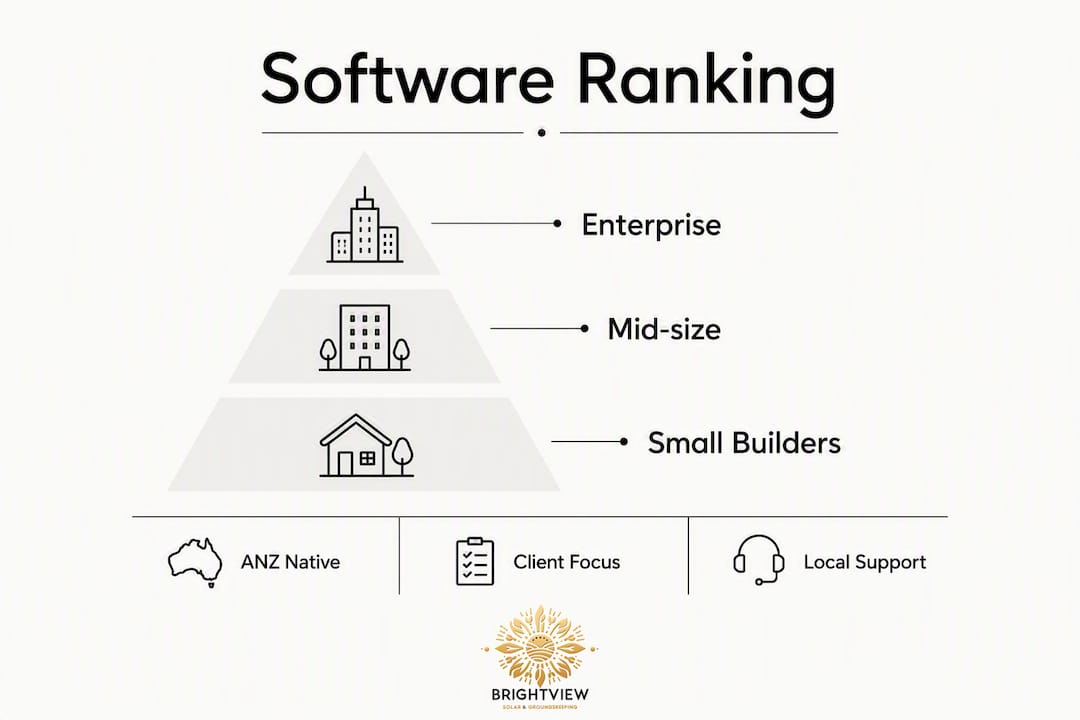
For most Australian construction businesses, the shortlist comes down to five platforms: Procore for large general contractors needing end-to-end control, Autodesk Construction Cloud where BIM and drawing management are central, Oracle Aconex for complex multi-stakeholder commercial builds, Jobpac (Trimble Jobpac) for mid-to-large contractors who need integrated project accounting, and Buildxact for small residential builders and tradie-led teams. Selection criteria used here: ANZ support availability, field mobility, RFI and drawing control, accounting integrations (Xero/MYOB), and implementation timeline.
Quick picks by company size:
- Small residential / tradie teams: Trial Buildxact or Buildertrend first.
- Mid-tier commercial contractors: Jobpac or Deep Space (with KAI) for ANZ-focused workflows.
- Enterprise / large commercial: Procore, Autodesk Construction Cloud, or Oracle Aconex.
- Field-service and subcontractor-heavy operations: Connecteam, Jobber, or FieldPulse depending on crew size.
Table of Contents
- The best contractor management software compared for ANZ projects
- How to choose the right platform for your business
- ANZ considerations: compliance, contracts and integrations
- Key takeaways
- What Australian project managers often get wrong about software selection
- Brightview Solar & Groundskeeping: a different approach to contractor workflows
- FAQ
- Research sources and vendor pages worth reviewing
The best contractor management software compared for ANZ projects
Australian facilities and property managers increasingly rely on CAFM and construction platforms that combine contractor compliance tracking, mobile access, and multi-site visibility. The table below maps each platform against the dimensions that matter most in an Australian procurement decision.
| Platform | Best for | Core features | Integrations | ANZ support | Pricing model |
|---|---|---|---|---|---|
| Procore | Large general contractors | RFIs, drawings, financials, quality & safety | Xero, MYOB, BIM tools | ANZ office, local references | Per-project / annual |
| Autodesk Construction Cloud | BIM-centric projects | Drawing control, model coordination, RFIs | Revit, Navisworks, BIM 360 | Regional resellers | Per-seat / annual |
| Oracle Aconex | Complex multi-stakeholder builds | Document control, audit trails, correspondence | Oracle ERP, BIM tools | ANZ presence, large-project focus | Per-project |
| Jobpac (Trimble Jobpac) | Mid-to-large civil & commercial | Project accounting, cost control, ERP back-office | MYOB, payroll, Trimble tools | ANZ-built, local support | Per-seat / module |
| Buildxact | Small residential builders | Estimating, scheduling, job management | Xero, MYOB | Australian-based support | Per-seat / monthly |
| Buildertrend | Residential builders, remodelers | Client communication, scheduling, daily logs | Xero, QuickBooks | ANZ users, US-based support | Per-seat / monthly |
| Deep Space (with KAI) | ANZ commercial contractors | Project controls, data insights, regional workflows | ANZ accounting tools | ANZ-focused | Enquire |
| Cheops | Specialised cost management | Cost reporting, custom reporting, project controls | Varies | Limited ANZ presence | Enquire |
| Field Service | Mobile workforce management | Scheduling, dispatch, technician tracking | CRM, ERP tools | Varies by vendor | Per-seat |
| Jobber | Small trades & maintenance | Job scheduling, invoicing, client management | Xero, QuickBooks | ANZ users, North American support | Per-seat / monthly |
| Field Nation | Subcontractor-heavy operations | Contractor marketplace, sourcing, compliance | Varies | US-focused | Per-transaction |
| Connecteam | Deskless field crews | Scheduling, checklists, comms | Varies | ANZ users, remote support | Per-seat / monthly |
| FieldPulse | Small service businesses | Mobile job management, invoicing | Xero, QuickBooks | Remote support | Per-seat / monthly |
| Emvisage | Inspection-heavy teams | Photo reporting, visual inspection workflows | Varies | ANZ users | Enquire |
Procore
Procore’s general contractor platform connects field operations, project financials, and quality and safety in one environment. For large Australian contractors managing multiple concurrent projects, the ability to track RFIs, drawings, and cost variations from a single dashboard is the core appeal. Local ANZ references exist, and the platform integrates with Xero and MYOB. Vendor marketing cites measurable project closeout improvements in customer stories; ask for ANZ-specific case studies during your demo to validate those claims against local conditions.

Strengths: End-to-end project control; strong financials module; solid mobile app for site teams.
Watch for: Per-project pricing can escalate on high-volume portfolios; confirm subcontractor licence costs upfront.
Autodesk Construction Cloud
Where drawing and model coordination is the daily workflow, Autodesk Construction Cloud is hard to beat. Its deep integration with Revit and Navisworks means design and construction teams share a single source of truth for drawings and models. RFI and submittal workflows are tightly linked to the document set. For Australian projects with BIM mandates or complex design coordination, this is the natural fit.

Strengths: Best-in-class BIM/CAD integration; version control for drawings; strong RFI workflows.
Watch for: Less suited to back-office financials; relies on third-party integrations for cost control.
Oracle Aconex
On large commercial and infrastructure projects with multiple head contractors, consultants, and owners, Aconex’s document control and audit trail capability is genuinely difficult to replicate. Every correspondence, drawing issue, and variation is logged with a tamper-evident history, which matters when contractual disputes arise. It has a meaningful ANZ presence built on major Australian infrastructure projects.
Strengths: Rigorous document audit trails; multi-party collaboration; contractual compliance records.
Watch for: Steeper learning curve; implementation timeline on large projects can run several months.
Jobpac (Trimble Jobpac)
Jobpac is an Australian-built ERP for construction, which means the cost-control logic, payroll integrations, and reporting structures are designed around how Australian contractors actually operate. Mid-to-large civil and commercial contractors who need project accounting tightly coupled to their back office will find it a closer fit than a US-built platform adapted for ANZ.
Strengths: ANZ-native; strong project accounting; integrates with local payroll providers.
Watch for: Less emphasis on field-mobile workflows compared to Procore or Autodesk.
Buildxact
For residential builders and small commercial teams, Buildxact solves the estimating-to-job-management gap that spreadsheets create. Estimating, scheduling, and client communication sit in one place, and the Xero integration means invoicing does not require double entry. Australian-based support is a genuine differentiator at this end of the market.
Strengths: Estimating tied to job management; Xero/MYOB integration; local support.
Watch for: Not designed for enterprise-scale project controls or complex RFI workflows.
Buildertrend
Buildertrend suits residential builders who need client-facing features: a client portal, daily logs, and photo sharing. Scheduling is straightforward. The platform has ANZ users but support is US-based, so time-zone response times are worth confirming before committing.
Deep Space (with KAI)
Deep Space is an ANZ-focused platform that brings construction data insights and project controls to commercial contractors in the region. Its regional focus means integrations and workflows are built around local practices rather than adapted from a global template.
Cheops, Field Service, Field Nation, Emvisage
Cheops suits contractors who need flexible cost reporting and custom project accounting. Field Service platforms (as a category) cover scheduling and dispatch for mobile workforces. Field Nation is a subcontractor marketplace rather than a project management tool. Emvisage targets teams that run photo-rich inspection and reporting workflows. Each fills a specific gap; none replaces a full construction management platform.
Jobber, Connecteam, FieldPulse
These three serve small-to-mid-size service and trades businesses. Jobber handles job scheduling and invoicing cleanly for small maintenance teams. Connecteam is strongest for deskless crew communication, checklists, and shift scheduling. FieldPulse is a lightweight mobile-first option for small service operators. None of the three is built for construction project controls, but all three are worth considering for subcontractor workforce management alongside a primary construction platform.
How to choose the right platform for your business
The single most useful decision rule: choose the platform that covers your top three operational pain points and integrates with your accounting and BIM tools without requiring a custom build.
Start by mapping where your current process breaks down. Is it drawing version control? Variation tracking? Subcontractor compliance records? Contractor onboarding? The answer narrows the field faster than any feature checklist.
Define your needs before the demo. Write down the three workflows that cost you the most time or create the most risk. Bring those to every vendor conversation and ask them to demonstrate exactly those scenarios, not a scripted tour.
Test field workflows on a real device. Mobile app quality varies enormously. Ask for a sandbox environment and have a site supervisor or foreman test it on the device they actually carry. Offline capability matters on Australian sites with patchy connectivity.
Validate contractor onboarding and compliance features. Can subcontractors upload their own licence and insurance documents? Does the system flag expiry dates automatically? These features reduce administrative load and protect you when a regulator asks for records.
Ask vendors directly:
- Do you have ANZ-based support staff, and what are their hours?
- Can you provide two or three Australian case studies in our project type?
- How does your platform handle SOPA-related variation records and contract correspondence?
- What is the typical onboarding timeline for a team our size?
- Are there additional fees for subcontractor user licences?
Red flags to watch for: hidden per-subcontractor fees that inflate the real cost; mobile apps that require constant connectivity; vendors who cannot name a single ANZ reference project; and implementation timelines quoted in weeks that experienced users say take months.
Pro Tip: On day one of a trial, load a real active project rather than dummy data. Assign one subcontractor as a test user. The friction points you hit in the first week are the friction points your whole team will hit at scale.
ANZ considerations: compliance, contracts and integrations
Australian construction projects carry compliance obligations that do not appear in US or European software defaults. Before signing a contract with any vendor, work through this checklist.
Contractor licence and insurance compliance:
- Confirm the platform can store and track contractor licence numbers by state (QBCC in Queensland, Building Commission in Victoria, etc.).
- Check whether insurance certificate expiry dates trigger automatic alerts.
- Verify WHS incident reporting workflows align with Safe Work Australia requirements.
Contract and variation records:
- Australian Standard (AS) contracts and ABIC forms require clear variation approval chains. Confirm the platform supports variation registers with approval timestamps.
- Security of Payment Act (SOPA) obligations mean payment claim records must be retrievable quickly. Ask how the platform stores and exports payment claim correspondence.
Accounting and BIM integrations:
- Xero and MYOB are the dominant accounting platforms for Australian contractors. Confirm native integration, not just CSV export.
- For BIM-heavy projects, check whether the platform connects to Revit, Navisworks, or the document storage your design team already uses (SharePoint, Procore Docs, BIM 360).
Data residency and support:
- Self-hostable CAFM options like inFM exist for organisations that need air-gapped or on-premises deployments, particularly relevant for defence, health, and mining sectors.
- For SaaS platforms, ask whether Australian data residency is available and whether the vendor can confirm data does not transit through US or EU servers without consent.
- QFM (Service Works Global) offers SLA tracking and IoT integrations relevant to facilities managers who need contract monitoring alongside construction controls.
Proving compliance to owners and tenants:
Software audit logs are increasingly accepted as evidence in Australian contract disputes. Ask vendors whether their audit trail is exportable in a format acceptable to legal counsel, and whether it captures user-level actions (who approved what, and when).
Key takeaways
The right contractor management platform for Australian builders is the one that fits your existing site workflows, supports local compliance, and connects to the accounting tools your finance team already uses.
| Point | Details |
|---|---|
| Match platform to project type | Large commercial needs Procore or Aconex; small residential suits Buildxact or Buildertrend. |
| ANZ support matters | Prioritise vendors with local support staff and Australian case studies to reduce onboarding delays. |
| Compliance features are non-negotiable | Confirm licence tracking, insurance expiry alerts, and SOPA-compatible variation records before signing. |
| Integration with Xero or MYOB | Native accounting integration prevents double entry and reduces financial reporting errors. |
| Brightview Solar & Groundskeeping | Offers an outsourced robotic alternative for grounds and solar maintenance, removing those contractor workflows from your software stack entirely. |
What Australian project managers often get wrong about software selection
The feature count is not the point. Every major platform in this list has more features than any single project team will use. The real question is whether the platform works the way your site teams actually work, not whether it can theoretically do everything.
The vendors that promise global scale but lack ANZ deployment resources are the ones that cause protracted onboarding. A platform with a local account manager who has been on an Australian construction site is worth more than a platform with twice the feature list and a US-based support queue that opens at midnight Sydney time.
There is also a tendency to underestimate subcontractor adoption. The software only delivers value when the people in the field use it. Including subcontractors in the pilot from week one, rather than treating them as an afterthought, is the single most reliable predictor of whether a rollout succeeds. The first three months of real usage reveal whether permission models and offline features are actually fit for purpose on your sites.
One more thing worth saying plainly: for some contractor workflows, particularly grounds maintenance and solar panel servicing, the better answer is not better software. It is removing the workflow from your plate entirely by contracting a specialist. That distinction matters when you are scoping what your platform actually needs to manage.
Brightview Solar & Groundskeeping: a different approach to contractor workflows
Software platforms manage contractor workflows. Brightview Solar & Groundskeeping removes certain workflows from the equation entirely. For commercial property managers and solar farm operators, robotic mowing, spraying, and solar panel cleaning are contractor tasks that typically require scheduling, compliance records, site access coordination, and quality checks inside whatever platform you choose. Brightview Solar & Groundskeeping handles all of that operationally, deploying autonomous machines that access difficult or hazardous areas safely, without the administrative overhead of managing a traditional contractor relationship.
The practical difference: instead of tracking a grounds or solar maintenance contractor through your project management platform, you receive a contracted service with built-in compliance and reporting. For asset managers and property managers who want to reduce the number of contractor relationships sitting inside their software stack, that is a concrete reduction in administrative load. Explore the benefits of robotic landscaping for commercial sites, or review solar panel cleaning options for your assets. Contact Brightview Solar & Groundskeeping to discuss a service assessment for your site.
FAQ
What is the best contractor management software for small Australian builders?
Buildxact and Buildertrend are the strongest options for small residential builders, with Buildxact offering Australian-based support and estimating tied directly to job management.
Does contractor management software support Australian compliance requirements?
The leading platforms support contractor licence tracking, insurance expiry alerts, and variation registers, but you must confirm SOPA-compatible records and state-specific licence fields (such as QBCC) during your demo.
How long does implementation typically take for an Australian construction team?
Implementation ranges from a few weeks for small-team platforms like Buildxact or Jobber to several months for enterprise deployments of Procore or Oracle Aconex on large commercial projects.
Can these platforms integrate with Xero or MYOB?
Procore, Buildxact, Buildertrend, Jobber, and FieldPulse all offer Xero or MYOB integrations; confirm whether the integration is native or requires a third-party connector before committing.
What should I look for in ANZ vendor support?
Prioritise vendors with local support staff, Australian case studies in your project type, and confirmed data residency options if your organisation has sovereignty requirements.
Research sources and vendor pages worth reviewing
- General contractor software — Procore: product capabilities and ANZ case study starting point.
- Best CAFM software for facilities management — JKFM: Australian-focused CAFM category guide with regional tool comparisons.
- inFM — self-hosted CAFM for Australian deployments: relevant for data sovereignty and air-gapped site requirements.
- QFM CMMS — Service Works Global Australia: SLA tracking, PPM scheduling, and IoT integrations for facilities managers.
- Brightview Solar & Groundskeeping — robotic grounds and solar services: outsourced contractor workflow alternative for grounds and solar maintenance.
- Automated grounds maintenance guide: practical overview of robotic service deployment for Australian commercial sites.

