
Robotic landscaping delivers three things commercial property managers consistently struggle to get from traditional crews: predictable quality, lower operating costs, and measurable solar output gains. Autonomous mowing and cleaning equipment runs to schedule regardless of staffing shortages, covers ground at consistent intervals, and generates the kind of operational data your OPEX reporting actually needs.
The short version:
- Lower OPEX — fewer labour hours, reduced fuel spend, and less servicing from electric fleets with fewer moving parts
- Consistent quality — “little and often” mowing cycles eliminate the boom-and-bust of weekly cuts
- Quieter operation — electric units run well below the noise threshold of petrol equipment, improving tenant amenity
- Reduced emissions — no combustion on site, lower carbon footprint for sustainability reporting
- Better turf health — fine clippings returned as mulch reduce chemical inputs
- Improved solar availability — regular automated cleaning reduces soiling losses and manual climb cycles
For KPIs and procurement detail, jump to the deployment and checklist sections below.
To start a pilot with Brightview Solar & Groundskeeping, the contact details are in the promo section.
Table of Contents
- How do the benefits of robotic landscaping reduce running costs?
- What are the environmental advantages for commercial sites?
- Safety, access and Australian regulatory compliance
- How does robotic cleaning improve solar panel performance?
- How do crews change after robotic deployment?
- What does a pilot look like, and which KPIs should you track?
- Procurement checklist for robotic landscaping suppliers
- Brightview Solar & Groundskeeping: operational results
- Key takeaways
- The adoption path most managers get wrong
- Brightview Solar & Groundskeeping: next steps for procurement
- Useful sources
- FAQ
How do the benefits of robotic landscaping reduce running costs?
The core mechanism is the shift from weekly heavy cuts to frequent shallow passes. Traditional mowing concentrates labour into a single long visit; robotic mowing spreads the same work across daily or near-daily cycles with no crew on site. That changes the labour model fundamentally.
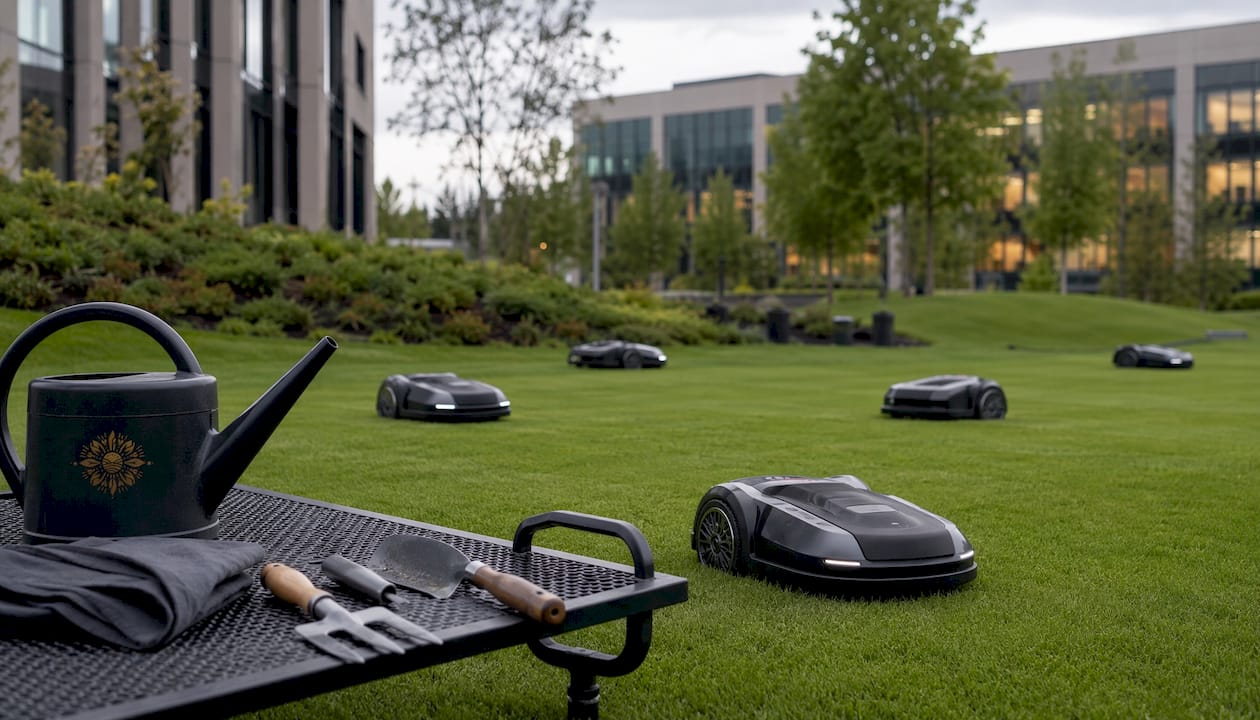
Fleet orchestration is where the real OPEX value sits for asset managers with multiple properties. A central platform handles scheduling, remote diagnostics and performance monitoring across sites, which means one fleet manager can oversee what previously required several crews. Downtime stabilises because faults are flagged before they become failures.
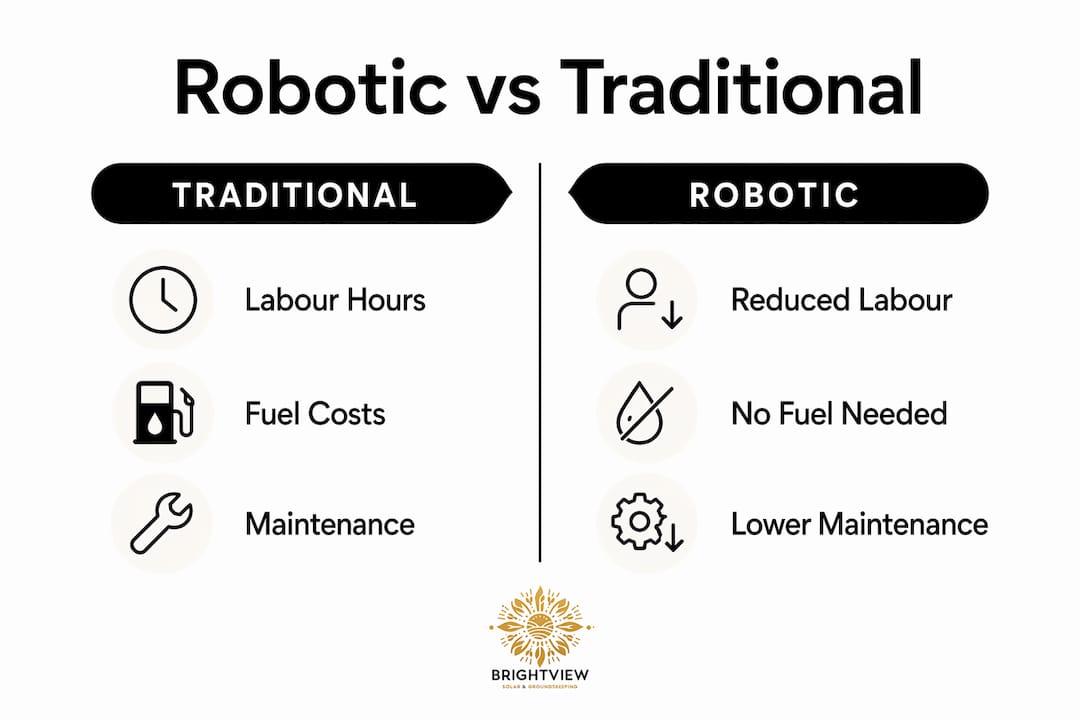
Electric commercial units also cut maintenance intervals. No oil changes, no spark plugs, no fuel storage — and fewer moving parts mean fewer breakdowns over a service contract term.
| Input category | Traditional approach | Robotic approach |
|---|---|---|
| Labour hours per visit | High (full crew, long duration) | Low (supervision and edging only) |
| Fuel/energy cost | Petrol, variable pricing | Electricity, predictable rate |
| Servicing frequency | Regular oil, filter, spark plug | Blade changes, battery cycles |
| Scheduling flexibility | Crew-dependent | Platform-controlled, consistent |
| Data output | Minimal | Uptime, area covered, fault logs |
Pro Tip: Before deployment, log your current service hours, visit frequency and fuel spend for a 90-day baseline. That single data set is what makes your before/after ROI case watertight.
What are the environmental advantages for commercial sites?
AI-supported smart irrigation paired with robotic groundskeeping can significantly improve water use efficiency in managed turf areas. When soil-moisture sensors drive irrigation schedules rather than fixed timers, water is applied only when the turf needs it.
The “little and often” cut pattern does something a weekly mower cannot: it returns fine clippings directly to the soil as a natural mulch. Nutrients and moisture stay in the root zone, microbial activity improves, and the need for synthetic fertiliser drops. Grass stays greener with less chemical input, which matters for sites near waterways or with environmental licence conditions.
Electrified robotic fleets eliminate on-site combustion entirely. No petrol fumes, no exhaust near building air intakes, and noise levels low enough to run during business hours without tenant complaints. For sustainability reporting under NABERS or similar frameworks, that shift from petrol to grid electricity is a straightforward emissions reduction to quantify.
Measurable sustainability outcomes you can report:
- Reduction in petrol consumption (litres per month)
- Reduction in synthetic fertiliser applications per season
- Water savings when paired with sensor-driven irrigation
- Noise reduction (decibels) during operating hours
- Lower carbon intensity per square metre maintained
Safety, access and Australian regulatory compliance
Autonomous grounds equipment in Australia sits at the intersection of electrical safety, workplace health and safety obligations, and site-specific access controls. Getting this right before deployment protects both your asset and your contractor relationship.
Key compliance items to verify with any supplier:
- Battery storage and charging — lithium-ion charging infrastructure must comply with AS/NZS standards for electrical installation; confirm your site’s switchboard capacity before adding charging stations
- Exclusion zones — define and document pedestrian exclusion areas during operating hours; this is a WHS obligation under the Work Health and Safety Act 2011 (Cth) and state equivalents
- Incident reporting — autonomous equipment incidents must be captured in your site’s hazard register; confirm the supplier’s protocol for remote fault notification
- Site isolation procedures — establish clear lockout/tagout procedures for maintenance access to charging docks and boundary hardware
Brightview Solar & Groundskeeping publishes a robotic mower safety guide that covers these compliance touchpoints in detail. Use it as a checklist during contract negotiations, not after.
Require documented risk assessments and safe work method statements from any robotic landscaping supplier before site access is granted. Suppliers who cannot produce these promptly are a procurement red flag.
Pro Tip: Stage your safety documentation review before the site survey, not after. Discovering a charging infrastructure gap post-contract costs significantly more to fix than addressing it in the scoping phase.
How does robotic cleaning improve solar panel performance?
Soiling is the primary cause of preventable generation loss on commercial and industrial solar arrays. Dust, bird droppings, pollen and organic debris accumulate on panel surfaces and reduce the amount of light reaching the cells. Regular automated cleaning removes this layer before it compounds.
Robotic solar cleaning units operate on programmed schedules, using sensor-based detection to identify debris and apply the right cleaning cycle without manual intervention. That means fewer technician climbs, lower safety exposure, and a cleaning frequency that manual programmes rarely match in practice. For large rooftop or ground-mounted arrays, the difference between monthly manual cleaning and weekly automated cleaning can be substantial in recovered generation.
Integration with SCADA or asset monitoring systems lets you correlate cleaning events with generation data directly. Track kWh recovered per cleaning cycle, monitor panel availability rates, and use fault alerts to schedule targeted maintenance rather than blanket inspections. Brightview Solar & Groundskeeping’s approach to solar energy robotics covers how this monitoring layer works in practice.
How do crews change after robotic deployment?
The honest answer: crew numbers often stay similar in the short term, but what those crews do changes completely. Repetitive mowing shifts to the machines; people move to tasks that actually require judgement.
Landscape companies using autonomy report labour consolidation around autonomous units, with crews redeployed to detailed finishing work, plant health monitoring and client-facing service. That reallocation tends to improve service quality on the tasks that matter most to tenants and asset owners.
New skills required after deployment:
- Fleet monitoring and scheduling platform operation
- Basic diagnostics and fault response
- Boundary mapping and site setup for new areas
- Irrigation system integration and tuning
Typical crew models post-deployment:
- Hybrid crew — one or two operators managing a mixed fleet of robotic and conventional equipment, handling edging, garden beds and exceptions
- Specialist fleet team — a small dedicated team managing multiple sites remotely, with periodic on-site visits for finishing and inspection
- Managed service model — supplier (e.g. Brightview Solar & Groundskeeping) provides fleet management and reporting; in-house staff handle access and tenant liaison only
What does a pilot look like, and which KPIs should you track?
Contractors advise mapping properties multiple times and sizing equipment conservatively rather than pushing capacity limits. Start with one site, learn the platform, then scale.
A practical pilot sequence runs 30–90 days: site assessment and boundary mapping, charging infrastructure installation, small fleet deployment, then a tuning period before full handover. Budget the first 30 days for calibration, not performance measurement.
| KPI | What to measure | Target signal |
|---|---|---|
| Fleet uptime | % of scheduled hours completed | Above 90% after tuning period |
| Area covered per day | m² per unit per operating day | Consistent with site spec |
| Service hours saved | Crew hours vs pre-deployment baseline | Measurable reduction |
| Mean time between faults | Hours between maintenance interventions | Improving trend over 90 days |
| Solar availability uplift | kWh recovered post-cleaning vs baseline | Positive delta per cleaning cycle |
Pilot acceptance criteria to insist on:
- Documented uptime logs from the fleet management platform
- Before/after area coverage comparison against the site plan
- Fault response time within the agreed SLA window
- Handover report including crew hours saved and any infrastructure issues identified
Procurement checklist for robotic landscaping suppliers
Must-have contract items:
- SLA metrics with defined uptime guarantees and response times
- Maintenance windows and who bears the cost of unplanned servicing
- Liability and insurance clauses covering autonomous equipment incidents
- Battery disposal and end-of-life equipment plan (relevant to Australian e-waste obligations)
- Data ownership — confirm you retain access to fleet performance logs
Questions to ask every supplier:
- What fleet management platform do you use, and can we access it directly?
- How are software updates managed, and do they require site downtime?
- What is your remote diagnostics capability, and how quickly are faults flagged?
- How does your equipment integrate with our existing BMS or property management system?
Red flags: no proof of fleet monitoring capability, vague safety documentation, inability to provide reference sites with verifiable performance data. For sites where robotics may not suit every area, robotic landscaping alternatives are worth reviewing before finalising scope.
Pro Tip: Stage payment milestones to performance. Tie a portion of contract value to verified KPI achievement at 30, 60 and 90 days — it aligns supplier incentives with your outcomes from day one.
Brightview Solar & Groundskeeping: operational results
Brightview Solar & Groundskeeping’s commercial deployments demonstrate the operational shifts property managers can expect. The table below reflects typical before/after indicators from Brightview’s service engagements.
| Metric | Before robotic service | After robotic service |
|---|---|---|
| Crew hours on mowing | High (full visit duration) | Reduced (edging and exceptions only) |
| Fleet uptime | N/A | 90%+ after tuning period |
| Solar panel cleaning frequency | Monthly manual | Weekly automated |
Brightview Solar & Groundskeeping’s safety and compliance resources are available for review before any site engagement.
Key takeaways
Robotic landscaping reduces OPEX, improves turf and solar asset performance, and delivers the operational consistency that commercial property managers cannot reliably get from traditional crew-based services.
| Point | Details |
|---|---|
| Track OPEX hours first | Service hours saved is the clearest month-one signal; establish a 90-day baseline before deployment. |
| Fleet management drives value | Central scheduling and remote diagnostics across multiple properties is where the real cost reduction sits. |
| Solar cleaning compounds gains | Regular automated cleaning reduces soiling losses and eliminates most manual climb cycles. |
| Compliance before site access | Require documented risk assessments, WHS-compliant charging infrastructure, and SLA metrics before signing. |
| Brightview Solar & Groundskeeping | Offers robotic mowing, spraying, and solar panel cleaning for commercial and industrial sites, with fleet management and safety documentation included. |
The adoption path most managers get wrong
The instinct is to start big: full fleet, multiple sites, immediate scale. That approach consistently underdelivers, and the reason is almost always the same. Site mapping takes longer than expected, charging infrastructure is underspecified, and crews haven’t been briefed on their new role before the machines arrive.
Brightview Solar & Groundskeeping’s recommended sequence is site selection first, then a contained pilot, then scale. The pilot is not a trial of the technology — it is a trial of your operational readiness. What you learn about boundary conditions, charging logistics and crew workflow in the first 90 days is what makes the scale-up work.
The other common mistake is treating fleet management as an afterthought. The machines are not the value centre; the platform that schedules them, flags faults and generates the performance data your asset reports need is. Insist on platform access from day one, not as an add-on after contract signing.
Brightview Solar & Groundskeeping: next steps for procurement
Commercial and industrial property managers who want predictable grounds and solar performance without the variability of traditional crew scheduling have a direct path forward with Brightview Solar & Groundskeeping.

Brightview Solar & Groundskeeping provides robotic mowing, robotic spraying, and robotic solar panel cleaning for commercial and industrial sites across Australia. Every engagement starts with a site survey and pilot proposal, with SLA metrics defined before any equipment is deployed. Fleet management and safety documentation are included, not optional extras.
For solar assets specifically, Brightview’s solar panel cleaning robot providers page outlines the cleaning options and how to assess which suits your array configuration. For grounds maintenance, the robotic lawn mowing service guide covers service models and pilot structures in detail.
Contact Brightview Solar & Groundskeeping at brightviewpty.au to request a site survey and pilot proposal.
Useful sources
- Brightview Solar & Groundskeeping — Robotic Mower Safety Guide — covers Australian WHS compliance, charging infrastructure and exclusion zone requirements for autonomous grounds equipment.
- Brightview Solar & Groundskeeping — Solar Energy Robotics — explains how robotic cleaning integrates with solar farm monitoring and SCADA systems.
- Green Industry Pros — Robotics and the next decade — industry analysis on fleet orchestration and adaptive navigation maturity.
- NALP — What contractors need to know before going all-in on robotics — practical deployment lessons from early adopters, including site mapping and pilot sequencing.
- MDPI — AI-supported smart irrigation study — research on water efficiency gains when AI irrigation is paired with automated groundskeeping.
- Landscape Management — Autonomous mowers transforming operations — case examples of crew redeployment and labour consolidation around autonomous units.
- Brightview Solar & Groundskeeping — Automation landscape for outdoor spaces — trend analysis and integration considerations for property management systems.
- Shed Factory — Artificial Lawn — useful reference for property areas where robotic mowing is not appropriate and low-maintenance turf alternatives apply.
FAQ
What are the main benefits of robotic landscaping for commercial properties?
Robotic landscaping reduces labour hours, lowers fuel and maintenance costs, delivers consistent mowing quality, and generates operational data for OPEX reporting. Paired with automated solar cleaning, it also improves panel availability and generation output.
How does robotic mowing improve turf health compared to traditional mowing?
Frequent shallow cuts return fine clippings to the soil as natural mulch, improving moisture retention and reducing the need for synthetic fertiliser. Weekly heavy cuts cannot replicate this nutrient cycle.
What Australian compliance requirements apply to autonomous grounds equipment?
Operators must comply with WHS obligations under the Work Health and Safety Act 2011 (Cth) and relevant state legislation, including exclusion zones, documented risk assessments, and electrical installation standards for charging infrastructure.
How do I measure ROI from a robotic landscaping pilot?
Track service hours saved, fleet uptime percentage, area covered per day, and solar kWh recovered per cleaning cycle against a 90-day pre-deployment baseline. These four metrics give a clear before/after picture.
Does Brightview Solar & Groundskeeping provide fleet management as part of its service?
Yes. Brightview Solar & Groundskeeping includes fleet management and safety documentation in its commercial service engagements, covering robotic mowing, spraying, and solar panel cleaning for Australian industrial and commercial sites.

