
The automation landscape is defined as the evolving ecosystem of technologies, platforms, and workflows that automate tasks to improve operational efficiency, cost-effectiveness, and environmental sustainability in landscape maintenance. In 2026, this ecosystem has moved well beyond simple timers and pre-programmed sprinkler systems. The sector is now shaped by AI-driven agents, autonomous robotics, and hybrid orchestration platforms that coordinate tasks across complex outdoor environments. Brightview Solar & Groundskeeping sits at the centre of this shift in Australia, applying robotic systems to lawn mowing, precision spraying, and solar panel cleaning. The industrial automation sector is projected to grow at a CAGR of 6–9% through 2030, driven by investments in robotics and autonomous systems. That growth signal tells organisations one thing: the window to adopt early and build operational advantage is open right now.
What technologies are shaping the automation landscape for outdoor spaces?
Autonomous robotics and AI agents are the two forces reshaping outdoor maintenance. They are not the same thing, and the difference matters enormously in practice.
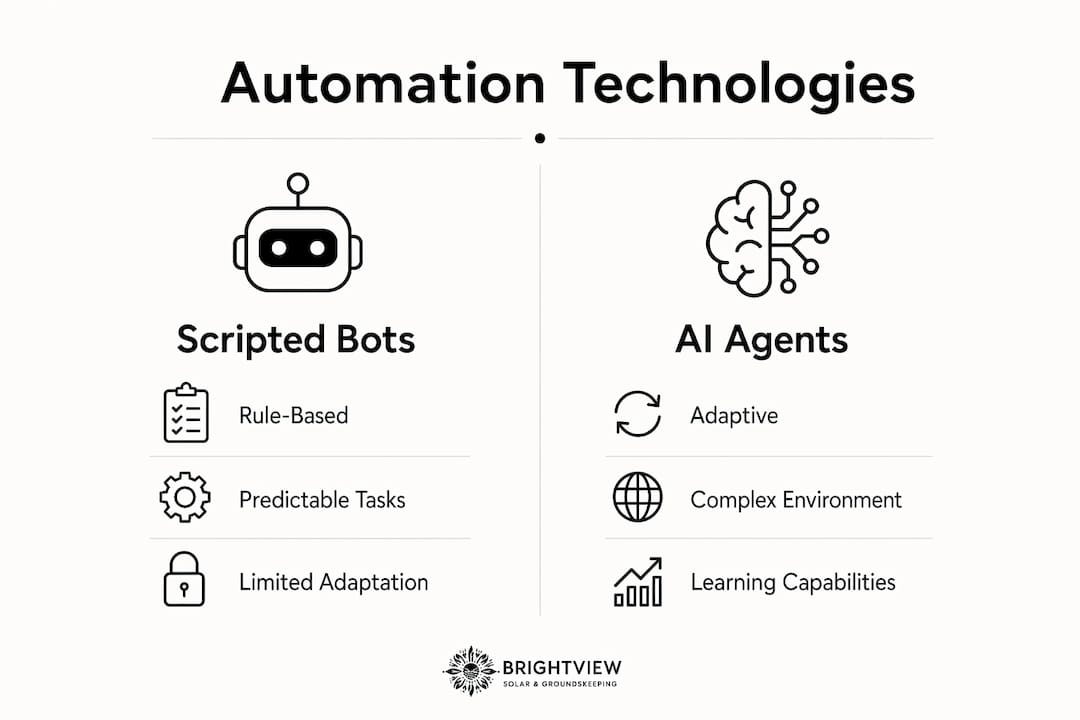
Scripted bots vs AI agents
Traditional scripted bots follow fixed rules. They work well in controlled, predictable environments. Outdoor spaces are neither. Grass grows unevenly, weather changes soil conditions, and obstacles appear without warning. AI agents that reason and adapt to environment variability outperform scripted bots in these conditions, reducing maintenance costs and improving outcomes. This shift from scripted to adaptive systems is the defining automation trend of 2026.
Hybrid orchestration platforms
88% of organisations operate across both cloud and on-premise infrastructure in 2026. That split creates a real problem: automation tools deployed in isolation produce inconsistent results. Hybrid orchestration platforms solve this by providing a centralised control layer that coordinates automated processes across multiple environments. For landscape operators managing multiple sites, this means a single dashboard can govern robotic mowers, irrigation systems, and solar panel cleaning robots simultaneously.
Digital twins and simulation
Digital twins are virtual replicas of physical environments. Operators use them to model terrain, test automation workflows, and identify failure points before deploying any hardware. Simulation environments are now considered a critical preparation step, not an optional extra. A commercial property manager, for example, can simulate how a robotic mower will handle a sloped lawn with garden beds before a single robot turns a wheel.
Pro Tip: Build your digital twin from real site survey data, not assumptions. Inaccurate terrain models produce automation plans that fail on day one.
What challenges affect automation adoption in landscape maintenance?
Automation in outdoor settings carries a specific set of challenges that indoor or factory-floor deployments do not face. Understanding these challenges before committing to a platform saves significant time and money.
Data quality as the core bottleneck
Data quality is the most significant bottleneck for autonomous landscaping robotics. Outdoor environments produce noisy, inconsistent data: variable lighting, uneven terrain, seasonal plant growth, and unpredictable weather all degrade sensor accuracy. Organisations that invest in simulation and digital twin preparation before hardware deployment consistently achieve better results than those that deploy first and troubleshoot later.
Human oversight and governance
Human-in-the-loop design remains a firm requirement in 2026. Automation handles routine workflow steps, but humans manage exception handling and critical decisions. This is not a limitation to work around. It is a governance feature that improves trust in automation outputs and reduces the risk of costly errors in residential or commercial settings.
The practical implications for landscape operators include:
- Assigning a designated operator to review flagged exceptions from robotic systems daily
- Setting clear escalation rules for situations the system cannot resolve autonomously
- Logging all human interventions to build a feedback dataset that improves future automation performance
- Scheduling regular audits of automated decisions to catch systematic errors early
Safety in residential and commercial settings
Full autonomous safe operation around humans in complex outdoor environments remains a development challenge, with truly general-purpose autonomy still years away. Current robotic systems perform best in defined zones with clear boundaries. Residential deployments require perimeter wire systems, sensor-based obstacle detection, and strict operational time windows to keep people and pets safe. Brightview Solar & Groundskeeping addresses this directly through its commitment to safety and regulatory compliance across all robotic deployments. For a thorough breakdown of what safe deployment looks like in practice, the robotic lawn mower safety guide covers the key requirements for 2026.
Pro Tip: Never deploy a robotic system in a new outdoor environment without a supervised trial period of at least two weeks. Real-world conditions always differ from the simulation.
How do organisations implement effective automation strategies?
Operational readiness determines the success or failure of automation implementation far more than the choice of technology. Organisations that treat automation as a strategic input into a closed-loop system, rather than a one-off purchase, consistently achieve stronger returns.
A practical implementation framework follows four steps:
- Map high-volume, high-cost processes first. Identify the landscape maintenance tasks that consume the most labour hours and carry the highest operational cost. Robotic mowing and solar panel cleaning are two clear candidates for most Australian commercial properties.
- Select platforms with centralised orchestration. Choose automation tools that integrate across your existing infrastructure. A platform that cannot communicate with your other systems creates data silos and governance gaps.
- Deploy incrementally, not all at once. Start with one focused workflow, measure the results, and refine before expanding. Broad deployments without a proven baseline produce unpredictable outcomes.
- Build a governance framework from day one. Define who monitors automated processes, how exceptions are escalated, and how performance data feeds back into system improvement. Closed-loop system design is what separates organisations that sustain automation gains from those that see early wins followed by stagnation.
Brightview Solar & Groundskeeping applies this incremental approach across its service offerings. Clients begin with a site assessment, move to a supervised robotic trial, and then transition to a fully managed automated maintenance programme. The robotic lawn mowing service guide details how this process works for residential and commercial clients across Australia.
Pro Tip: Treat your first automation deployment as a learning exercise, not a finished product. The data you collect in the first three months is more valuable than the efficiency gains.
What future trends will shape outdoor maintenance automation beyond 2026?
The next phase of the automation landscape will be defined by software, not hardware. Standardised hardware combined with software-driven value lowers entry barriers for smaller operators, making advanced automation accessible to businesses that previously could not justify the capital cost. This democratisation of automation tools is already visible in the Australian market.
| Trend | Current status | Expected impact by 2030 |
|---|---|---|
| AI agent adoption | Growing in controlled outdoor tasks | Wider deployment across variable environments |
| Digital twin use | Standard in enterprise deployments | Accessible to mid-size operators |
| Standardised hardware | Emerging across robotic platforms | Lower costs, broader adoption |
| Predictive analytics | Used in solar and irrigation systems | Integrated across full maintenance workflows |
| Hybrid orchestration | Adopted by 88% of large organisations | Extended to smaller multi-site operators |
AI agents will grow more capable at handling environmental variability, reducing the gap between what robots can do in a controlled test and what they can do on a real Australian property. Predictive analytics will move from a reporting tool to an operational one, triggering maintenance actions before problems develop rather than after. Humanoid robots and advanced autonomous mobile robots (AMRs) show promise for complex outdoor tasks, but their practical application in landscaping remains limited to specific, well-defined workflows for now.
The organisations that position themselves well for 2030 are those building software competency today. Knowing how to configure, monitor, and improve automated processes is a more durable advantage than owning the latest hardware.
Key takeaways
Automation success in landscape maintenance depends on operational readiness, incremental deployment, and closed-loop governance, not on the technology alone.
| Point | Details |
|---|---|
| Define your automation scope | Map high-volume, high-cost tasks before selecting any platform or hardware. |
| Prioritise AI agents over scripted bots | AI agents handle outdoor variability far better and reduce long-term maintenance costs. |
| Use digital twins before deployment | Simulate terrain and workflows virtually to reduce risk before committing hardware to a site. |
| Keep humans in the loop | Assign operators to manage exceptions and feed intervention data back into system improvement. |
| Build governance from day one | Monitoring, escalation rules, and performance audits determine whether automation gains last. |
What I have learned from watching automation take hold in outdoor maintenance
The organisations that struggle with automation share one trait: they buy the technology before they understand their own processes. They assume the robot or the platform will reveal the inefficiencies. It does not. Automation amplifies whatever is already there. If your maintenance scheduling is inconsistent, an automated system will execute that inconsistency faster and at greater scale.
The organisations that succeed start with a process audit. They know exactly which tasks consume the most time, which carry the highest cost, and which are most affected by human error. Only then do they bring in the technology. That sequence sounds obvious, but most operators reverse it.
The sustainability argument for automation is also stronger than most people realise. Robotic mowers run on electricity, operate at night when energy costs are lower, and eliminate the fuel and emissions associated with traditional petrol-powered equipment. Solar panel cleaning robots maintain panel efficiency without water waste or chemical runoff. These are not marginal gains. Over a full year across a commercial property, they add up to a measurable reduction in both cost and environmental impact.
My honest advice: run a 90-day pilot on one site, measure everything, and let the data make the case for broader rollout. The technology is ready. The question is whether your operation is.
— BrightView
Brightview Solar & Groundskeeping: putting automation to work outdoors
Brightview Solar & Groundskeeping brings robotic automation to Australian lawns, gardens, and solar installations, replacing manual maintenance with systems that work consistently and safely.

The robotic lawn mowing service covers residential and commercial properties, with supervised deployment, safety compliance, and ongoing performance monitoring built into every engagement. For properties with solar installations, Brightview’s robotic panel cleaning service maintains energy output without manual labour or water waste. Clients looking to understand the full range of outdoor automation options can explore the solar panel cleaning robot providers guide for 2026. Brightview Solar & Groundskeeping handles the complexity so your outdoor spaces perform at their best, year-round.
FAQ
What is the automation landscape in landscape maintenance?
The automation landscape in landscape maintenance refers to the ecosystem of technologies, platforms, and workflows that automate outdoor maintenance tasks such as mowing, irrigation, and solar panel cleaning to improve efficiency and reduce costs.
Are robotic lawn mowers safe for residential properties?
Current robotic mowers are safe for residential use when deployed with proper perimeter systems, obstacle detection sensors, and defined operational windows. Full autonomous operation around people in complex environments is still an area of active development.
What is the difference between a scripted bot and an AI agent in outdoor automation?
A scripted bot follows fixed rules and breaks when conditions change. An AI agent reasons and adapts to variability, making it far more reliable for outdoor environments where terrain, weather, and obstacles are unpredictable.
How do organisations get the best return from automation investments?
Operational readiness and process mapping before deployment produce the strongest returns. Organisations that start with high-volume, high-cost tasks and deploy incrementally consistently outperform those that attempt broad rollouts without a baseline.
What is driving growth in the outdoor automation sector?
The sector is projected to grow at a CAGR of 6–9% through 2030, driven by investment in robotics, AI agents, and software-driven platforms that lower the cost of adoption for operators of all sizes.

