
An AI maintenance schedule is a condition-based, predictive timetable that pulls sensor telemetry and historical maintenance records into a model, then outputs prioritised work orders before failures occur. Predictive platforms can detect degradation patterns 2–4 weeks ahead of failure and cut unplanned downtime by 40–60%. That is the headline number. The immediate action is to run a 6–12 week data readiness pilot: attach sensors to 3–10 representative assets, stream feeds into your CMMS, and track uptime, mean time between failures (MTBF), and travel time per job. Brightview Solar & Groundskeeping offers a managed pilot path for robotic mowing, spraying, and solar panel cleaning across Australian commercial and industrial sites.
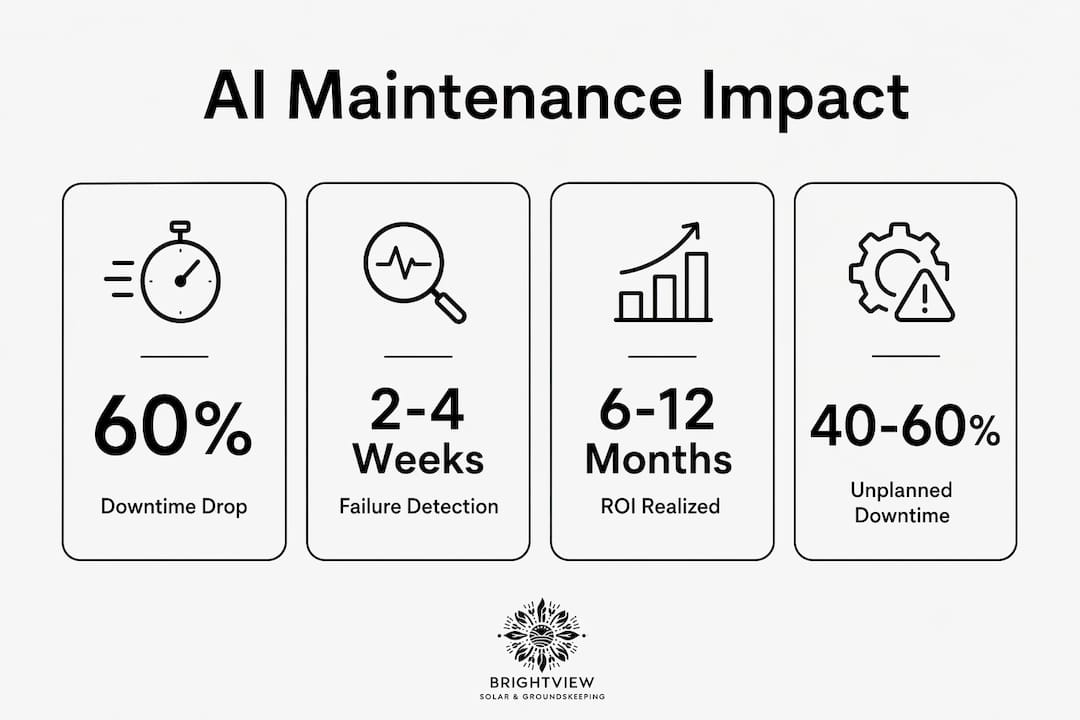
Table of Contents
- How does an AI maintenance schedule actually generate work orders?
- What measurable benefits do property managers see?
- Which sensors and signals matter for robotic mowing and solar cleaning?
- How do you design a hybrid AI maintenance schedule?
- Step-by-step checklist for piloting an AI maintenance schedule
- Australian operational, safety and regulatory considerations
- Common pitfalls and how to avoid them
- Key takeaways
- The case for not over-indexing on the AI
- Brightview Solar & Groundskeeping pilots AI-scheduled robotic maintenance across Australia
- Useful sources
- FAQ
How does an AI maintenance schedule actually generate work orders?
The process runs in three stages: data in, model processing, outputs.
Inputs the model needs:
- IoT telemetry from onboard sensors (vibration, temperature, battery state, motor load)
- Historical maintenance logs with consistent asset IDs and canonical timestamps
- Production and access constraints (site hours, contractor windows, safety zones)
- Weather forecasts and site maps for outdoor assets
Model logic:
- Time-series models identify degradation windows and assign failure probabilities to each asset
- Optimisation engines then sequence and bundle tasks by location and technician skill set, cutting travel time across distributed sites
- Rules engines enforce safety and legal constraints before any work order is released
What comes out:
- Timestamped, prioritised work orders matched to available technicians
- Spare-parts triggers fired when failure probability crosses a configurable threshold
- Optimal maintenance windows timed to minimise disruption to production or solar generation
Predictive platforms recommend windows based on failure probability, production schedules, spare-part availability, and technician workload simultaneously. That combination is what separates an AI-driven upkeep schedule from a spreadsheet with reminders.
Pro Tip: Set your rules engine to enforce no-spray buffers and site access windows before the optimisation step runs. Constraints baked in early prevent non-compliant work orders from ever reaching a technician’s queue.
What measurable benefits do property managers see?
The 40–60% unplanned-downtime reduction figure is the most-cited gain, and it is credible for asset-intensive outdoor operations where reactive callouts are expensive. But the full picture is broader.
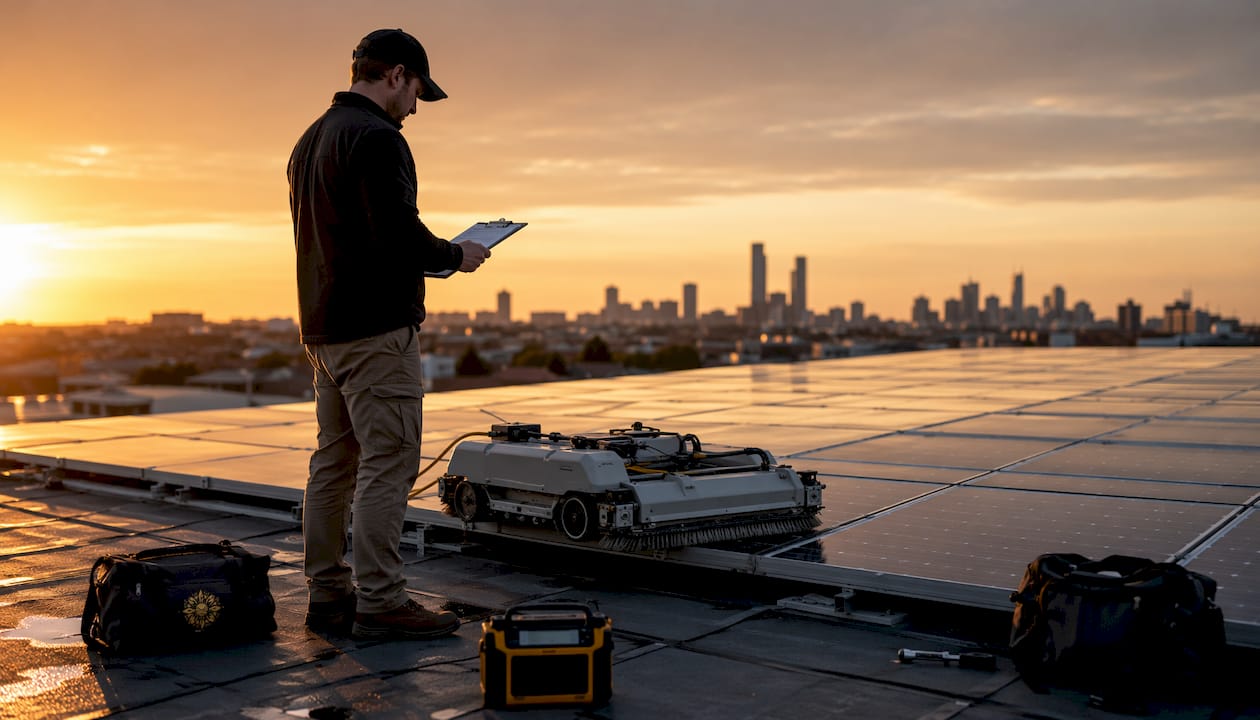
Fewer emergency repairs means lower parts costs and less overtime. Bundling geographically distributed tasks reduces travel-related inefficiencies and lifts service levels across multi-site estates. Technician utilisation improves because the scheduler matches skill sets to tasks rather than sending whoever is available.
KPIs to track from day one:
- Asset uptime (%)
- MTBF and mean time to repair (MTTR)
- Travel time per job
- Solar kWh output uplift after cleaning cycles
- Maintenance cost per asset per period
The solar kWh metric deserves attention. Soiling-driven output losses on Australian commercial arrays are real and measurable. Cleaning triggered by actual power drop data rather than a fixed calendar consistently recovers more generation hours than a monthly-by-default approach.
Which sensors and signals matter for robotic mowing and solar cleaning?
Getting the sensor set right is where most pilots either succeed or stall. You do not need everything at once; you need the signals that actually predict the failures that cost you money.
For groundskeeping robots:
- GPS and location logs (perimeter compliance, coverage gaps)
- Wheel and drive-train vibration (bearing wear, terrain stress)
- Battery state of charge and charge cycle count
- Blade and motor vibration (blade wear, motor load anomalies)
- Rain and wetness sensors (mowing and spraying inhibit triggers)
- Obstacle and perimeter sensors (safety zone compliance)
For robotic solar panel cleaning:
- PV string current and voltage per inverter
- Module temperature (thermal anomalies, soiling correlation)
- Soiling index derived from irradiance vs actual output
- Robotic arm status and cleaning cycle completion logs
Site and operational inputs:
- Bureau of Meteorology forecast feeds (wind, rain, UV)
- Contractor access windows and site opening hours
- Safety zone maps and licencing constraints
Integration protocols worth specifying in your RFP: MQTT for lightweight sensor telemetry, REST APIs for CMMS work-order creation, and OPC-UA where industrial PLCs are involved. Locking these down early prevents the data-format mismatches that derail pilots. For more on robotic groundskeeping operations and site-specific sensor considerations, Brightview Solar & Groundskeeping’s Australian guides are a practical starting point.
How do you design a hybrid AI maintenance schedule?
The hybrid model is the right default: condition-based monitoring for critical assets, time-based routines for low-risk tasks like visual inspections and lubrication. Trying to put everything on condition-based triggers at once is one of the most common pilot mistakes.
Example cadence rules:
| Asset | Trigger type | Trigger condition | Fallback interval |
|---|---|---|---|
| Robotic mower | Condition-based | Blade vibration anomaly or NDVI growth threshold | — |
| Autonomous sprayer | Condition-based | Rain sensor clear + growth index threshold | — |
| Solar panel array | Condition-based | String output drop >3% over 5 days or soiling index threshold | — |
| Mower drive train | Time-based | Scheduled lubrication and visual check | — |
| Inverter inspection | Time-based | Scheduled thermal and connection check | — |
The fallback interval matters. If the condition trigger does not fire within the fallback window, the task generates automatically. That safety net keeps assets covered when sensor data is temporarily unavailable.
For solar cleaning cadence specifically, correlating inverter string output with recent weather and cleaning cycle logs produces far more accurate triggers than a fixed calendar.
Pro Tip: Bundle visits by postcode or site cluster and match them to technicians already scheduled nearby. On a multi-site estate, coordinating distributed task bundles can recover significant travel time per week.
Step-by-step checklist for piloting an AI maintenance schedule
Phase 1: Pilot design (weeks 1–4)
- Select 3–10 assets that represent your highest-cost failure categories
- Define KPIs and baseline values before any AI intervention
- Install sensors and confirm data streams are reaching your CMMS sandbox
- Agree on a canonical asset ID schema and timestamp format with your vendor
Phase 2: Validation (weeks 5–12)
- Compare AI failure predictions against actual outcomes weekly
- Measure KPI movement: uptime, MTTR, travel time per job
- Verify spare-parts triggers fire at the right thresholds without generating false positives
- Document any safety or access constraint violations and refine rules
Phase 3: Scale
| Step | Action | Owner |
|---|---|---|
| Expand asset coverage | Add remaining asset classes to the model | Operations lead |
| Multi-site bundling | Enable geography-aware optimisation | Vendor integration lead |
| SLA refinement | Update business rules and approval workflows | Data owner + procurement |
| Safety sign-off | Confirm all autonomous machine rules comply with site permits | Safety officer |
Predictive maintenance programmes frequently show ROI within 6–12 months once data quality and integration are resolved. Setting that expectation with stakeholders before the pilot starts prevents premature cancellations. The maintenance planning AI guide from Brightview Solar & Groundskeeping covers CMMS integration steps in more detail.
Australian operational, safety and regulatory considerations
Autonomous outdoor machines in Australia operate under a layered set of obligations. Getting these right before you automate is far cheaper than retrofitting compliance after an incident.
Safety obligations:
- Robotic mowers and sprayers must operate within defined perimeters with physical or virtual fencing active at all times
- Public liability coverage must explicitly include autonomous machine operation
- Incident reporting obligations vary by state; confirm your obligations under the relevant Work Health and Safety Act before deployment
Spraying approvals:
- Check state-specific chemical use licences (requirements differ between NSW, VIC, QLD, WA, and SA)
- Confirm no-spray buffer distances from waterways, property boundaries, and public spaces with your local council
- Obtain any public space permits required before autonomous spraying on shared or council-managed land
- Review label conditions for every product used; some restrict application method or wind speed thresholds
Operational constraints:
- Solar cleaning is most effective in early morning before thermal stress builds; schedule cleaning windows accordingly
- Mowing cadence in northern Australia peaks during the wet season (November–April); southern sites have a shorter active growth window
- Battery charging and depot logistics need to be factored into the schedule, not treated as background tasks
For detailed autonomous spraying safety rules and state-specific notes, Brightview Solar & Groundskeeping’s spraying guide covers the key requirements.
Common pitfalls and how to avoid them
Data quality is the most common pilot killer. Missing telemetry, mislabelled logs, and inconsistent timestamps produce models that predict the wrong things. Run a data audit and agree on a canonical schema before the first sensor goes live.
Over-automation is the second trap. Replacing every time-based interval with a condition-based trigger at once creates confusion and erodes trust in the system. Keep safety-critical tasks on time-based checks until the model has a validated track record on that asset class.
Change management is underestimated. Field technicians who had no input into the new schedule will find reasons to ignore it. Include them in pilot design and show them the wrench-time data. When technicians see fewer wasted trips, resistance drops quickly.
Parts and logistics failures extend repair times even when the AI prediction is correct. Integrate your inventory system early and set configurable failure thresholds so spare-parts orders trigger automatically when probability crosses the agreed level.
Key takeaways
An AI maintenance schedule cuts unplanned downtime by 40–60% when condition-based triggers, CMMS integration, and spare-parts linkage are in place from the start of the pilot.
| Point | Details |
|---|---|
| Start a sensor pilot | Attach sensors to 3–10 assets and stream data to your CMMS within a 6–12 week pilot window. |
| Track the right KPIs | Measure uptime, MTBF, MTTR, travel time per job, and solar kWh uplift from day one. |
| Use a hybrid schedule | Apply condition-based triggers to critical assets; keep time-based routines for low-risk tasks. |
| Integrate spare parts early | Link inventory to predicted work orders so parts arrive before the repair, not after. |
| Brightview Solar & Groundskeeping | Offers managed AI-scheduled robotic mowing, spraying, and solar cleaning pilots across Australian commercial sites. |
The case for not over-indexing on the AI
The 40–60% downtime reduction figure is real, but it comes with a condition that most vendor marketing glosses over: the data has to be clean, the asset IDs have to be consistent, and someone has to own the rules engine. Organisations that treat an AI maintenance schedule as a plug-in solution and skip the data readiness work typically see modest gains and then blame the technology.
The more useful frame is this: AI scheduling is a coordination tool, not a replacement for operational judgement. The best deployments keep humans in the loop for safety-critical decisions and use the AI to handle the combinatorial problem of sequencing dozens of assets across multiple sites. That is genuinely hard to do manually, and it is where the travel-time and wrench-time gains actually come from.
For robotic outdoor assets specifically, the hybrid model matters more than it does in a controlled factory environment. Weather, seasonal growth rates, and council access restrictions create variability that no static schedule handles well. A system that can update mowing frequency when NDVI data shows a growth spike, or defer a spraying run when wind speed exceeds a label threshold, is doing something a spreadsheet cannot.
Brightview Solar & Groundskeeping pilots AI-scheduled robotic maintenance across Australia
Property managers who want the efficiency gains without building an in-house data science team have a direct path: Brightview Solar & Groundskeeping delivers robotic mowing, autonomous spraying, and robotic solar panel cleaning as contracted services with AI scheduling built in. The difference from a traditional grounds contract is that maintenance windows are driven by actual asset condition, not a fixed calendar, and every visit is bundled to minimise travel across your site portfolio.

The pilot structure is designed for low risk: defined KPIs, a 6–12 week validation window, and CMMS integration handled by Brightview Solar & Groundskeeping’s team. For solar assets, the solar panel maintenance best practices guide sets out the cleaning triggers and efficiency metrics the pilot will track. To scope a pilot for your site, contact Brightview Solar & Groundskeeping directly at brightviewpty.au.
Useful sources
- Predictive Maintenance Agent, Continuous Intelligence — the primary source for the 2–4 week prediction window and 40–60% downtime reduction figures; recommended for operations and procurement teams building a business case.
- Predictive Maintenance Platform, Shreeng AI — covers optimisation outputs including spare-parts triggers and maintenance window selection; useful for technical teams specifying model requirements.
- Maintenance Optimisation Agent, UptimeAI — explains continuous PM interval optimisation based on asset risk; relevant for teams moving from static to dynamic schedules.
- Maintenance Solutions, DecisionBrain — covers geographically distributed task bundling and technician skill matching; best for operations leads evaluating multi-site scheduling.
- Maintenance Schedule AI, ePlane AI — explains how failure forecasts convert to working hours and technician allocation; useful for integration and procurement teams.
- Brightview Solar & Groundskeeping, Solar Panel Maintenance Best Practices — practical cleaning cadence, safety, and efficiency metrics for Australian solar assets; recommended for operations and pilot scoping.
- Brightview Solar & Groundskeeping, Maintenance Planning AI Guide — CMMS integration steps and AI maintenance planning context for Australian property managers; recommended for technical decision-makers.
FAQ
What is an AI maintenance schedule?
An AI maintenance schedule is a condition-based, predictive timetable that uses sensor telemetry and historical data to generate prioritised work orders before failures occur, rather than following fixed calendar intervals.
How much can AI scheduling reduce unplanned downtime?
Predictive maintenance platforms commonly detect failures 2–4 weeks in advance and can cut unplanned downtime by 40–60% once data quality and CMMS integration are in place.
How long does a pilot take before you see results?
A well-structured pilot runs 6–12 weeks, covering sensor installation, CMMS integration, and KPI baseline measurement, with initial prediction-vs-actual validation completed by week 12.
Can Brightview Solar & Groundskeeping manage the AI scheduling for my site?
Brightview Solar & Groundskeeping delivers robotic mowing, spraying, and solar panel cleaning as contracted services with AI scheduling included, covering pilot design, CMMS integration, and KPI tracking for Australian commercial and industrial properties.
Do I need to replace all time-based maintenance with AI condition triggers?
No. A hybrid model is recommended: condition-based triggers for critical assets and time-based routines for low-risk tasks like lubrication and visual inspections, with fallback intervals to cover gaps in sensor data.

